DARPA calls for antibiotic replacement
November 23, 2011
by Bob Yirka
in Medications
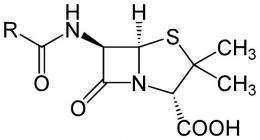
Penicillin, the first natural antibiotic discovered by Alexander Fleming in 1928
(Medical Xpress) -- Most everyone that has been keeping abreast of world events knows that the clock is ticking on antibiotics; bacteria have been slowly developing a resistance and development of new antibiotics has slowed to a crawl, thus the day will soon come that all of the tools were are currently using to fight bacterial infections will be lost, leaving everyone at their mercy. This problem has not gone unnoticed by those at the upper reaches of the military establishment in the United States, thus it should not come as a surprise to anyone that DARPA, via the Small Business Innovation Research (SBIR) program, has issued a Request for Proposals (RFP) to completely replace antibiotics with something new and better.
As noted in the RFP, the military has seen firsthand the problems with current antibiotics; soldiers experiencing wounds in war, especially those involved in fires, that develop bacterial infections now require triple the amount of hospital time to recover as doctor’s plow through a host of antibiotics in trying to find the one that will work. Clearly frightened at the prospect of sending soldiers into battle where they may encounter bioengineered bacterial agents, the top brass has decided it’s time to take another approach and to get on it now.
Instead of working to develop new antibiotics, DARPA proposes the development and use of so-called nanoparticles to deliver gene altering chemicals directly to the cells of bacteria to kill them. In addition, they are hoping that someone will be able to come up with a way to make it so that the nanoparticles and chemicals they carry can be reprogrammed on-the-fly so as to combat newly evolved or created bacteria as soon as they appear. The idea is that the nanoparticles would carry something called small interfering RNA (siRNA) which are groups of molecules that would actually do the work of shutting down the genes inside the cells of the bacteria.
DARPA has laid out the project in three phases: Study what’s out there now, develop the nanoparticle delivery system and siRNA, and devise a means for rapidly reprogramming them.
On its face, the project seems rather simple, after all, this is not science fiction, DARPA points out that just last year a research group used siRNA delivered by nanoparticles to kill the Ebola virus in four primates. Unfortunately, the problem is, it’s not as easy as it looks, all of this science is still in its infancy and if a way can be found to do what is being asked, it likely will take years, if not decades to fully develop. The success against the Ebola virus was one agent against just one virus in a structured environment. To do what DARPA wants would mean using one technique to kill any and all bad bacteria and/or viruses. Also, if it can be done, no one really knows if the procedure would be reprogrammable, much less whether it could be done on-the-fly, so it’s not really clear if anyone will be able to achieve what DARPA is asking for; though it seems for the sake of all of us, we better hope so. Turning back the clock to a time when we were helpless against the onslaught of bacterial infections would be difficult to swallow, to say the least.
© 2011 PhysOrg.com
-
E. coli bacteria more likely to develop resistance after exposure to low levels of antibiotics
Jun 14, 2011 |
not rated yet |
0
-
Tuberculosis researchers discover potential new target for treatments
Nov 21, 2011 |
not rated yet |
0
-
Outsmarting killer bacteria: Next generation of antibiotics to combat drug-resistant 'superbugs'
Sep 14, 2010 |
not rated yet |
0
-
Computer simulations aid understanding of bacterial resistance against commonly used antibiotics
Jul 21, 2011 |
not rated yet |
0
-
Researchers take early step towards devising new antibiotics
Jan 19, 2010 |
not rated yet |
0
-
Motion perception revisited: High Phi effect challenges established motion perception assumptions
Apr 23, 2013 |
3 / 5 (2) |
2
-
Anything you can do I can do better: Neuromolecular foundations of the superiority illusion (Update)
Apr 02, 2013 |
4.5 / 5 (11) |
5
-
The visual system as economist: Neural resource allocation in visual adaptation
Mar 30, 2013 |
5 / 5 (2) |
9
-
Separate lives: Neuronal and organismal lifespans decoupled
Mar 27, 2013 |
4.9 / 5 (8) |
0
-
Sizing things up: The evolutionary neurobiology of scale invariance
Feb 28, 2013 |
4.8 / 5 (10) |
14
-
Why is zone 1 in liver more prone to ischemic injury?
May 23, 2013
-
How can there be villous adenoma in colon, if there are no villi there
May 22, 2013
-
How can there be a term called "intestinal metaplasia" of stomach
May 21, 2013
-
Pressure-volume curve: Elastic Recoil Pressure don't make sense
May 18, 2013
-
If you became brain-dead, would you want them to pull the plug?
May 17, 2013
-
MRI bill question
May 15, 2013
- More from Physics Forums - Medical Sciences
More news stories
Merck ends development of Parkinson's disease drug
(AP)—Merck & Co. says it is ending development of an experimental Parkinson's disease drug because the drug wasn't working.
Medications
May 23, 2013 |
1 / 5 (1) |
0
J&J expects 10-plus new drug applications by 2017
(AP)—Johnson & Johnson is developing what could eventually be game-changing treatments for depression and pain, and it's aiming to apply for approval of more than 10 new medicines by 2017, executives said Thursday during ...
Medications
May 23, 2013 |
5 / 5 (1) |
0
Experts favor US approval of Merck sleeping pill (Update)
An independent panel of experts on Wednesday recommended US approval of a new Merck sleeping pill called suvorexant, but expressed concerns over the highest dosage and risks of drowsy daytime driving.
Medications
May 22, 2013 |
not rated yet |
0
Glaxo, US partnering to develop new antibiotics
GlaxoSmithKline PLC says it's starting an unusual collaboration with the U.S. government to develop several antibiotics for both bioterrorism threats and bacterial infections resistant to current medicines.
Medications
May 22, 2013 |
not rated yet |
0
Study finds new pneumococcal vaccine appears to be as safe as previously used vaccine
The new 13-valent pneumococcal conjugate vaccine (PCV13) appears to be as safe as the previous version used prior to 2010, the 7-valent pneumococcal conjugate vaccine (PCV7), according to a Kaiser Permanente study published ...
Medications
May 22, 2013 |
not rated yet |
0
Engineered cytomegalovirus protects monkeys from HIV equivalent
(Medical Xpress)—A new study by researchers in the US has shown that an ancient virus can be modified to help in the fight against the simian immunodeficiency virus SIV, which is the equivalent in monkeys ...
Researchers identify first drug targets in childhood genetic tumor disorder
Two mutations central to the development of infantile myofibromatosis (IM)—a disorder characterized by multiple tumors involving the skin, bone, and soft tissue—may provide new therapeutic targets, according to researchers ...
Hormone levels may provide key to understanding psychological disorders in women
Women at a particular stage in their monthly menstrual cycle may be more vulnerable to some of the psychological side-effects associated with stressful experiences, according to a study from UCL.
Going live: Immune cell activation in multiple sclerosis
Biological processes are generally based on events at the molecular and cellular level. To understand what happens in the course of infections, diseases or normal bodily functions, scientists would need to ...
Driving and hands-free talking lead to spike in errors, study shows
Talking on a hands-free device while behind the wheel can lead to a sharp increase in errors that could imperil other drivers on the road, according to new research from the University of Alberta.
Depression raises diabetics' risk of severe low blood sugar episodes
(Medical Xpress)—Patients with diabetes who are depressed are much more likely to develop episodes of dangerously low blood sugars, or hypoglycemia, than are those who are not depressed, a new study has ...
Nov 23, 2011
Rank: not rated yet
Nov 23, 2011
Rank: 2.5 / 5 (6)
But who am I kidding? We all know that this is what we should already be doing and we don't, so this new reason won't change anything.
Nov 23, 2011
Rank: 4 / 5 (1)
Nov 23, 2011
Rank: 4.2 / 5 (5)
The reason DARPA wants this isn't to protect people against things a regular immune system will help you with. It's to protect against new bio-engineered diseases created as weapons. I think the people designing such diseases will make them powerful enough that broccoli isn't going to do the trick.
Also *preach preach preach*.
Then they have to make a little Bruce Campbell out of nano-particles. Do you know how hard that would be?!
Nov 23, 2011
Rank: 4 / 5 (3)
Our homes do not need to be sterile. Our kids do not need to be protected from germs. By trying to "protect" ourselves, we only put ourselves in more danger...
Nov 23, 2011
Rank: 1 / 5 (2)
http://www.youtub...a_player
-Not covered by obamacare unfortunately.
Nov 28, 2011
Rank: not rated yet
Nov 29, 2011
Rank: not rated yet
Dec 04, 2011
Rank: not rated yet
There is another superior technology to antibiotics already...Phage Therapy. Phages can kill strains that are resistant through biofilms; Now that there is a form of gonorrhea that resist all antibiotics this technology should be combined with nano-particles and SiRna and genetic therapy... Phages can be used to ingect sirna to silence the genes that cause antibiotic resistance!, then the antibiotics can be used in smaller doses to finish the job... get to work darpa
Dec 08, 2011
Rank: not rated yet