eButton: An easy way to monitor food intake, exercise, and lifestyle
November 8, 2011 By B. Rose Huber in Health
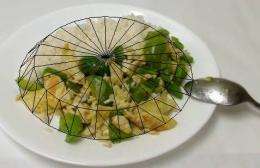
(Medical Xpress) -- People attempting to lose weight wont need to track their daily food intake anymore, thanks to a wearable, picture-taking device created at the University of Pittsburgh. eButtona device worn on the chest (like a pin) that contains a miniature camera, accelerometer, GPS, and other sensorscaptures data and information of health activities, eliminating the need for daily self-reporting. The eButton prototype was the result of research from a four-year NIH Genes, Environment, and Health Initiative grant that ended this year.
eButton was created to combat obesity, which has become a widespread problem in the United States, said Mingui Sun, lead investigator and Pitt professor of neurosurgery and electrical and computer engineering. This disease affects 60 percent of people and costs our country upwards of $225 billion in direct and indirect costs.
The eButtons reporting extends even further than food and exercise: It can determine the amount of time wearers spend watching TV or sitting in front of a computer screen and how much time they spend outdoors. It tracks where food is bought, how meals are prepared, which restaurants are visited, and what items are ordered. The device analyzes how long the wearer spends eating, what foods and beverages are consumed, and how the wearer interacts with family or friends at the dining table. According to Sun, all of these factors determine participants caloric intake and expenditure.
This multidimensional approach looks at the overall health of eButton wearers, which is more important than just food and exercise alone, said Sun. We have to take into account how people live, not only what they eat or how they exercise at the gym.
Retrieving the results of eButton is convenient, added Sun, who says its as easy as transferring pictures from a digital camera onto a computer. To protect participants privacy, the data are coded so they cannot be read until scanned by a computer to block human faces.
Although not available commercially, the device is currently being used in a pilot study estimating the caloric intake and physical activity levels of the participants.
Findings of the eButton monitoring system were featured in Eat Right, a publication of the American Dietetic Association.
Provided by University of Pittsburgh
-
Dead of winter is tough on arthritis sufferers
Nov 04, 2011 |
not rated yet |
0
-
New government dietary guidelines may require altering habits
Feb 03, 2011 |
not rated yet |
0
-
Diet soda doesn't make you fat -- it's the extra food
Jul 04, 2011 |
not rated yet |
0
-
Our brains have multiple mechanisms for learning
Jul 14, 2011 |
not rated yet |
0
-
Children with bedroom TVs might be at greater obesity risk
Apr 29, 2011 |
not rated yet |
0
-
Motion perception revisited: High Phi effect challenges established motion perception assumptions
Apr 23, 2013 |
3 / 5 (2) |
2
-
Anything you can do I can do better: Neuromolecular foundations of the superiority illusion (Update)
Apr 02, 2013 |
4.5 / 5 (11) |
5
-
The visual system as economist: Neural resource allocation in visual adaptation
Mar 30, 2013 |
5 / 5 (2) |
9
-
Separate lives: Neuronal and organismal lifespans decoupled
Mar 27, 2013 |
4.9 / 5 (8) |
0
-
Sizing things up: The evolutionary neurobiology of scale invariance
Feb 28, 2013 |
4.8 / 5 (10) |
14
-
Classical and Quantum Mechanics via Lie algebras
Apr 15, 2011
- More from Physics Forums - Independent Research
More news stories
Youth who have their first drink during puberty have higher levels of later drinking
Research shows that the earlier the age at which youth take their first alcoholic drink, the greater the risk of developing alcohol problems. Thus, age at first drink (AFD) is generally considered a powerful predictor of ...
Health
12 hours ago |
not rated yet |
0
British MPs concerned about parliamentary boozing
One quarter of British lawmakers believe there is an "unhealthy" drinking culture in the Houses of Parliament, according to a survey published on Friday.
Health
17 hours ago |
not rated yet |
0
Patient openness to research can depend on race and sex of study personnel
Researchers at the University of Cincinnati (UC) have found that the race and sex of study personnel can influence a patient's decision on whether or not to participate in clinical research.
Health
18 hours ago |
not rated yet |
0
Clinical support for patient self-management is rhetoric rather than reality
The processes to allow people to self-manage their own illness are not being used appropriately by health professionals to the benefit of their patients, new research suggests.
Health
18 hours ago |
not rated yet |
0
Control of heart disease risk factors varies among outpatient practices
Control of heart disease risk factors varies widely among outpatient practices, according to a study presented at the American Heart Association's Quality of Care and Outcomes Research Scientific Sessions 2013.
Health
19 hours ago |
not rated yet |
0
AIDS science at 30: 'Cure' now part of lexicon
Big names in medicine are set to give an upbeat assessment of the war on AIDS on Tuesday, 30 years after French researchers identified the virus that causes the disease.
Temporal processing in the olfactory system
The neural machinery underlying our olfactory sense continues to be an enigma for neuroscience. A recent review in Neuron seeks to expand traditional ideas about how neurons in the olfactory bulb might encode information about ...
Melon focus headband turns to Kickstarter for rollout plans
(Medical Xpress)—What if the quality of your work depends more on your focus on the piano keys or canvas or laptop than your musical or painting or computing skills? If target users can be convinced, they ...
For combat veterans suffering from post-traumatic stress disorder, 'fear circuitry' in the brain never rests
Chronic trauma can inflict lasting damage to brain regions associated with fear and anxiety. Previous imaging studies of people with post-traumatic stress disorder, or PTSD, have shown that these brain regions can over-or ...
Now we know why old scizophrenia medicine works on antibiotics-resistant bacteria
In 2008 researchers from the University of Southern Denmark showed that the drug thioridazine, which has previously been used to treat schizophrenia, is also a powerful weapon against antibiotic-resistant bacteria such as ...
Study identifies new approach to improving treatment for MS and other conditions
(Medical Xpress)—Working with lab mice models of multiple sclerosis (MS), UC Davis scientists have detected a novel molecular target for the design of drugs that could be safer and more effective than current FDA-approved ...