Genetic defect disturbs salt handling and pushes up blood pressure levels
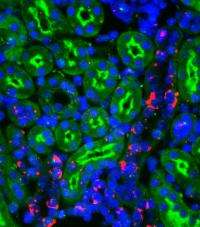
Microscopic cross section of a kidney. The image shows the organs filtration tubes, the so-called tubules. The cell walls of the tubules contain proteins, which are active as water transporter (green) and sodium transporters (red). The cell nuclei are highlighted in blue. © MPI for Heart and Lung Research
(Medical Xpress) -- Hypertension is an endemic condition with far-reaching consequences. For instance, high blood pressure is the main cause of heart attacks and strokes. Other organs are also damaged by the chronic condition. Hypertension is attributed to a high salt intake and a genetic predisposition. Scientists from the Max Planck Institute for Heart and Lung Research in Bad Nauheim have now discovered that even a normal salt intake can cause hypertension in people suffering from a sodium dysregulation. Researchers have managed to identify the responsible gene.
The regulation of blood pressure is highly complex. The blood pressure level is first and foremost determined by the blood volume. The more blood is circulated in the body, the higher the blood pressure. The ‘control centre’ is located in the kidneys: Here, blood volume and, in turn, blood pressure, are regulated by renal excretion of water and sodium. To do this, the kidneys receive information from arterial pressure receptors, the autonomic nervous system and different hormones.
The research group headed by Thomas Böttger from the Max Planck Institute for Heart and Lung Research in Bad Nauheim has looked closer at the gene SLC4A5. This gene encodes a protein that transports certain ions (salt compounds), thereby preventing an excessive concentration of salt in the blood. The scientists were able to prove that a defect in this particular gene causes excessive renal retention of sodium and water. This leads to an abnormal increase in blood pressure. “Through studies of large series of patients, many genes have been identified that could be associated with hypertension. However, their specific roles were often not clear”, Böttger says.
The scientists in Bad Nauheimer managed to corner the gene when studying mutant mice in which the gene had been specifically inactivated. The so-called “knockout mice” suffered from hypertension. Although various compensatory mechanisms had been activated in the mice, the sodium concentration and blood pressure remained permanently high in these mice. “This shows that we have indeed discovered an important gene for blood pressure regulation in SLC4A5”, Böttger says. The study of the knockout mice largely contributed to the result. It actually enabled the scientists to closely investigate the mechanisms that cause high blood pressure. In previous studies of human genetics, SLC4A5 was only known as one of many candidate genes.
The Max Planck scientists hope that they have found a new approach to treating hypertension more effectively. “First, we must investigate in which percentage of patients hypertension is caused by the SLC4A5 gene”, Böttger says. Any potential treatment depends on this. “If it is possible to re-establish the regulation of sodium in these patients, we could bring the blood pressure back to normal levels.”
More information: Nicole Gröger, Helga Vitzthum, Henning Fröhlich, Marcus Krüger, Heimo Ehmke, Thomas Braun, Thomas Böttger, Targeted mutation of SLC4A5 induces arterial hypertension and renal metabolic acidosis, Hum. Mol. Genet. (2011); doi:10.1093/hmg/ddr533 , advance online publication, 14 November 2011
Provided by
Max-Planck-Gesellschaft
-
Blood pressure research addresses differences
Nov 21, 2011 |
not rated yet |
0
-
Genetic profile guides search for the right blood pressure drug
Nov 26, 2010 |
not rated yet |
0
-
Abnormal activation of a protein may explain deadly link between high salt intake and obesity
Sep 19, 2011 |
not rated yet |
0
-
Blood pressure control system found in kidney's structural units
Jan 14, 2011 |
not rated yet |
0
-
New study identifies possible cause of salt-induced hypertension
Apr 14, 2011 |
not rated yet |
0
-
Motion perception revisited: High Phi effect challenges established motion perception assumptions
Apr 23, 2013 |
3 / 5 (2) |
2
-
Anything you can do I can do better: Neuromolecular foundations of the superiority illusion (Update)
Apr 02, 2013 |
4.5 / 5 (11) |
5
-
The visual system as economist: Neural resource allocation in visual adaptation
Mar 30, 2013 |
5 / 5 (2) |
9
-
Separate lives: Neuronal and organismal lifespans decoupled
Mar 27, 2013 |
4.9 / 5 (8) |
0
-
Sizing things up: The evolutionary neurobiology of scale invariance
Feb 28, 2013 |
4.8 / 5 (10) |
14
-
Classical and Quantum Mechanics via Lie algebras
Apr 15, 2011
- More from Physics Forums - Independent Research
More news stories
Researchers complete largest genetic sequencing study of human disease
Researchers from Queen Mary, University of London have led the largest sequencing study of human disease to date, investigating the genetic basis of six autoimmune diseases.
Genetics
May 22, 2013 |
4.5 / 5 (4) |
0
|
Researchers develop model for better testing, targeting of malignant peripheral nerve sheath tumors
University of Minnesota Medical School researchers from the Masonic Cancer Center, University of Minnesota, in partnership with the University's Brain Tumor Program, have developed a new mouse model of malignant peripheral ...
Genetics
May 20, 2013 |
5 / 5 (1) |
0
|
Researchers identify new circadian clock component
Northwestern University scientists have shown a gene involved in neurodegenerative disease also plays a critical role in the proper function of the circadian clock.
Genetics
May 16, 2013 |
3 / 5 (1) |
1
|
Returning genetic incidental findings without patient consent violates basic rights, experts say
Informed consent is the backbone of patient care. Genetic testing has long required patient consent and patients have had a "right not to know" the results. However, as 21st century medicine now begins to use the tools of ...
Genetics
May 16, 2013 |
5 / 5 (1) |
3
|
Ethicists provide framework supporting new recommendations on reporting incidental findings in gene sequencing
In a paper published in Science Express, a group of experts led by bioethicists in the Center for Medical Ethics and Health Policy at Baylor College of Medicine provide a framework for the new American College of Medical Geneti ...
Genetics
May 16, 2013 |
not rated yet |
0
Type 2 diabetes progresses faster in kids, study finds
(HealthDay)—Type 2 diabetes is more aggressive in children than adults, with signs of serious complications seen just a few years after diagnosis, new research finds.
Glucosamine supplements tied to risk of eye condition
(HealthDay)—Glucosamine supplements that millions of Americans take to help treat hip and knee osteoarthritis may have an unexpected side effect: They may increase risk for developing glaucoma, a small ...
Controlling mood through the motions of mitochondria
(Medical Xpress)—Regulating the distribution of power in neurons is done by a system that makes the national electric grid look simple by comparison. Each neuron has several thousand mitochondria confined ...
Scientists discover molecule triggers sensation of itch
Scientists at the National Institutes of Health report they have discovered in mouse studies that a small molecule released in the spinal cord triggers a process that is later experienced in the brain as ...
Multiple research teams unable to confirm high-profile Alzheimer's study
Teams of highly respected Alzheimer's researchers failed to replicate what appeared to be breakthrough results for the treatment of this brain disease when they were published last year in the journal Science.
Researchers find common childhood asthma unconnected to allergens or inflammation
Little is known about why asthma develops, how it constricts the airway or why response to treatments varies between patients. Now, a team of researchers at Weill Cornell Medical College, Columbia University Medical Center ...
Nov 25, 2011
Rank: not rated yet
The article identifies a genetic defect which links salt to hypertension. The general belief that dietary salt intake translates to elevated blood pressure, however, has not been established. Most people have no difficulty excreting salt and are not adversely affected by normal dietary salt intake.
Nov 25, 2011
Rank: not rated yet