Imaging technique IDs plaques, tangles in brains of severely depressed older adults
November 8, 2011 in Psychology & Psychiatry

Imaging technique IDs plaques, tangles in brains of severely depressed older adults

Enlarge

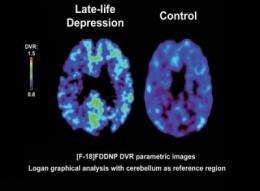
Brain images demonstrate higher FDDNP binding (yellow areas) and thus more abnormal proteins in a patient with major depressive disorder compared with a healthy control. Credit: UCLA

Depression is one of the most common mental disorders in the elderly, but little is known about the underlying biology of its development in older adults.

In a small study published in the November issue of the peer-reviewed journal , UCLA researchers used a unique brain scan to assess the levels of and in older adults with a type of called (MDD).

Previous research has suggested that plaque and tangle deposits in the brain -- hallmarks of Alzheimer's disease and many dementias -- are associated not only with memory loss but also with mild and anxiety in middle-aged and older individuals. The team wanted to see what the brain-scanning technique developed at UCLA would find in older people with MDD.

UCLA researchers have created a called FDDNP that binds to both plaque and tangle deposits, which can then be viewed through a positron emission tomography (PET) brain scan, providing a "window into the brain." Using this method, researchers are able to pinpoint where in the brain these abnormal protein deposits are accumulating.

Researchers compared the FDDNP brain scans of 20 older adults between ages 60 to 82 who had been diagnosed with MDD with the scans of 19 healthy controls of similar age, education and gender.

They found that in patients with MDD, FDDNP binding was significantly higher throughout the brain and in critical brain regions, including the posterior cingulate and lateral temporal areas, that are involved in decision-making, complex reasoning, memory and emotions.

"This is the first study using FDDNP to assess the abnormal in brains of older adults with severe depression," said the study's senior author, Dr. Gary Small, UCLA's Parlow-Solomon Professor on Aging and a professor of psychiatry at the Semel Institute for Neuroscience and Human Behavior at UCLA. "The findings suggest that the higher protein load in critical may contribute to the development of severe depression in late life."

Researchers also found that similar protein deposit patterns in the lateral temporal and posterior cingulate areas in patients were associated with different clinical symptoms. Some patients demonstrated indicators of depression only, while others displayed symptoms of mild cognitive impairment as well.

Dr. Small noted that previous research has shown that depression may be a risk factor for or a precursor to memory loss, such as mild cognitive impairment, which can later lead to dementia.

"We may find that depression in the elderly may be an initial manifestation of progressive neurodegenerative disease," said the study's first author, Dr. Anand Kumar, the Lizzie Gilman Professor and department head of psychiatry at the University of Illinois at Chicago. " using FDDNP allow us to take a closer look at the different types of protein deposits and track them to see how clinical symptoms develop."

According to Kumar and Small, more follow-up over time is needed to evaluate the significance of the outcomes of the study's patient subgroups. Such research will help further assess if depression later in life might be a precursor to mild cognitive impairment and dementia.

In addition, the researchers said, FDDNP used with PET may also be helpful in identifying new treatments and in tracking the effectiveness of current antidepressant therapy and medications designed to help reduce build-up in the brain.

The team is planning larger studies involving investigators at UCLA and the University of Illinois that will address the impact of the genetic marker APOE-4, which is a risk factor for dementia and Alzheimer's disease.

Provided by University of California - Los Angeles Health Sciences

5 /5 (1 vote)  

Filter


Move the slider to adjust rank threshold, so that you can hide some of the comments.


Display comments: newest first

CHollman82
Nov 08, 2011

Rank: 1.4 / 5 (9)
I always say we have less control of ourselves than we think we do, "free will" is likely an illusion. More and more we find evidence that we are little more than chemical machines governed by physical law like everything else. An article like this which points out that brain chemistry can cause significant alteration of a persons attitude and personality (obviously) only serves to illustrate that we are not in control like we think we are...
CHollman82
Nov 09, 2011

Rank: 1 / 5 (8)
Some loser with nothing else going on in his life has 5 or 6 different accounts that he uses to rate all my posts with 1's... he's been doing it for a while now, it probably gives him reason enough to go another day without killing himself.
Rank 5 /5 (1 vote)
Relevant PhysicsForums posts

More news stories

US psychiatry gets makeover in new manual

The latest makeover to a massive psychiatric tome honored by some, reviled by others and even called the "Bible" of mental disorders is being released Saturday with a host of new changes.

Psychology & Psychiatry created 8 hours ago | popularity not rated yet | comments 0

Study reviews readmissions in inpatient psychiatric facilities

(HealthDay)—Most Medicare beneficiaries treated in inpatient psychiatric facilities (IPFs) exhibit characteristics associated with hospital readmission, according to a report prepared for the National Association ...

Psychology & Psychiatry created May 17, 2013 | popularity not rated yet | comments 0

Skydiving is never plane sailing

Skydivers show the same level of physical stress before every jump whether a first-timer or experienced jumper, say Northumbria researchers.

Psychology & Psychiatry created May 17, 2013 | popularity not rated yet | comments 0 | with audio podcast

Kids, especially boys, perceive sadness of depressed parents

Children of depressed parents pick up on their parents' sadness—whether mom or dad realizes their mood or not.

Psychology & Psychiatry created May 17, 2013 | popularity 4.5 / 5 (2) | comments 1 | with audio podcast

One in five U.S. kids has a mental health disorder, CDC reports

(HealthDay)—As many as one in five American children under the age of 17 has a diagnosable mental disorder in a given year, according to a new federal report.

Psychology & Psychiatry created May 16, 2013 | popularity 2.2 / 5 (5) | comments 1 | with audio podcast


New research identifies risks, interventions for children's GI health

An increasing number of U.S. children are experiencing gastrointestinal issues that require interventions to resolve, according to research presented at Digestive Disease Week (DDW).

New case of SARS-like virus in Saudi: ministry

A new case of the deadly coronavirus has been detected in Saudi Arabia where 15 people have already died after contracting it, the health ministry announced on Saturday on its Internet website.

AIDS science at 30: 'Cure' now part of lexicon

Big names in medicine are set to give an upbeat assessment of the war on AIDS on Tuesday, 30 years after French researchers identified the virus that causes the disease.

For combat veterans suffering from post-traumatic stress disorder, 'fear circuitry' in the brain never rests

Chronic trauma can inflict lasting damage to brain regions associated with fear and anxiety. Previous imaging studies of people with post-traumatic stress disorder, or PTSD, have shown that these brain regions can over-or ...

New colonoscope provides ground-breaking view of colon

A ground-breaking advance in colonoscopy technology signals the future of colorectal care, according to research presented today at Digestive Disease Week(DDW). Additional research focuses on optimizing the minimal withdrawal ...

Flesh-eating disease victim gets prosthetic hands

(AP)—A woman who lost both hands, her left leg and right foot after contracting a flesh-eating disease has been fitted with prosthetic hands.