Of mice and men, a common cortical connection
November 16, 2011 in Neuroscience
Of mice and men, a common cortical connection

Enlarge

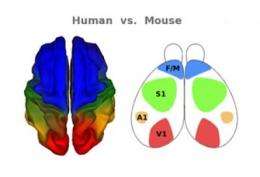
Color-coded representations of human and mouse brains show similarities in cortical functional organization, with some variance according to species-specific needs. F/M indicates the frontal/motor cortex; S1, primary somatosensory cortex; A1, auditory cortex and V1, visual cortex. Credit: UC San Diego School of Medicine

A new study using magnetic resonance imaging data of 406 adult human twins affirms the long-standing idea that the genetic basis of human cortical regionalization – the organization of the outer brain into specific functional areas – is similar to and consistent with patterns found in other mammals, indicating a common conservation mechanism in evolution.

The findings by researchers at the University of California, San Diego School of Medicine and colleagues are published in the November 17 issue of the journal Neuron.

Past animal studies, primarily in rodents, have shown that development of distinct areas of the cortex – the outer layer of the – is influenced by genes exhibiting highly regionalized expression patterns. The new study is among the first to confirm these findings using data from human subjects. As in other mammals, the researchers found that that genetic influences in human brain development progress along a graduating scale anterior-to-posterior (front-to-back) in a bilateral, symmetric pattern.

There were, of course, differences based upon the particular needs and functions of each species.

"For example, humans have very high-level thinking abilities. Mice don't engage in abstract thinking, but they do make extensive use of their whiskers to negotiate the sensory environment," said William S. Kremen, PhD, professor of clinical psychology and corresponding author of the study. "Consistent with these species-specific features, we found that genetic influences resulted in greatly expanded frontal regions in humans – the area of the brain responsible for higher level functions – but much-expanded somatosensory regions in the mouse brain."

The scientists conducted their study by mapping genetic correlations in area growth between targeted brain regions and other cortical locations. By studying , they were able to expand the scope of the inquiry. "In non-twin studies," Kremen said, "researchers have been able to examine the effects of a small number of individual genes. By comparing identical and fraternal twins, we can account for the total of all genetic influences on the patterns of expansion and contraction of different brain regions."

The researchers selected targets called "seed points" in the brain to look for patterns to how each point was related to all other points. They double-checked the validity of these seed points by also examining "marching seeds" – lines of seed points from one brain region to another. "If the results are meaningful, the patterns should remain similar within a region and then change when the seed point enters a new region," said Kremen.

They also used a hypothesis-free approach, a statistical method that doesn't involve any seed points and so eliminates the possibility of biased assumptions about particular seed points.

Anders M. Dale, PhD, professor of radiology and neurosciences at UC San Diego and a co-author of the study, said the study's findings have both basic and clinical implications.

"We know that genetics are important in determining brain structure," said Dale. "Increasing our understanding of genetics is a key step toward understanding normal brain development, but it is also crucial for understanding the development of brain abnormalities. Eventually, it may provide clues to the treatment of developmental brain anomalies that occur early or late in life. Also, because the study identified regions of the brain based on their genetic similarity, it may well improve the ability of researchers to find the specific individual genes that control the size of those regions."

Provided by University of California - San Diego search and more info website

not rated yet  

Rank not rated yet
Relevant PhysicsForums posts
  • Potential Breakthrough in Seizure Control
    created10 hours ago
  • Popping/Cracked sternum.
    created15 hours ago
  • Which Mental Illness Encompasses This Problem?
    created15 hours ago
  • A question about drug tolerance
    createdMay 23, 2012
  • Poor nutrition leading to overeating?
    createdMay 23, 2012
  • Math and dyslexia?
    createdMay 21, 2012
  • More from Physics Forums - Medical Sciences

More news stories

Of mice and mental models: Neuroscientific implications of risk-optimized behavior in the mouse

(Medical Xpress) -- Regardless of an organism’s biological complexity, every encephalized animal continuously makes under-informed behavioral choices that can have serious consequences. Despite its ubiquity, ...

Neuroscience created May 25, 2012 | popularity not rated yet | comments 0 | with audio podcast feature

Persistent sensory experience is good for aging brain

Despite a long-held scientific belief that much of the wiring of the brain is fixed by the time of adolescence, a new study shows that changes in sensory experience can cause massive rewiring of the brain, even as one ages. ...

Neuroscience created May 24, 2012 | popularity not rated yet | comments 0

Boundary stops molecule right where it needs to be

A molecule responsible for the proper formation of a key portion of the nervous system finds its way to the proper place not because it is actively recruited, but instead because it can't go anywhere else.

Neuroscience created May 24, 2012 | popularity not rated yet | comments 0 | with audio podcast

Locating ground zero: How the brain's emergency workers find the disaster area

Like emergency workers rushing to a disaster scene, cells called microglia speed to places where the brain has been injured, to contain the damage by 'eating up' any cellular debris and dead or dying neurons. ...

Neuroscience created May 24, 2012 | popularity 5 / 5 (2) | comments 0 | with audio podcast

Genetic 'reset switch' enables signaling pathway to induce multiple developmental outcomes for olfactory neurons

Within the nervous system, a handful of signaling pathways modulate development of a cornucopia of different neuronal subtypes. “Even small alterations in neuron differentiation pathways can disrupt subsequent ...

Neuroscience created May 24, 2012 | popularity not rated yet | comments 0


Travel to high altitudes tied to Crohn's, colitis flare-ups

(HealthDay) -- People with inflammatory bowel disease, which includes Crohn's disease and colitis, may be at increased risk for flare-ups when they fly or travel to high altitudes for skiing or mountain climbing, ...

Family history of Alzheimer's affects functional connectivity

(HealthDay) -- Cognitively normal individuals with a family history of late-onset Alzheimer's disease (AD) may display lower resting state functional connectivity in the default mode network (DMN) of the brain, ...

Transvaginal mesh op restores pelvic organ prolapse at price

(HealthDay) -- Transvaginal mesh (TVM) procedures are effective for anatomical restoration of pelvic organ prolapse (POP), but patients report a worsening of sexual function following surgery, according to ...

Tongue analysis software uses ancient Chinese medicine to warn of disease

For 5,000 years, the Chinese have used a system of medicine based on the flow and balance of positive and negative energies in the body. In this system, the appearance of the tongue is one of the measures used to classify ...

Skp2 activates cancer-promoting, glucose-processing Akt

HER2 and its epidermal growth factor receptor cousins mobilize a specialized protein to activate a major player in cancer development and sugar metabolism, scientists report in the May 25 issue of Cell.

Early physical therapist treatment associated with reduced risk of healthcare utilization and reduced overall healthcare

A new study published in Spine shows that early treatment by a physical therapist for low back pain (LBP), as compared to delayed treatment, was associated with reduced risk of subsequent healthcare utilization and lower ...