Mitochondria restructuring protein provides new therapeutic target for heart disease
November 17, 2011 in Cardiology
Mitochondria restructuring protein provides new therapeutic target for heart disease

Enlarge

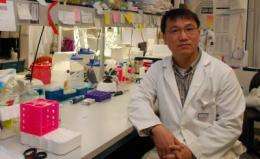
Hyungsoo Kim, Ph.D. is a postdoctoral researcher and first author of the study. Credit: Sanford-Burnham Medical Research Institute

Mitochondria are often called cellular "powerhouses" because they convert nutrients into energy. But these tiny structures also help determine cellular lifespan. Scientists at Sanford-Burnham Medical Research Institute (Sanford-Burnham) are now discovering how mitochondria alternate between duplicating and fragmenting and how these events help cells adapt to diverse physiological conditions.

In a paper published November 18 in Molecular Cell, a team led by Ze'ev Ronai, Ph.D. discovered that the protein Siah2 regulates mitochondrial fragmentation under low oxygen conditions. The significance of these findings is demonstrated by the heart's response to oxygen shortage and ischemia, the caused by , when the researchers inhibited Siah2. In cells and mice lacking the protein, heart cell death was prevented. As a result, tissue damage was reduced in a that mimics a heart attack.

"Our work reveals key aspects to controlling mitochondrial dynamics in response to low oxygen tension," said Dr. Ronai, associate director of Sanford-Burnham's National Cancer Institute-designated Cancer Center and senior author of the study. "By manipulating mitochondrial dynamics, we can help cells adapt to ischemic conditions in a way that might translate into new treatment options for patients who've experienced a heart attack."

Siah2 is an ubiquitin ligase, meaning its job is to tag other proteins with a molecule called ubiquitin, marking them for destruction. This way, Siah2 controls which proteins are active and which are destroyed in response to . In this study, Dr. Ronai and his team found that one such signal—low oxygen, a condition also known as hypoxia—engages Siah2 in the control mitochondrial fragmentation process by allowing two key regulators (the proteins Drp1 and Fis1) to get together. Their union, however, increases mitochondrial fragmentation, cell death, and cardiac tissue damage under ischemic conditions.

"In a hypoxic environment, increased Siah2 activity takes a protein called AKAP121 out of the picture, freeing up the Drp1-Fis1 complex to shift the balance in favor of mitochondrial fragmentation," explained Hyungsoo Kim, Ph.D., postdoctoral researcher in Dr. Ronai's lab and first author of the study. "This change in mitochondrial structure is accompanied by changes in function that lead to heart under stress, giving us a new understanding of how cells respond to hypoxia and a new target to prevent the damage often seen in ischemic injury."

When the researchers mimicked in cells and mice lacking Siah2, AKAP121 levels increased (keeping a damper on the Drp1-Fis1 relationship), mitochondrial fission was reduced, and fewer heart cells died. Under hypoxic conditions, Siah2-deficient mice fared better than their normal counterparts.

Dr. Ronai credits a collaborative approach for the success in demonstrating both Siah2's role in mitochondrial fragmentation and its physiological importance. Teaming up with the laboratory of Sanford-Burnham's Mark Mercola, Ph.D. helped unravel Siah2's role in cardiovascular function. In addition, contributions by the laboratory of Andrew Dillin, Ph.D. at the Salk Institute for Biological Studies revealed the roles of Siah2 and in the lifespan of C. elegans, a worm model.

Dr. Ronai and his team are now searching for chemical compounds that inhibit Siah2, which they hope can be further developed into new therapies for cardiac damage and cancer.

Provided by Sanford-Burnham Medical Research Institute

5 /5 (2 votes)  

Rank 5 /5 (2 votes)
Related Stories
Relevant PhysicsForums posts
  • Force in a magnetic coupling
    created6 hours ago
  • Sign of scalar product in electric potential integral?
    created13 hours ago
  • Heat engines: how can we yield work?
    created14 hours ago
  • Work done by us on the spring
    createdMay 25, 2012
  • Surface current density
    createdMay 25, 2012
  • Work done on body moving in a circle
    createdMay 25, 2012
  • More from Physics Forums - Classical Physics

More news stories

One-fifth of healthy middle-aged men have low-grade murmur

(HealthDay) -- More than one-fifth of healthy middle-aged men have a low-grade systolic heart murmur that confers a nearly five-fold higher risk of future aortic valve replacement (AVR), according to a study ...

Cardiology created May 25, 2012 | popularity not rated yet | comments 0

New device allows pacemaker patients to safely undergo MRIs

For many, it's a medical conundrum: The very pacemaker keeping their heart in rhythm prevents them from undergoing an MRI to diagnose other ailments, because interaction between the two devices could prove deadly.

Cardiology created May 25, 2012 | popularity not rated yet | comments 0 | with audio podcast

New study should end debate over magnesium treatment for preventing poor outcome after haemorrhagic stroke

An international randomised trial and meta-analysis published Online First in The Lancet should put an end to the debate about the use of intravenous magnesium sulphate to prevent poor outcomes after haemorrhagic stroke. The in ...

Cardiology created May 25, 2012 | popularity not rated yet | comments 0

Low vitamin D in diet increases stroke risk in Japanese-Americans

Japanese-American men who did not eat foods rich in vitamin D had a higher risk of stroke later in life, according to results of a 34-year study reported in Stroke, an American Heart Association journal.

Cardiology created May 24, 2012 | popularity not rated yet | comments 0

Clot buster seems to help up to 6 hours after stroke

(HealthDay) -- The largest study of its kind finds that stroke patients benefit from a clot-busting drug even six hours after a stroke, suggesting that the current recommended 4.5-hour limit could be expanded.

Cardiology created May 24, 2012 | popularity not rated yet | comments 0


Travel to high altitudes tied to Crohn's, colitis flare-ups

(HealthDay) -- People with inflammatory bowel disease, which includes Crohn's disease and colitis, may be at increased risk for flare-ups when they fly or travel to high altitudes for skiing or mountain climbing, ...

Family history of Alzheimer's affects functional connectivity

(HealthDay) -- Cognitively normal individuals with a family history of late-onset Alzheimer's disease (AD) may display lower resting state functional connectivity in the default mode network (DMN) of the brain, ...

Transvaginal mesh op restores pelvic organ prolapse at price

(HealthDay) -- Transvaginal mesh (TVM) procedures are effective for anatomical restoration of pelvic organ prolapse (POP), but patients report a worsening of sexual function following surgery, according to ...

Tongue analysis software uses ancient Chinese medicine to warn of disease

For 5,000 years, the Chinese have used a system of medicine based on the flow and balance of positive and negative energies in the body. In this system, the appearance of the tongue is one of the measures used to classify ...

Skp2 activates cancer-promoting, glucose-processing Akt

HER2 and its epidermal growth factor receptor cousins mobilize a specialized protein to activate a major player in cancer development and sugar metabolism, scientists report in the May 25 issue of Cell.

Early physical therapist treatment associated with reduced risk of healthcare utilization and reduced overall healthcare

A new study published in Spine shows that early treatment by a physical therapist for low back pain (LBP), as compared to delayed treatment, was associated with reduced risk of subsequent healthcare utilization and lower ...