No painkillers please, we're British
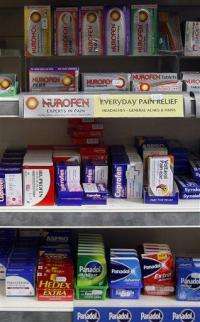
In Britain, the popular U.S. painkiller OxyContin is considered similar to morphine and used sparingly. Vicodin isn't even licensed. And at most shops, remedies like ibuprofen are sold only in 16-pill packs.
To avoid risks including addiction, strong painkillers are often kept at arm's length from patients - even if that means some people will be left suffering.
Many British doctors say the country has a more conservative approach to doling out painkillers than in the U.S., where overdose deaths from powerful drugs including OxyContin and Vicodin, tripled over a decade, according to a government report there earlier this month.
"We are much more cautious here about all sorts of painkillers," said Dr. Anthony Ordman, founder of a pain clinic at London's Royal Free Hospital. He said the U.K.'s socialized medicine system, where nearly everyone gets their prescriptions from a single physician, makes "doctor shopping" to get drugs from different doctors nearly impossible.
Prescriptions for opioid drugs must be written on a special pink pad - and even those from private doctors get cross-referenced with the country's national health service so that patients' primary doctors know what their patients are getting from others.
Ordman also said British doctors may be less inclined to automatically do what their patients want. "In the U.S., doctors might wish to please their patients and prescribe them something because they're clients," he said. "But in the U.K., the patient doesn't pay the doctor directly so I can choose not to prescribe painkillers without the fear of suffering financially myself."
In the U.S., some experts said they don't want to deprive people of much-needed drugs. "It's a delicate balance," said Kyle Hultgren, managing director of the Center for Medication Safety Advancement at Purdue University. "It would be hasty to say that it's too easy for people to get prescription medication because there are still people in serious need who can't get access," he said.
Hultgren said aggressive pharmaceutical advertising puts more pressure on American doctors. "Patients sometimes openly ask for medications because they've seen them advertised," he said. "Physicians need to be very disciplined and explain to patients why a certain medication may not be right for them."
Painkiller use in Britain has been rising in recent years, but not at a scale comparable to the U.S. According to the Royal Pharmaceutical Society, about 60 million drugs like aspirin and codeine were given out last year, a slight rise from the nearly 58 million dispensed in 2009.
There are a few hundred deaths every year due to overdoses of drugs including methadone, codeine and other opioid medicines - though that also includes people who have taken other drugs like heroin.
Powerful painkillers are commonly used to treat people after traumatic accidents, those with cancer-related pain, or in palliative care. But doctors are often loathe to use drugs like morphine for people with long-term pain like those with muscular-skeletal disorders like rheumatoid arthritis.
For people seeking relief from everyday pains like headaches or sore muscles, painkillers like acetaminophen, sometimes sold as Tylenol, and ibuprofen are only sold in limited quantities. By law, most shops can only sell packs of 16 tablets and no one is allowed to buy more than 100 pills at once without a prescription.
Codeine is available over the counter but all packages carry a warning about the dangers of addiction. Pharmacists selling it also advise people to only take it for three days.
Doctors who work in emergency rooms or at after-hours clinics may also be more wary of giving out strong drugs because they don't know what else the patient may be on.
Britain's medical profession was also scarred by Dr. Harold Shipman, a notorious serial killer thought to have murdered more than 200 patients from about 1975 to 1998 in Manchester with deadly doses of a drug often used for cancer pain.
After the murders, prescribing practices for powerful painkillers were tightened; all doctors who prescribe such medicines must now have a special license from the U.K.'s governing body for doctors.
But many patients say this restrictive approach to pain management unfairly denies them treatment.
Ian Semmons said he was left in agony for three years after breaking his back, shattering both ankles and suffering head injuries after trying to stop a robbery about two decades ago. "The National Health Service saved my life but neglected my pain," he said, explaining he wasn't given anything stronger than acetaminophen in the three years after his accident.
Semmons, who worked in human resources and risk management, was in such pain he often couldn't walk, couldn't work, and couldn't play with his two-year-old daughter. "If I had been in the U.S., I would probably have received strong opioid drugs and been able to get on with my life much sooner," he said.
It wasn't until Semmons was referred to a specialist pain clinic three years after his accident that he got relief. There, he not only got opioid drugs, but acupuncture, physiotherapy and nerve stimulation. He also spoke to a psychologist whom he credits with reducing his reliance on medication.
These days, Semmons has learned to manage his pain with acetaminophen or the occasional use of diazepam, a muscle relaxant, or MST, a type of opioid drug. He was so frustrated with his experience being denied painkillers that he founded the advocacy group, Action on Pain, in 1998.
Some doctors said a better balance needs to be struck between relieving pain and avoiding the risks of using stronger drugs.
"To make it harder to prescribe enough painkillers for a patient in agony is wrong and essentially a form of torture," said Dr. Michael Platt, lead clinician for pain services at St. Mary's Hospital in London. "Either we need to treat the pain properly or we tell the patient they are just going to have to suffer."
©2011 The Associated Press. All rights reserved. This material may not be published, broadcast, rewritten or redistributed.


