Too posh to push? More C-sections on demand in UK
November 4, 2011 By MARIA CHENG , AP Medical Writer in Health
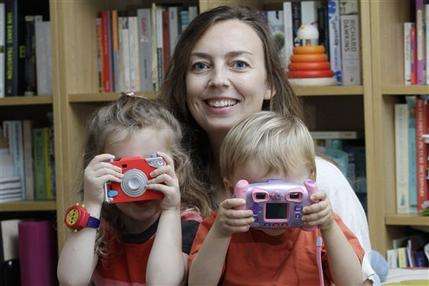
Pauline Hull, who runs a website about elective cesarean child birth, C-sections, poses for picture with her children in Farnham, England, in this photo dated Thursday, Nov. 3, 2011. Pregnant women in Britain, where the government provides free health care, may soon be able to get a cesarean section on demand thanks to a rule change. Hull has had two C-section births herself and says that doctors tend to over exaggerate the risks of C-sections. (AP Photo/Sang Tan)
(AP) -- Pregnant women in Britain, where the government provides free health care, may soon be able to get a cesarean section on demand thanks to a rule change that critics describe as the health system caving into the "too posh to push" crowd.
Currently, British women who can't afford to pay private doctors for their baby's delivery have been allowed to have planned C-sections only if there are health concerns for mother or baby. Emergency C-sections are done when the situation demands it.
But new guidelines set to take effect later this month say pregnant women "with no identifiable reason" should be allowed a cesarean if they still want it following a discussion with mental health experts.
"It's about time women who have no desire to view labor as a rite of passage into motherhood be able to choose how they want to have their baby," said Pauline Hull, who has had two children by cesarean because of medical reasons. "The important thing to me was meeting my baby, not the experience of labor."
Hull runs the website, Elective Cesarean, from her home in Surrey, south of London. She said midwives tend to overexaggerate the risks of C-sections and underestimate those of vaginal births.
The new draft guidelines come from the National Institute for Health and Clinical Excellence, or NICE. The agency's guidelines are usually accepted by the government and determine what will be paid for by its health system.
"In general, a C-section is a safe operation, especially when performed as a planned procedure," the new guidance says.
The agency says it routinely updates guidance every few years and denies there was any pressure to change its more restrictive C-section advice. But in recent years, advocates and some doctors have slammed the U.K. health system for not giving women a greater say in childbirth.
The change comes at a price for Britain's cash-strapped health system. NICE estimates C-sections cost about 800 pounds ($1,280) more than a vaginal birth, although that doesn't include the price of treating possible long-term complications like urinary incontinence from vaginal births.
The report notes that for every percentage point the C-section rate falls, the health system could save 5.6 billion pounds ($8.9 billion).
In the U.K., about 25 percent of women have C-sections, versus about 30 percent in the U.S. In both countries, rates have doubled in recent years, though doctors say that's not just due to demand, but because pregnant women increasingly have other problems like obesity and diabetes.
About 10 percent of all U.K. births are planned C-sections while about 15 percent are emergency procedures, according to NHS figures.
The World Health Organization has previously said wealthy countries should aim for a C-section rate of about 15 percent, though it also says there isn't enough evidence to know what the ideal rate is.
The National Health Service estimates that about 15 percent of British births take place in private hospitals, which tend to have higher cesarean rates. At Portland Hospital in London, where many celebrities check in, the C-section rate ranges from 35 to 40 percent.
The issue of women having C-sections on demand has long been a hot button issue in the U.K., with celebrities like Madonna and former Spice Girl Victoria Beckham having scheduled procedures at upscale hospitals. Criticism for the wealthy getting these elective surgeries led to the phrase "too posh to push."
But some experts say the new British guidance won't dramatically change how pregnant women are treated.
"It's only a small percentage of women who ask for a C-section," said Cathy Warwick, chief executive of the Royal College of Midwives.
Warwick said doctors and midwives regularly talk to women who have concerns about childbirth and after addressing their fears, most women agree to skip a planned C-section.
"As long as it's safe for both mother and baby, a vaginal birth is absolutely the best way for anyone to deliver," said Dr. Daghni Rajasingham, an obstetrician and spokeswoman for the Royal College of Obstetricians and Gynaecologists. She said the physical stress put on a baby's lungs during labor helps them adapt to breathing after being born.
Rajasingham also said while C-sections are safe, the operation comes with risks including infections, bleeding, and the potential for problems with future pregnancies.
"As an obstetrician working with limited resources, I want to make sure we have safe and high-quality health care for all women and not be skewed by a few women who want something specifically," Rajasingham said.
For women like Hull, however, the policy shift is long overdue.
"Women shouldn't think a C-section is going to be a walk in the park, but they should have all the information they need to help them make an informed choice," she said.
©2011 The Associated Press. All rights reserved. This material may not be published, broadcast, rewritten or redistributed.
-
Scientists expect C-section rate to keep rising
Aug 30, 2010 |
not rated yet |
0
-
Local efforts can stem the increasing unnecessary cesarean sections
Jul 26, 2011 |
not rated yet |
0
-
New guidelines aim to reduce repeated C-sections
Jul 21, 2010 |
not rated yet |
0
-
Vaginal birth safe after C-sections
Jun 30, 2006 |
not rated yet |
0
-
Fear of childbirth increases likelihood of C-section
Sep 21, 2011 |
not rated yet |
0
-
Of mice and mental models: Neuroscientific implications of risk-optimized behavior in the mouse
May 25, 2012 |
not rated yet |
0
-
Limits to growth: Scientists identify key metastasis-enabling enzyme
May 22, 2012 |
5 / 5 (4) |
0
-
Seeing is as seeing does: Spatially-structured retinal input in early development of cortical maps
Apr 26, 2012 |
5 / 5 (4) |
1
-
Dreamless nights: Brain activity during nonrapid eye movement sleep
Apr 09, 2012 |
4.4 / 5 (12) |
0
-
Take your time: Neurobiology sheds light on the superiority of spaced vs. massed learning
Mar 28, 2012 |
4.5 / 5 (21) |
3
-
Classical and Quantum Mechanics via Lie algebras
Apr 15, 2011
- More from Physics Forums - Independent Research
More news stories
Most occupational injury and illness costs are paid by the government and private payers
UC Davis researchers have found that workers' compensation insurance is not used nearly as much as it should be to cover the nation's multi-billion dollar price tag for workplace illnesses and injuries. Instead, almost 80 ...
Health
22 hours ago |
not rated yet |
0
Early physical therapist treatment associated with reduced risk of healthcare utilization and reduced overall healthcare
A new study published in Spine shows that early treatment by a physical therapist for low back pain (LBP), as compared to delayed treatment, was associated with reduced risk of subsequent healthcare utilization and lower ...
Health
May 25, 2012 |
not rated yet |
0
|
Cancer patients share web info with docs for insight, advice
(HealthDay) -- Cancer patients' primary goal in talking with their doctors about information they've found on the Internet is to get more insight and advice on the online information, new research indicates.
Health
May 25, 2012 |
not rated yet |
0
P&G to add latches to make detergent packs safer
(AP) -- Procter & Gamble says it will change the design of packaging for its miniature laundry detergent product to deter children from eating the brightly colored packets that look like candy.
Health
May 25, 2012 |
not rated yet |
0
In Spain, 70 percent of women use contraceptives during their first sexual encounter
Contraceptive use in Spain during the first sexual encounter is similar to other European countries. However, there are some geographical differences between Spanish regions: women in Murcia use contraceptives ...
Health
May 25, 2012 |
not rated yet |
0
Travel to high altitudes tied to Crohn's, colitis flare-ups
(HealthDay) -- People with inflammatory bowel disease, which includes Crohn's disease and colitis, may be at increased risk for flare-ups when they fly or travel to high altitudes for skiing or mountain climbing, ...
Family history of Alzheimer's affects functional connectivity
(HealthDay) -- Cognitively normal individuals with a family history of late-onset Alzheimer's disease (AD) may display lower resting state functional connectivity in the default mode network (DMN) of the brain, ...
Transvaginal mesh op restores pelvic organ prolapse at price
(HealthDay) -- Transvaginal mesh (TVM) procedures are effective for anatomical restoration of pelvic organ prolapse (POP), but patients report a worsening of sexual function following surgery, according to ...
Tongue analysis software uses ancient Chinese medicine to warn of disease
For 5,000 years, the Chinese have used a system of medicine based on the flow and balance of positive and negative energies in the body. In this system, the appearance of the tongue is one of the measures used to classify ...
Of mice and mental models: Neuroscientific implications of risk-optimized behavior in the mouse
(Medical Xpress) -- Regardless of an organism’s biological complexity, every encephalized animal continuously makes under-informed behavioral choices that can have serious consequences. Despite its ubiquity, ...
Weight struggles? Blame new neurons in your hypothalamus
New nerve cells formed in a select part of the brain could hold considerable sway over how much you eat and consequently weigh, new animal research by Johns Hopkins scientists suggests in a study published in the May issue ...