Giving thanks helps your psychological outlook
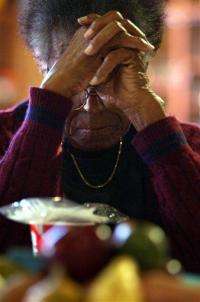
(AP) -- Count your blessings this Thanksgiving. It's good for you.
While it seems pretty obvious that gratitude is a positive emotion, psychologists for decades rarely delved into the science of giving thanks. But in the last several years they have, learning in many experiments that it is one of humanity's most powerful emotions. It makes you happier and can change your attitude about life, like an emotional reset button.
Especially in hard times, like these.
Beyond proving that being grateful helps you, psychologists also are trying to figure out the brain chemistry behind gratitude and the best ways of showing it.
"Oprah was right," said University of Miami psychology professor Michael McCullough, who has studied people who are asked to be regularly thankful. "When you are stopping and counting your blessings, you are sort of hijacking your emotional system."
And he means hijacking it from out of a funk into a good place. A very good place. Research by McCullough and others finds that giving thanks is a potent emotion that feeds on itself, almost the equivalent of being victorious. It could be called a vicious circle, but it's anything but vicious.
He said psychologists used to underestimate the strength of simple gratitude: "It does make people happier ... It's that incredible feeling."
One of the reasons why gratitude works so well is that it connects us with others, McCullough said. That's why when you give thanks it should be more heartfelt and personal instead of a terse thank you note for a gift or a hastily run-through grace before dinner, psychologists say.
Chicago area psychologist and self-help book author Maryann Troiani said she starts getting clients on gratitude gradually, sometimes just by limiting their complaints to two whines a session. Then she eventually gets them to log good things that happened to them in gratitude journals: "Gratitude really changes your attitude and your outlook on life."
Gratitude journals or diaries, in which people list weekly or nightly what they are thankful for, are becoming regular therapy tools.
And in those journals, it is important to focus more on the people you are grateful for, said Robert Emmons, a psychology professor at the University of California, Davis. Concentrate on what life would be without the good things - especially people such as spouses - in your life and how you are grateful they are there, he said.
Grateful people "feel more alert, alive, interested, enthusiastic. They also feel more connected to others," said Emmons, who has written two books on the science of gratitude and often studies the effects of those gratitude diaries.
"Gratitude also serves as a stress buffer," Emmons said in an e-mail interview. "Grateful people are less likely to experience envy, anger, resentment, regret and other unpleasant states that produce stress."
Scientists are not just looking at the emotions behind gratitude but the nuts-and-bolts physiology as well.
Preliminary theories look at the brain chemistry and hormones in the blood and neurotransmitters in the brain that are connected to feelings of gratitude, Emmons said. And the left prefrontal cortex of the brain, which is also associated with positive emotions like love and compassion, seems to be a key spot, especially in Buddhist monks, Emmons said.
However it works in the brain, Emmons said there is little doubt that it works.
Emmons, who has conducted several studies on people from ages 12 to 80, including those with neuromuscular disease, asked volunteers to keep daily or weekly gratitude diaries. Another group listed hassles, and others just recorded random events. He noticed a significant and consistent difference. About three-quarters of the people studied who regularly counted their blessings scored higher in happiness tests and some even showed improvements in amounts of sleep and exercise.
Christopher Peterson of the University of Michigan studied different gratitude methods and found the biggest immediate improvement in happiness scores was among people who were given one week to write and deliver in person a letter of gratitude to someone who had been especially kind to them, but was never thanked. That emotional health boost was large, but it didn't last over the weeks and months to come.
Peterson also asked people to write down nightly three things that went well that day and why that went well. That took longer to show any difference in happiness scores over control groups, but after one month the results were significantly better and they stayed better through six months.
Peterson said it worked so well that he is adopted it in his daily life, writing from-the-heart thank you notes, logging his feelings of gratitude: "It was very beneficial for me. I was much more cheerful."
At the University of North Carolina, Sara Algoe studied the interaction between cancer patients and their support group, especially when acts of gratitude were made. Like Peterson, she saw the effects last well over a month and she saw the feedback cycle that McCullough described.
"It must be really powerful," Algoe said.
It has to be potent to combat gloom many may be feeling in such uncertain times.
There have been many Thanksgivings throughout history that might challenge society's ability to be grateful. The first Thanksgiving with the Pilgrims came after about half of the Plymouth colony died in the first year. Thanksgiving became a national holiday in the United States when Abraham Lincoln proclaimed it in 1863 during the Civil War, the deadliest war the country has ever known. And the holiday moved to the fourth Thursday in November during the tail end of the Great Depression.
Emmons actually encourages people to "think of your worst moments, your sorrows, your losses, your sadness and then remember that here you are, able to remember them. You got through the worst day of your life ... remember the bad things, then look to see where you are."
That grace amid difficulty motif may make this Thanksgiving especially meaningful, McCullough said.
"In order to be grateful for something, we have to remember that something good happened," Peterson said. "It's important to remind ourselves that the world doesn't always suck."
More information:
Robert Emmons: http://psychology.ucdavis.edu/labs/emmons/PWT/index.cfm
National Association of School Psychologists' tips on fostering gratitude in children: http://bit.ly/rHlqCz
©2011 The Associated Press. All rights reserved. This material may not be published, broadcast, rewritten or redistributed.


