Results of the BRIDGE trial reported at TCT 2011
November 9, 2011 in Cardiology
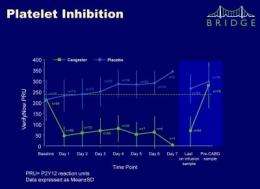
The first stage of BRIDGE identified the cangrelor dose that maintains a "thienopyridine-like" level of platelet inhibition. The second stage reported today was a prospective, randomized, double-blind, placebo-controlled trial in 210 patients with an acute coronary syndromes (ACS) or treated with a coronary stent (bare metal stent or drug eluting stent) on a thienopyridine awaiting coronary artery bypass grafting (CABG). After thienopyridine discontinuation (<72 hours), patients were administered cangrelor or placebo for at least 48 hours and up to 7 days, which was discontinued 1-6 hours prior to CABG. The objective was to demonstrate that a cangrelor IV infusion would maintain levels of platelet reactivity <240 P2Y12 Reaction Units (PRU) throughout the pre-operative period as measured by a P2Y12 assay. Credit: Data on file at The Medicines Company
Data from the BRIDGE clinical trial demonstrate that intravenous use of the drug cangrelor was effective at maintaining platelet inhibition in patients on thienopyridines who required bypass surgery. Trial results were presented today at the 23rd annual Transcatheter Cardiovascular Therapeutics (TCT) scientific symposium, sponsored by the Cardiovascular Research Foundation.
Thienopyridines are anti-platelet medications that work to prevent blood clotting and improve circulation. Though they are among the most widely prescribed medications, their use can be complicated by the unanticipated need for surgery. Despite increased risk of thrombosis, guidelines recommend discontinuing thienopyridines 5 7 days prior to surgery to minimize bleeding.
In the BRIDGE trial, researchers sought to determine whether the investigational drug cangrelor could be used as a "bridge" between discontinuing thienopyridines and surgery.
BRIDGE is a prospective, randomized double-blind, placebo-controlled, multicenter trial in 210 patients with acute coronary syndrome (ACS) or treated with a coronary stent on a thienopyridine awaiting coronary artery bypass grafting (CABG) to receive either cangrelor or placebo after an initial open-label, dose-finding phase. After thienopyridines were stopped, patients were administered cangrelor or a placebo for at least 48 hours, which was then discontinued 1 6 hours prior to surgery.
The primary efficacy endpoint of the trial was platelet reactivity (measured in P2Y12 Reaction Units [PRU]), assessed daily with the VerifyNowTM P2Y12 assay. The main safety endpoint was excessive CABG-related bleeding.
The dose of cangrelor determined in the open-label stage was 0.75 µg/kg/min. In the randomized phase, a greater proportion of patients treated with cangrelor had low levels of platelet reactivity throughout the entire treatment period compared with placebo (primary endpoint, PRU<240: 98.8% vs. 19.0%; odds ratio: 353, 95% confidence interval: 45.6-2728, p<0.001). Excessive CABG-related bleeding occurred in 11.8% vs. 10.4% in the cangrelor and placebo groups, respectively (p=0.76). There were no significant differences in major bleeding prior to CABG, although minor bleeding was numerically higher with cangrelor.
"Results of the BRIDGE trial indicate that in patients on thienopyridines who undergo cardiac surgery, intravenous cangrelor provides effective maintenance of platelet inhibition with no apparent increase in major bleeding, despite numerically higher rates of minor bleeding prior to surgery, which however were mostly attributed to ecchymosis at the site of venipuncture. Larger patient samples are needed to more definitively assert the safety and effectiveness of cangrelor bridging therapy to surgery," said Dominick J. Angiolillo, MD, PhD, the lead investigator of the trial. Dr. Angiolillo is an Associate Professor of Medicine and Director of Cardiovascular Research at the University of Florida College of Medicine in Jacksonville, Florida.
Provided by Cardiovascular Research Foundation
-
Results of the TRIGGER-PCI trial reported at TCT 2011
Nov 09, 2011 |
not rated yet |
0
-
Lower achieved platelet reactivity associated with better cardiovascular
Aug 30, 2011 |
not rated yet |
0
-
New Anti-Clotting Medication Not More Effective than Standard Care; Hint of Other Clinical Benefits
Nov 17, 2009 |
not rated yet |
0
-
Study examines outcomes of high-dose antiplatelet drug after stent placement
Mar 15, 2011 |
not rated yet |
0
-
30-day results of ADAPT-DES registry reported at TCT 2011
Nov 09, 2011 |
not rated yet |
0
-
Motion perception revisited: High Phi effect challenges established motion perception assumptions
Apr 23, 2013 |
3 / 5 (2) |
2
-
Anything you can do I can do better: Neuromolecular foundations of the superiority illusion (Update)
Apr 02, 2013 |
4.5 / 5 (11) |
5
-
The visual system as economist: Neural resource allocation in visual adaptation
Mar 30, 2013 |
5 / 5 (2) |
9
-
Separate lives: Neuronal and organismal lifespans decoupled
Mar 27, 2013 |
4.9 / 5 (8) |
0
-
Sizing things up: The evolutionary neurobiology of scale invariance
Feb 28, 2013 |
4.8 / 5 (10) |
14
-
Calculating on-axis elements of a solenoid
5 hours ago
-
latitude & longitude & air pressure
7 hours ago
-
Differences of Classical Mechanics when learned with Calc vs algebra?
10 hours ago
-
what is the distance traveled
14 hours ago
-
Image of a Convex Lens Cut in Half Horizontally
18 hours ago
-
Ray tracing through optical system of thick lenses
18 hours ago
- More from Physics Forums - Classical Physics
More news stories
Costs to treat stroke in America may double by 2030
Costs to treat stroke are projected to more than double and the number of people having strokes may increase 20 percent by 2030, according to the American Heart Association/American Stroke Association.
Cardiology
15 hours ago |
not rated yet |
0
New blood-thinner measures may cut medication errors
Blood thinners are the preferred treatment option to prevent heart attacks, blood clots and stroke, but they are not without risk, and not just because of their side effects. These high-risk drugs, known as anticoagulants, ...
Cardiology
17 hours ago |
not rated yet |
0
Registry questions superiority of bivalirudin over heparin
Results from a large observational study reported at EuroPCR 2013 today question whether bivalirudin is superior to heparin in the absence of GPIIb/IIIa blockade, showing similar 30-day mortality in patients with non-ST segment ...
Cardiology
17 hours ago |
not rated yet |
0
Study shows low rate of late lumen loss with bioresorbable DESolve device
The DESolve bioresorbable coronary scaffold system achieves good efficacy and safety with low rates of late lumen loss and major coronary adverse events at six months, show first results from the pivotal DESolve Nx trial ...
Cardiology
17 hours ago |
not rated yet |
0
Biodegradable stent proves non-inferior to drug-eluting stent
The Orsiro stent, which is a novel stent platform eluting sirolimus from a biodegradable polymer, demonstrated non-inferiority to the Xience Prime everolimus-eluting stent for the primary angiographic endpoint of in-stent ...
Cardiology
May 21, 2013 |
5 / 5 (1) |
0
Rate of bicycle-related fatalities significantly lower in states with helmet laws
Existing research shows that bicyclists who wear helmets have an 88 percent lower risk of brain injury, but researchers at Boston Children's Hospital found that simply having bicycle helmet laws in place showed a 20 percent ...
Slowing the aging process—only with antibiotics
Swiss scientists reveal the mechanism responsible for aging hidden deep within mitochondria—and dramatically slow it down in worms by administering antibiotics to the young.
Researchers complete largest genetic sequencing study of human disease
Researchers from Queen Mary, University of London have led the largest sequencing study of human disease to date, investigating the genetic basis of six autoimmune diseases.
Brain can be trained in compassion, study shows
Until now, little was scientifically known about the human potential to cultivate compassion—the emotional state of caring for people who are suffering in a way that motivates altruistic behavior.
Having both migraines, depression may mean smaller brain
(HealthDay)—Migraines and depression can each cause a great deal of suffering, but new research indicates the combination of the two may be linked to something else entirely—a smaller brain.
Novel approach for influenza vaccination shows promise in early animal testing
A new approach for immunizing against influenza elicited a more potent immune response and broader protection than the currently licensed seasonal influenza vaccines when tested in mice and ferrets. The vaccine ...