Starving prostate cancer
November 2, 2011 in Cancer
Starving prostate cancer

Enlarge

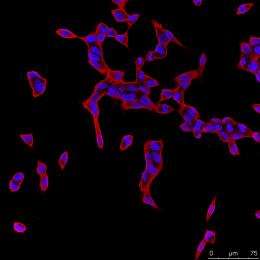
"Early stage prostate cancer cells showing the nucleus in blue, and the nutrient pump on the surface of the cells in red. Credit: Centenary Institute"

(Medical Xpress) -- Researchers at the Centenary Institute in Sydney have discovered a potential future treatment for prostate cancer—through starving the tumor cells of an essential nutrient they need to grow rapidly.

Their work, with human cells grown in the lab, reveals targets for drugs that could slow the progress of early and late stage .

Each year about 3300 Australian men die of prostate cancer. It’s Australia’s second worst cancer killer for men, matching the impact of breast cancer on women.

Current therapies for prostate cancer include surgical removal of the prostate, radiation, freezing the tumour or cutting off the supply of the hormone testosterone—but there are often side-effects including incontinence and impotence.

Growing cells need an essential nutrient, the amino acid called leucine, which is pumped into the cell by specialized proteins. And this could be prostate cancer’s weak link.

Dr. Jeff Holst and his team at the Centenary Institute found in a study to be published in November’s Cancer Research that prostate have more pumps than normal. This allows the cancer cells to take in more leucine and outgrow normal cells.

“This information allows us to target the pumps – and we’ve tried two routes. We found that we could disrupt the uptake of leucine firstly by reducing the amount of the protein pumps, and secondly by introducing a drug that competes with leucine. Both approaches slowed cancer growth, in essence ‘starving’ the cancer cells,” Jeff says.

First author Dr. Qian Wang says by targeting different sets of pumps, the researchers were able to slow tumor growth in both the early and late stages of prostate cancer. “In some of the experiments, we were able to slow tumour growth by as much as 50 per cent. Our hope is that we could develop a treatment that slows the growth of the cancer so that it would not require surgical removal. If animal trials are successful over the next few years then clinical trials could start in as little as five years,” he says.

Jeff says one of the other spin-offs of the discovery is a better understanding of the links between prostate cancer and eating foods high in leucine. “Diets high in red meat and dairy are correlated with prostate cancer but still no one really understands why.  We have already begun examining whether these pumps can explain the links between diet and prostate cancer.”

“Given one in nine men in Australia may develop prostate cancer in their lifetime, this discovery could touch thousands of lives.”

The publication of the study comes just in time for Movember, a month-long charity drive in which thousands of people around the globe grow moustaches to raise money for men’s health issues including prostate cancer.

“This fundamental research tells us more about how prostate and other cancers grow, and will open the way for new treatments in the long term,” says Movember chairman Paul Villanti.

“Movember is now one of the largest non-government global funders of prostate cancer research. We strongly support innovative targeted research that leads to significantly improved clinical tests and treatments to reduce the burden of prostate cancer.  It’s great to see the progress that Dr. Holst and his team have made with the support of a Movember Young Investigator grant.

PCFA and Movember have been working together since 2004 to reduce the impact of prostate cancer on Australian men and their loved ones.

PCFA CEO Dr. Anthony Lowe says research that has the potential to reduce the impact of prostate cancer on those who are diagnosed is a huge priority for the PCFA’s grants program. “We commend the team at the Centenary Institute on the remarkable progress they are making in this regard,” he says.

“This is part of a body of work that is investigating the very nature of cancer and opening up new avenues for cancer treatment,” says Centenary Institute executive director Professor Mathew Vadas.

More information: Cancer Res. 2011 Oct 17, Androgen receptor and nutrient signalling pathways coordinate the demand for increased amino acid transport during prostate cancer progression, Qian Wang, et al. doi: 10.1158/0008-5472.CAN-11-1821

Provided by Science in Public

3 /5 (1 vote)  

Rank 3 /5 (1 vote)
Relevant PhysicsForums posts
  • Potential Breakthrough in Seizure Control
    created12 hours ago
  • Popping/Cracked sternum.
    created17 hours ago
  • Which Mental Illness Encompasses This Problem?
    created17 hours ago
  • A question about drug tolerance
    createdMay 23, 2012
  • Poor nutrition leading to overeating?
    createdMay 23, 2012
  • Math and dyslexia?
    createdMay 21, 2012
  • More from Physics Forums - Medical Sciences

More news stories

Skp2 activates cancer-promoting, glucose-processing Akt

HER2 and its epidermal growth factor receptor cousins mobilize a specialized protein to activate a major player in cancer development and sugar metabolism, scientists report in the May 25 issue of Cell.

Cancer created May 25, 2012 | popularity not rated yet | comments 0 | with audio podcast

Pancreatectomy OK without downstaging from therapy

(HealthDay) -- Pancreatectomy improves median survival in pancreatic cancer patients even when presurgical neoadjuvant therapy does not lead to radiographic downstaging of tumors, according to a study published ...

Cancer created May 25, 2012 | popularity not rated yet | comments 0

Common therapies for basal cell carcinoma offer similar survival

(HealthDay) -- For patients with superficial basal cell carcinoma (sBCC), treatment with imiquimod or photodynamic therapy (PDT) results in similar long-term tumor-free survival, according to a review published ...

Cancer created May 25, 2012 | popularity not rated yet | comments 0

Cancer may require simpler genetic mutations than previously thought

Chromosomal deletions in DNA often involve just one of two gene copies inherited from either parent. But scientists haven't known how a deletion in one gene from one parent, called a "hemizygous" deletion, can contribute ...

Cancer created May 25, 2012 | popularity not rated yet | comments 0 | with audio podcast

New prostate cancer screening guidelines face a tough sell, study suggests

(Medical Xpress) -- Recent recommendations from the U.S. Preventive Services Task Force (USPSTF) advising elimination of routine prostate-specific antigen (PSA) screening for prostate cancer in healthy men are likely to encounter ...

Cancer created May 25, 2012 | popularity not rated yet | comments 1


Travel to high altitudes tied to Crohn's, colitis flare-ups

(HealthDay) -- People with inflammatory bowel disease, which includes Crohn's disease and colitis, may be at increased risk for flare-ups when they fly or travel to high altitudes for skiing or mountain climbing, ...

Family history of Alzheimer's affects functional connectivity

(HealthDay) -- Cognitively normal individuals with a family history of late-onset Alzheimer's disease (AD) may display lower resting state functional connectivity in the default mode network (DMN) of the brain, ...

Transvaginal mesh op restores pelvic organ prolapse at price

(HealthDay) -- Transvaginal mesh (TVM) procedures are effective for anatomical restoration of pelvic organ prolapse (POP), but patients report a worsening of sexual function following surgery, according to ...

Tongue analysis software uses ancient Chinese medicine to warn of disease

For 5,000 years, the Chinese have used a system of medicine based on the flow and balance of positive and negative energies in the body. In this system, the appearance of the tongue is one of the measures used to classify ...

Of mice and mental models: Neuroscientific implications of risk-optimized behavior in the mouse

(Medical Xpress) -- Regardless of an organism’s biological complexity, every encephalized animal continuously makes under-informed behavioral choices that can have serious consequences. Despite its ubiquity, ...

Weight struggles? Blame new neurons in your hypothalamus

New nerve cells formed in a select part of the brain could hold considerable sway over how much you eat and consequently weigh, new animal research by Johns Hopkins scientists suggests in a study published in the May issue ...