Rehabilitating vacant lots improves urban health and safety, study finds
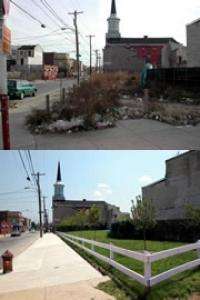
Greening of vacant urban land may affect the health and safety of nearby residents, according to a study published online in the American Journal of Epidemiology this week. The team, led by senior author Charles C. Branas, PhD, associate professor of Epidemiology at the Perelman School of Medicine, University of Pennsylvania, found in a decade-long comparison of vacant lots and improved vacant lots, that greening was linked to significant reductions in gun assaults across most of Philadelphia and significant reductions in vandalism in one section of the city. Vacant lot greening was also associated with residents in certain sections of the city reporting significantly less stress and more exercise.
"Improving the places where people live, work and play, holds great promise for changing health and safety," says Branas. "Greening vacant lots is a low-cost, high-value approach, which may prevent certain crimes and encourage healthy activity for more people and for longer periods of time than many other approaches."
"Dr. Branas's study adds to the growing body of evidence that cleaned and greened lots are important elements in a revitalized community," said Mayor Michael A. Nutter. "The City's partnership with the Pennsylvania Horticultural Society enhances health and safety in addition to creating jobs and increasing property values; now we have scientific proof of the benefits of this collaboration."
"The study by Dr. Branas and his team is fantastic news for the Pennsylvania Horticultural Society [PHS], which in partnership with the City of Philadelphia has reclaimed thousands of blighted vacant lots," said PHS President Drew Becher. "We have known that greening these lots has helped transform neighborhoods in various ways. The Penn findings reveal other significant, direct impacts of this program on the lives of residents."
A Decade of Greening
In 1999, PHS began a program to green vacant lots – abandoned open spaces with no buildings – in Philadelphia. This program involved removing trash and debris, grading the land, planting grass and trees to create a park-like setting, and installing low wooden post-and-rail fences around each lot to show that it was cared for and to deter illegal dumping. Several times a year, PHS returned to each greened lot to perform basic maintenance, such as mowing the grass, tending trees, or repairing fences.
Branas and his team analyzed the impact of this program for a decade, from 1999 to 2008, using a statistical design that considered various health and safety outcomes and numerous other factors occurring on and around vacant lots, before and after they were treated, as compared to vacant lots that were not greened over the same time period.
Across Philadelphia, nearly 4,500 vacant lots totaling over 7.8 million square feet were greened from 1999-2008. Untreated control lots were randomly selected and matched to treated lots by section of the city, within four of the five sections of Philadelphia. The Northeast section was excluded because only a handful of vacant lots were greened there. Vacant lots eligible to serve as matched controls included only those that had never been greened from 1999-2008, but that could have been chosen by the PHS for greening.
A master database of over 50,000 vacant lots in Philadelphia from 1999-2008 was assembled from Philadelphia Bureau of Revision of Taxes and Philadelphia Department of Licenses and Inspections records. This database was separated into lots greened by PHS and lots that were not greened. The Philadelphia Police Department provided the dates and locations for several types of crimes and arrests from 1999-2008: aggravated assaults, aggravated assaults with guns, robberies, robberies with guns, narcotics sales and possession, burglaries, thefts, vandalism and criminal mischief, disorderly conduct, public drunkenness, and illegal dumping. The Philadelphia Health Management Corporation provided community-level health data from the Southeastern Pennsylvania Household Health Survey.
The Pluses of Greening
"This is one of the first rigorous studies to show that reducing physical decay in neighborhoods -through such efforts as cleaning up vacant lots - reduces public safety crimes, demonstrating that healthier places are safer places," says co-author John MacDonald, PhD, chair of the Department of Criminology at Penn. "Public policies that promote active living can also enhance personal safety."
Vacant lot greening was associated with significant reductions in gun assaults across all four sections of Philadelphia in the study and significant reductions in vandalism in one section of the city.
Greening was also associated with residents reporting significantly less stress and more exercise in certain sections of Philadelphia. Because newly greened vacant lots may serve as safe havens, residents may have felt less stress or may have seen greater outdoor opportunities for exercise in a cleaner, more attractive, and safer environment, say the authors. Even though these findings pertaining to stress and exercise only applied to certain sections of the city, they have potentially important implications for the future study of urban vacant lot greening as a tool to enhance health.
"Violent crime may have simply been discouraged in the presence of greened and tended vacant lots that signaled someone in the community cared and was watching over the space in question," says Branas. "The effect of greening may have also been more tangible, especially for gun assaults, where vacant lots may have been a haven, storage ground, or disposal point for illegal guns. Because the penalty of being caught with an illegal gun is high, criminals may hide their guns in abandoned vacant lots."
Surprisingly, acts of disorderly conduct – a catch-all category encompassing various violations and nuisances – increased after the greening of vacant lots. A greened lot may serve as a new opportunity for community gatherings, bringing large groups of people together and increasing the opportunity for crowd-based nuisance crimes such as disorderly conduct, say the researchers. Community interest in maintaining a newly greened lot may have also increased calls to police and arrests for disorderly conduct.
"The large number of vacant lots we studied and the design of our analysis make this study some of the strongest evidence to date that greening vacant urban land is a promising approach to improving health and safety," notes Branas. "As with all studies, it's not the final word, and we are now moving forward with a randomized trial of vacant lot greening to even more thoroughly investigate. Philadelphia, like many cities, still has tens of thousands of vacant and abandoned lots to support such a study."


