2.5M young adults gain coverage
December 14, 2011 By RICARDO ALONSO-ZALDIVAR , Associated Press in Health
APNewsBreak: 2.5M young adults gain coverage (AP)

Enlarge

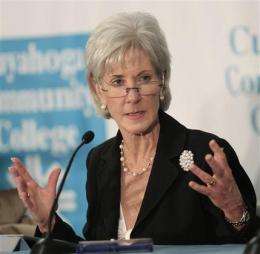
In this Nov. 30, 2011, file photo, U.S. Health and Human Services Secretary Kathleen Sebelius participates in an roundtable discussion on health information technology and job creation at Cuyahoga Community College in Cleveland. The Obama administration says the number of young adults going without medical coverage has shrunk by 2.5 million since the new health care law took effect. A new analysis to be released Wednesday, Dec. 14, 2011, finds the drop is two-and-half times larger than indicated by government and private estimates from earlier this year. The health care overhaul allows young adults to stay on a parent’s plan until they turn 26. (AP Photo/Tony Dejak, File)

(AP) -- The number of young adults lacking medical coverage has shrunk by 2.5 million since the new health care overhaul law took effect, according to a new analysis the Obama administration is to release Wednesday.

That drop is 2 1/2 times as large as the drop indicated by previous government and private estimates from earlier this year, which showed about 1 million Americans ages 19-25 had gained coverage.

Administration officials said they now have more data. They say they're also slicing the numbers more precisely than the government usually does, trying to pinpoint the impact of a popular provision in an otherwise politically divisive law.

Under the health overhaul, children can remain on their parents' health insurance plans until they turn 26, and families have flocked to sign up making the transition to work in a challenging economic environment. But the fate of President Barack Obama's signature domestic accomplishment remains uncertain, with the Supreme Court scheduled to hear a constitutional challenge next year, and Republican presidential candidates vowing to repeal it.

"The increase in coverage among 19- to 25-year-olds can be directly attributed to the Act's new dependent coverage provision," said a draft report from the Health and Human Services Department. "Initial gains from this policy have continued to grow as ... students graduate from high school and college." A copy of the report was obtained by The Associated Press.

HHS Secretary is scheduled to release the findings Wednesday.

The health care law's main push to cover the uninsured doesn't come until 2014. But the young adults' provision took effect last fall. Most workplace health plans started carrying it out Jan. 1.

Using unpublished quarterly statistics from the government's ongoing National , analysts in Sebelius' policy office determined that nearly 36 percent of those age 19-25 were uninsured in the third calendar quarter of 2010, before the law's provision took effect.

That translates to more than 10.5 million people.

By the second calendar quarter of 2011, the proportion of uninsured young adults had dropped to a little over 27 percent, or about 8 million people.

The difference - nearly 2.5 million getting coverage - can only be the result of the health care law, administration officials said, because the number covered by public programs like Medicaid went down slightly.

Overall, nearly 30 million Americans are between the ages of 19 to 25. For those who are little older, ages 26-35, the uninsured rate went up during the same period.

"From September 2010 to June 2011, coverage rose only among those adults affect by the policy," said the HHS report.

The National Center for Health Statistics has documented a broadly similar trend in its official publications, only it's not nearly as dramatic.

Administration officials said those statistics do not focus on the change from calendar quarter to calendar quarter, as does the report by Sebelius' staff. Instead, they pool data over longer time periods. That has the effect of diluting the perceived impact of the law, administration officials said.

Traditionally, young adults were more likely to be uninsured than any other age group.

Some are making the switch from school to work. Others are holding down low-wage jobs that don't usually come with . And some - termed the "invincibles" - pass up job-based health insurance because they don't think they'll use it and would rather get extra money in their paychecks.

Other early coverage expansions in the have not worked as well, including a special program for people with health problems who got turned away by private insurers. Many applicants found the premiums unaffordable.

Young adults are a less expensive group to cover than people who are middle-aged, and many companies have spread the extra premiums among their workers. Benefits consultant Delloite LLP has projected additional health plan costs in the range of 1 percent to 2 percent for covering young adults.

©2011 The Associated Press. All rights reserved. This material may not be published, broadcast, rewritten or redistributed.

not rated yet  

Rank not rated yet
Relevant PhysicsForums posts

More news stories

Keep food safety in mind this memorial day weekend

(HealthDay) -- Picnics, parades and cookouts are as much a part of Memorial Day weekend as tributes to the United States' war veterans.

Health created 36 minutes ago | popularity not rated yet | comments 0

Most occupational injury and illness costs are paid by the government and private payers

UC Davis researchers have found that workers' compensation insurance is not used nearly as much as it should be to cover the nation's multi-billion dollar price tag for workplace illnesses and injuries. Instead, almost 80 ...

Health created May 25, 2012 | popularity not rated yet | comments 0

Early physical therapist treatment associated with reduced risk of healthcare utilization and reduced overall healthcare

A new study published in Spine shows that early treatment by a physical therapist for low back pain (LBP), as compared to delayed treatment, was associated with reduced risk of subsequent healthcare utilization and lower ...

Health created May 25, 2012 | popularity not rated yet | comments 0 | with audio podcast

Cancer patients share web info with docs for insight, advice

(HealthDay) -- Cancer patients' primary goal in talking with their doctors about information they've found on the Internet is to get more insight and advice on the online information, new research indicates.

Health created May 25, 2012 | popularity not rated yet | comments 0

P&G to add latches to make detergent packs safer

(AP) -- Procter & Gamble says it will change the design of packaging for its miniature laundry detergent product to deter children from eating the brightly colored packets that look like candy.

Health created May 25, 2012 | popularity not rated yet | comments 0


Travel to high altitudes tied to Crohn's, colitis flare-ups

(HealthDay) -- People with inflammatory bowel disease, which includes Crohn's disease and colitis, may be at increased risk for flare-ups when they fly or travel to high altitudes for skiing or mountain climbing, ...

Family history of Alzheimer's affects functional connectivity

(HealthDay) -- Cognitively normal individuals with a family history of late-onset Alzheimer's disease (AD) may display lower resting state functional connectivity in the default mode network (DMN) of the brain, ...

Transvaginal mesh op restores pelvic organ prolapse at price

(HealthDay) -- Transvaginal mesh (TVM) procedures are effective for anatomical restoration of pelvic organ prolapse (POP), but patients report a worsening of sexual function following surgery, according to ...

Of mice and mental models: Neuroscientific implications of risk-optimized behavior in the mouse

(Medical Xpress) -- Regardless of an organism’s biological complexity, every encephalized animal continuously makes under-informed behavioral choices that can have serious consequences. Despite its ubiquity, ...

Weight struggles? Blame new neurons in your hypothalamus

New nerve cells formed in a select part of the brain could hold considerable sway over how much you eat and consequently weigh, new animal research by Johns Hopkins scientists suggests in a study published in the May issue ...

Thioridazine kills cancer stem cells in human while avoiding toxic side-effects of conventional cancer treatments

A team of scientists at McMaster University has discovered a drug, thioridazine, successfully kills cancer stem cells in the human while avoiding the toxic side-effects of conventional cancer treatments.