Research advances breast reconstruction
December 6, 2011 in Other
Breast reconstruction surgery will become both safer and more realistic thanks to research led by Queensland University of Technology (QUT) in Brisbane, Australia.
Professor Dietmar W. Hutmacher from QUT's Institute of Health and Biomedical Innovation (IHBI) recently conducted a research project in collaboration with engineers and surgeons in Singapore and Germany, which used computer aided design (CAD) to produce moulds accurately modelled on a laser scan of a patient's healthy breast.
Surgeons successfully used the moulds during three tissue reconstruction operations.
"Previously the surgeon would do everything by eye and feel. With the mould they have a physical template to check out the exact shape and tissue volume needed for the reconstruction surgery," Professor Hutmacher said.
The three patients taking part in the study reported higher levels of satisfaction with the surgery results than those in a control group.
While these moulds have proven to be useful in surgery where tissue is taken from a patient's own body, for example, their abdomen, Professor Hutmacher is now developing the technology so that it can allow for breast tissue engineering.
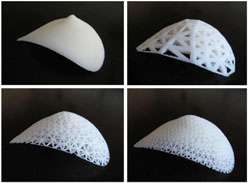
The CAD which created the moulds has also been used to create biodegradable 3D scaffolds, on which a patient's own tissue could be grown.
"When you think about the volume of a breast, to recreate this with randomly shaped tissue removed from elsewhere on a patient's body is quite difficult. Normally patients have two or three operations to enable the surgeon to correct and get the shape right," Professor Hutmacher said.
"With scaffolding you can get the shape and form right from the beginning, using a small amount of tissue - around one cubic centimetre - from the patient.
"The scaffold is biodegradable. After two to three years it will dissolve, whereas silicone implants, the most common material used in breast reconstruction surgery, stays forever and can cause a lot of long-term problems such as fibrous encapsulation."
Professor Hutmacher said that he is currently testing different materials for the scaffolding. The goal is to have this technology ready for clinical use in three to five years.
Provided by
Queensland University of Technology
-
Computer-aided design used for breast tissue reconstruction
Sep 08, 2011 |
not rated yet |
0
-
Advanced post-mastectomy breast reconstruction improves women's psychosocial and sexual well-being
Oct 24, 2011 |
not rated yet |
0
-
Researchers Use Adult Stem Cells to Create Soft Tissue
Jul 06, 2007 |
not rated yet |
0
-
Most breast cancer patients do not have breast reconstruction surgery
Oct 20, 2011 |
not rated yet |
0
-
Breast reconstruction advances fix distortions left by lumpectomy
Apr 23, 2008 |
not rated yet |
0
-
Of mice and mental models: Neuroscientific implications of risk-optimized behavior in the mouse
May 25, 2012 |
not rated yet |
0
-
Limits to growth: Scientists identify key metastasis-enabling enzyme
May 22, 2012 |
5 / 5 (4) |
0
-
Seeing is as seeing does: Spatially-structured retinal input in early development of cortical maps
Apr 26, 2012 |
5 / 5 (4) |
1
-
Dreamless nights: Brain activity during nonrapid eye movement sleep
Apr 09, 2012 |
4.4 / 5 (12) |
0
-
Take your time: Neurobiology sheds light on the superiority of spaced vs. massed learning
Mar 28, 2012 |
4.5 / 5 (21) |
3
-
Classical and Quantum Mechanics via Lie algebras
Apr 15, 2011
- More from Physics Forums - Independent Research
More news stories
Transvaginal mesh op restores pelvic organ prolapse at price
(HealthDay) -- Transvaginal mesh (TVM) procedures are effective for anatomical restoration of pelvic organ prolapse (POP), but patients report a worsening of sexual function following surgery, according to ...
Other
10 hours ago |
not rated yet |
0
Tongue analysis software uses ancient Chinese medicine to warn of disease
For 5,000 years, the Chinese have used a system of medicine based on the flow and balance of positive and negative energies in the body. In this system, the appearance of the tongue is one of the measures used to classify ...
Other
May 25, 2012 |
1 / 5 (1) |
0
|
Neck strength, cervical spine mobility don't predict pain
(HealthDay) -- Neither isometric neck muscle strength nor passive mobility of the cervical spine, two physical capacity parameters found to be associated with neck pain in other studies, predicts later neck ...
Other
May 25, 2012 |
not rated yet |
0
Pool access for the disabled sparks controversy
(AP) -- The Obama administration is sidestepping an election-year confrontation with the hotel industry and other pool owners to give them more time to comply with access rules for the disabled.
Other
May 25, 2012 |
not rated yet |
0
Chile to cover sex change operations
Chile will soon cover sex change surgeries under its public health plan in order to allow citizens of limited means to "recover their true sexual identity," Health Minister Jaime Manalich said.
Other
May 25, 2012 |
not rated yet |
0
Keep food safety in mind this memorial day weekend
(HealthDay) -- Picnics, parades and cookouts are as much a part of Memorial Day weekend as tributes to the United States' war veterans.
Travel to high altitudes tied to Crohn's, colitis flare-ups
(HealthDay) -- People with inflammatory bowel disease, which includes Crohn's disease and colitis, may be at increased risk for flare-ups when they fly or travel to high altitudes for skiing or mountain climbing, ...
Family history of Alzheimer's affects functional connectivity
(HealthDay) -- Cognitively normal individuals with a family history of late-onset Alzheimer's disease (AD) may display lower resting state functional connectivity in the default mode network (DMN) of the brain, ...
Of mice and mental models: Neuroscientific implications of risk-optimized behavior in the mouse
(Medical Xpress) -- Regardless of an organism’s biological complexity, every encephalized animal continuously makes under-informed behavioral choices that can have serious consequences. Despite its ubiquity, ...
Weight struggles? Blame new neurons in your hypothalamus
New nerve cells formed in a select part of the brain could hold considerable sway over how much you eat and consequently weigh, new animal research by Johns Hopkins scientists suggests in a study published in the May issue ...
Thioridazine kills cancer stem cells in human while avoiding toxic side-effects of conventional cancer treatments
A team of scientists at McMaster University has discovered a drug, thioridazine, successfully kills cancer stem cells in the human while avoiding the toxic side-effects of conventional cancer treatments.