No brakes on breast cancer cells
December 16, 2011 in Cancer
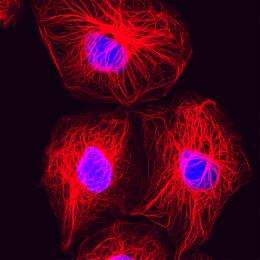
Breast cancer cells; proteins of the cytoskeleton are shown in red. Source: Lutz Langbein, German Cancer Research Center
Scientists of the German Cancer Research Center have discovered a tiny RNA molecule, called miR-520, which at once blocks two important pathways in the development of cancer in cells. In estrogen receptor-negative breast cancer, the production of this microRNA is often reduced and this is correlated with malignant behavior of tumor cells. The DKFZ team has found out that tumors with low levels of miR-520 have a particularly strong tendency to metastasize.
MicroRNAs or miRNAs are tiny RNA molecules that have only about 20 nucleotides and do not code for proteins. They regulate many important processes in cells by binding to target messenger RNAs the instructions for protein production , thus blocking production of the respective protein. In cancer, the production of some miRNAs is often reduced or amplified. This particularly affects miRNAs that regulate the activity of cancer-promoting genes.
A key molecule in the development of cancer is a transcription factor called NFkappaB, which is an important switch for many genes with inflammation-promoting effects. At DKFZ, Professor Dr. Stefan Wiemann and collaborators have now investigated whether microRNAs that affect NFkappaB production are deregulated in breast cancer. Jointly with colleagues at Heidelberg and Tuebingen University Hospitals, the DKFZ team studied over 800 miRNAs and discovered a family of RNA molecules known as miR-520, which particularly strongly reduce the production of NFkappaB. "If the cells produce less NFkappaB, the production of inflammation-promoting signaling molecules is reduced. This puts a brake on cancer growth, because these signaling molecules promote invasive capacity, formation of new vessels and metastasis," says Ioanna Keklikoglou, a doctoral student Wiemann's department, explaining this mechanism.
However, miR-520 does not only act like a cancer brake by suppressing NFkappaB. In addition, Wiemann's team discovered that this microRNA also blocks another cancer-promoting signaling pathway that is triggered by growth factor TGF-beta. TGF-beta signals cause malignant cells to be less firmly anchored in the tissue and, thus, better able to invade surrounding organs a characteristic feature of cancer cells.
Subsequently, the DKFZ researchers studied the question of whether the findings obtained in cancer cells in the culture dish are also involved in breast cancer. Studying tumor tissue samples of 76 patients, the team discovered that tumors which have already spread to the lymph nodes produce less miR-520 than those which have not yet spread. However, this connection was only found in tumors that do not produce receptors for the female sexual hormone, estrogen (ER-negative tumors).
"Our findings clearly demonstrate that miR-520 is a genuine cancer brake that suppresses the malignant behavior of tumor cells in two different ways at once," said Stefan Wiemann, commenting on the findings reported in his now published work. "This cancer brake appears to fail in many ER-negative breast tumors and also in cells of other types of cancer, as colleagues have now demonstrated." ER-negative breast cancer is particularly difficult to treat in many cases. Developing a microRNA therapy that blocks several cancer-promoting signaling pathways at once may therefore be an interesting option.
More information: I Keklikoglou, C Koerner, C Schmidt, JD Zhang, D Heckmann, A Shavinskaya, H Allgayer, B Gückel, T Fehm, A Schneeweiss, Ö Sahin, S Wiemann and U Tschulena: MicroRNA-520/373 family functions as a tumor suppressor in estrogen receptor negative breast cancer by targeting NF-kappaB and TGF-b signaling pathways. Oncogene 2011, DOI: 10.1038/onc.2011.571
Provided by
Helmholtz Association of German Research Centres
-
Too much of a good thing: Important mechanism in hormone-sensitive breast cancer uncovered
Nov 23, 2010 |
not rated yet |
0
-
Micro-RNA determines malignancy of lung cancer
Sep 08, 2010 |
not rated yet |
0
-
MicroRNA suppresses prostate cancer stem cells and metastasis
Jan 16, 2011 |
not rated yet |
0
-
Molecule blocks gene, sheds light on liver cancer
Aug 01, 2007 |
not rated yet |
0
-
Common cancer gene sends death order to tiny killer
May 31, 2007 |
not rated yet |
0
-
Of mice and mental models: Neuroscientific implications of risk-optimized behavior in the mouse
May 25, 2012 |
not rated yet |
0
-
Limits to growth: Scientists identify key metastasis-enabling enzyme
May 22, 2012 |
5 / 5 (4) |
0
-
Seeing is as seeing does: Spatially-structured retinal input in early development of cortical maps
Apr 26, 2012 |
5 / 5 (4) |
1
-
Dreamless nights: Brain activity during nonrapid eye movement sleep
Apr 09, 2012 |
4.4 / 5 (12) |
0
-
Take your time: Neurobiology sheds light on the superiority of spaced vs. massed learning
Mar 28, 2012 |
4.5 / 5 (21) |
3
-
Potential Breakthrough in Seizure Control
13 hours ago
-
Popping/Cracked sternum.
18 hours ago
-
Which Mental Illness Encompasses This Problem?
18 hours ago
-
A question about drug tolerance
May 23, 2012
-
Poor nutrition leading to overeating?
May 23, 2012
-
Math and dyslexia?
May 21, 2012
- More from Physics Forums - Medical Sciences
More news stories
Skp2 activates cancer-promoting, glucose-processing Akt
HER2 and its epidermal growth factor receptor cousins mobilize a specialized protein to activate a major player in cancer development and sugar metabolism, scientists report in the May 25 issue of Cell.
Cancer
May 25, 2012 |
not rated yet |
0
|
Pancreatectomy OK without downstaging from therapy
(HealthDay) -- Pancreatectomy improves median survival in pancreatic cancer patients even when presurgical neoadjuvant therapy does not lead to radiographic downstaging of tumors, according to a study published ...
Cancer
May 25, 2012 |
not rated yet |
0
Common therapies for basal cell carcinoma offer similar survival
(HealthDay) -- For patients with superficial basal cell carcinoma (sBCC), treatment with imiquimod or photodynamic therapy (PDT) results in similar long-term tumor-free survival, according to a review published ...
Cancer
May 25, 2012 |
not rated yet |
0
Cancer may require simpler genetic mutations than previously thought
Chromosomal deletions in DNA often involve just one of two gene copies inherited from either parent. But scientists haven't known how a deletion in one gene from one parent, called a "hemizygous" deletion, can contribute ...
Cancer
May 25, 2012 |
not rated yet |
0
|
New prostate cancer screening guidelines face a tough sell, study suggests
(Medical Xpress) -- Recent recommendations from the U.S. Preventive Services Task Force (USPSTF) advising elimination of routine prostate-specific antigen (PSA) screening for prostate cancer in healthy men are likely to encounter ...
Cancer
May 25, 2012 |
not rated yet |
1
Travel to high altitudes tied to Crohn's, colitis flare-ups
(HealthDay) -- People with inflammatory bowel disease, which includes Crohn's disease and colitis, may be at increased risk for flare-ups when they fly or travel to high altitudes for skiing or mountain climbing, ...
Family history of Alzheimer's affects functional connectivity
(HealthDay) -- Cognitively normal individuals with a family history of late-onset Alzheimer's disease (AD) may display lower resting state functional connectivity in the default mode network (DMN) of the brain, ...
Transvaginal mesh op restores pelvic organ prolapse at price
(HealthDay) -- Transvaginal mesh (TVM) procedures are effective for anatomical restoration of pelvic organ prolapse (POP), but patients report a worsening of sexual function following surgery, according to ...
Of mice and mental models: Neuroscientific implications of risk-optimized behavior in the mouse
(Medical Xpress) -- Regardless of an organism’s biological complexity, every encephalized animal continuously makes under-informed behavioral choices that can have serious consequences. Despite its ubiquity, ...
Weight struggles? Blame new neurons in your hypothalamus
New nerve cells formed in a select part of the brain could hold considerable sway over how much you eat and consequently weigh, new animal research by Johns Hopkins scientists suggests in a study published in the May issue ...
Thioridazine kills cancer stem cells in human while avoiding toxic side-effects of conventional cancer treatments
A team of scientists at McMaster University has discovered a drug, thioridazine, successfully kills cancer stem cells in the human while avoiding the toxic side-effects of conventional cancer treatments.