Study details how dengue infection hits harder the second time around
One of the most vexing challenges in the battle against dengue virus, a mosquito-borne virus responsible for 50-100 million infections every year, is that getting infected once can put people at greater risk for a more severe infection down the road.
Now, for the first time, an international team of researchers that includes experts from the University of California, Berkeley, has pulled apart the mechanism behind changing dengue virus genetics and dynamics of host immunity, and they are reporting their findings in the Dec. 21 issue of Science Translational Medicine.
The virus that causes dengue disease is divided into four closely related serotypes (dengue virus 1, 2, 3 and 4), and those serotypes can be further divided into genetic variants, or subtypes.
The researchers showed that a person's prior immune response to one serotype of dengue virus could influence the interaction with virus subtypes in a subsequent infection. How that interaction plays out could mean the difference between getting a mild fever and going into a fatal circulatory failure from dengue hemorrhagic fever or dengue shock syndrome.
The findings have implications for the efforts to combat a disease that has grown dramatically in recent decades, including the development of a first-ever dengue vaccine.
According to the World Health Organization, dengue disease is now endemic in more than 100 countries around the world, and recent estimates say some 3 billion people – almost half of the world's population – are at risk.
It was already known that upon a person's first infection with dengue virus, the immune system reacts normally by creating antibodies to fight the viral invaders. The problem is that those antibodies can then be confused if confronted later with one of the other three types of dengue virus, and as this new study revealed, even different subtypes within the same serotype.
"With the second infection, the antibodies sort of recognize the new type of viruses, but not well enough to clear them from the system," said study lead author Molly OhAinle, post-doctoral fellow in infectious diseases at UC Berkeley's School of Public Health. "Instead of neutralizing the viruses, the antibodies bind to them in a way that actually helps them invade the immune system's other cells and spread."
The study authors noted that this Trojan horse effect has been shown before, but the new research provides an analysis of the interplay between viral genetics and immune response with unprecedented detail, going beyond the main serotype.
Putting the puzzle pieces together required UC Berkeley's expertise in immunology and virology, the genome analysis and biostatistical capabilities at the Broad Institute of Harvard University and Massachusetts Institute of Technology, and the epidemiological and clinical field work at Nicaragua's National Virology Laboratory.
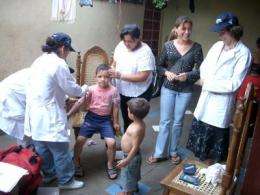
Researchers used data from two independent, Nicaragua-based studies headed by Eva Harris, professor of infectious diseases and vaccinology and director of UC Berkeley's Center for Global Public Health, and Dr. Angel Balmaseda, director of the National Virology Laboratory in Nicaragua. One was a hospital-based study that examined children admitted to the National Pediatric Reference hospital with dengue between 2005 and 2009. The other was a prospective study that had followed 3,800 children since 2004, with blood samples collected annually.
By following dengue cases in both studies, researchers were able to identify a dramatic increase in severe dengue disease and then sequence the virus across time. They detected genetic changes in the virus that coincided with changes in disease severity, but only in the context of pre-existing immune response to specific dengue virus serotypes.
They found that children who had antibodies to dengue virus 3, which circulated in the region from 1994-1998, were at greater risk for developing severe infections when exposed to subtype 2B of dengue virus 2. They also found that children who had antibodies to dengue virus 1, which circulated from 2002-2005, were also at increased risk of severe disease from exposure to subtype 1 of dengue virus 2 after an initial period of immunity wears off.
"We showed for dengue that both the subtype of virus you get infected with and whether your body has antibodies to another type of virus matter," said Matthew Henn, director of viral genomics at the Broad Institute. "If you get the wrong combination of the two, you are more likely to get severe disease. This study provides a framework we can utilize to eventually predict which specific virus types will proliferate in different human populations. We lacked a good model for this previously."
The researchers followed up with tests in the lab to confirm the complex interplay of viral genetics and immune system response.
Harris understands this risk on a personal level. She has been studying dengue in Nicaragua for 24 years, and in 1995, became infected with dengue virus type 3. That puts her at greater risk for a severe reaction should she become exposed to other dengue virus serotypes.
While no vaccine yet exists for dengue, Harris noted that the vaccines currently under development aim to immunize against all types of the virus.
"Our findings have implications for vaccine development and implementation, as the precise genetics of vaccine strains, as well as the timing and serotype sequence of infection prior to and after vaccination, play an important role in determining the outcome of infection," she said.
Harris added that this study benefitted from decades of productive collaboration between U.S. and Nicaraguan researchers. "It was the multi-disciplinary approach we took to analyzing two high-quality studies that allowed us to untangle this very complex phenomena," she said.
More information: OhAinle M, et al. Dynamics of Dengue Disease Severity Determined by the Interplay Between Viral Genetics and Serotype-Specific Immunity. Science Translational Medicine, December 21, 2011. DOI: 10.1126/scitranslmed.3003084


