Fish oil may hold key to leukemia cure
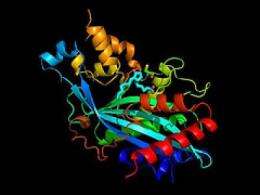
The compound shown above is D12-PGJ2, which closely resembles delta-12-protaglandin J3, or D12-PGJ3, a compound that targeted and killed the stem cells of chronic myelogenous leukemia, or CML, in mice during experiments conducted by Penn State researchers. According to the American Cancer Society, about 5,150 new cases of CML are reported annually and approximately 270 people die from the disease each year. Credit: Sandeep Prabhu
A compound produced from fish oil that appears to target leukemia stem cells could lead to a cure for the disease, according to Penn State researchers. The compound -- delta-12-protaglandin J3, or D12-PGJ3 -- targeted and killed the stem cells of chronic myelogenous leukemia, or CML, in mice, said Sandeep Prabhu, associate professor of immunology and molecular toxicology in the Department of Veterinary and Medical Sciences. The compound is produced from EPA -- Eicosapentaenoic Acid -- an Omega-3 fatty acid found in fish and in fish oil, he said.
"Research in the past on fatty acids has shown the health benefits of fatty acids on cardiovascular system and brain development, particularly in infants, but we have shown that some metabolites of Omega-3 have the ability to selectively kill the leukemia-causing stem cells in mice," said Prabhu. "The important thing is that the mice were completely cured of leukemia with no relapse."
The researchers, who released their findings in the current issue of Blood, said the compound kills cancer-causing stem cells in the mice's spleen and bone marrow. Specifically, it activates a gene -- p53 -- in the leukemia stem cell that programs the cell's own death. "p53 is a tumor suppressor gene that regulates the response to DNA damage and maintains genomic stability," Prabhu said.
Killing the stem cells in leukemia, a cancer of the white blood cells, is important because stem cells can divide and produce more cancer cells, as well as create more stem cells, Prabhu said.
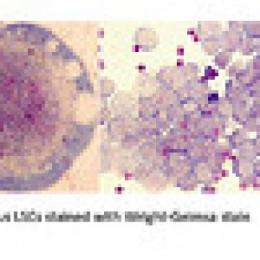
Penn State researchers initially tested a compound produced from fish oil on a type of leukemia found in mice called the Friend Virus. This slide shows a Friend Virus Leukemia Stem Cell. Learning how to target and kill leukemia stem cells is critical to finding a cure for leukemia. Credit: Robert Paulson
The current therapy for CML extends the patient's life by keeping the number of leukemia cells low, but the drugs fail to completely cure the disease because they do not target leukemia stem cells, said Robert Paulson, associate professor of veterinary and biomedical sciences, who co-directed this research with Prabhu."The patients must take the drugs continuously," said Paulson. "If they stop, the disease relapses because the leukemia stem cells are resistant to the drugs."
Current treatments are unable to kill the leukemia stem cells, Paulson noted. "These stem cells can hide from the treatment, and a small population of stem cells give rise to more leukemia cells," said Paulson. "So, targeting the stem cells is essential if you want to cure leukemia."
During the experiments, the researchers injected each mouse with about 600 nanograms of D12-PGJ3 each day for a week. Tests showed that the mice were completely cured of the disease. The blood count was normal, and the spleen returned to normal size. The disease did not relapse.
In previous experiments, the compound also killed the stem cells of Friend Virus-induced leukemia, an experimental model for human leukemia.
The researchers focused on D12-PGJ3 because it killed the leukemia stem cells, but had the least number of side effects. The researchers currently are working to determine whether the compound can be used to treat the terminal stage of CML, referred to as Blast Crisis. There are currently no drugs available that can treat the disease when it progresses to this stage.
More information: Researchers have uncovered what cells respond to anesthesia in an organism known as the C. elegans, according to a new study from the Seattle Children's Research Institute.
Provided by
Pennsylvania State University
-
A lethal cancer knocked down by one-two drug punch
Jun 07, 2009 |
not rated yet |
0
-
Combination therapy targets stubborn leukemia stem cells
May 17, 2010 |
not rated yet |
0
-
Study: How some cancers become leukemia
Jul 17, 2006 |
not rated yet |
0
-
A potential new way to make a good anti-leukemia drug even better
Oct 20, 2008 |
not rated yet |
0
-
Tracking down the origin of leukemia relapse
Apr 04, 2011 |
not rated yet |
0
-
Motion perception revisited: High Phi effect challenges established motion perception assumptions
Apr 23, 2013 |
3 / 5 (2) |
2
-
Anything you can do I can do better: Neuromolecular foundations of the superiority illusion (Update)
Apr 02, 2013 |
4.5 / 5 (11) |
5
-
The visual system as economist: Neural resource allocation in visual adaptation
Mar 30, 2013 |
5 / 5 (2) |
9
-
Separate lives: Neuronal and organismal lifespans decoupled
Mar 27, 2013 |
4.9 / 5 (8) |
0
-
Sizing things up: The evolutionary neurobiology of scale invariance
Feb 28, 2013 |
4.8 / 5 (10) |
14
-
How can there be villous adenoma in colon, if there are no villi there
19 hours ago
-
How can there be a term called "intestinal metaplasia" of stomach
May 21, 2013
-
Pressure-volume curve: Elastic Recoil Pressure don't make sense
May 18, 2013
-
If you became brain-dead, would you want them to pull the plug?
May 17, 2013
-
MRI bill question
May 15, 2013
-
Ratio of Hydrogen of Oxygen in Dessicated Animal Protein
May 13, 2013
- More from Physics Forums - Medical Sciences
More news stories
American cancer society celebrates 100 years of progress
(HealthDay)—The American Cancer Society, which is celebrating on Wednesday a century of fighting a disease once viewed as a death sentence, is making a pledge to put itself out of business.
Cancer
9 hours ago |
not rated yet |
0
CT detects twice as many lung cancers as X-ray at initial screening exam
National Lung Screening Trial (NLST) investigators also conclude that the 20 percent reduction in lung cancer mortality with low-dose computed tomography (LDCT) versus chest X-ray (CXR) screening previously reported in the ...
Cancer
10 hours ago |
not rated yet |
0
Research offers promising new approach to treatment of lung cancer
Researchers have developed a new drug delivery system that allows inhalation of chemotherapeutic drugs to help treat lung cancer, and in laboratory and animal tests it appears to reduce the systemic damage ...
Cancer
13 hours ago |
not rated yet |
0
|
Study details genes that control whether tumors adapt or die when faced with p53 activating drugs
When turned on, the gene p53 turns off cancer. However, when existing drugs boost p53, only a few tumors die – the rest resist the challenge. A study published in the journal Cell Reports shows how: tumors that live even i ...
Cancer
13 hours ago |
not rated yet |
0
|
Small increase in cancer risk following CT scans in childhood and adolescence
Study leader, Professor John Mathews from the University of Melbourne said this small increase in cancer risk must be weighed against the undoubted benefits from CT scans in diagnosing and monitoring disease.
Cancer
17 hours ago |
not rated yet |
0
Slowing the aging process—only with antibiotics
Swiss scientists reveal the mechanism responsible for aging hidden deep within mitochondria—and dramatically slow it down in worms by administering antibiotics to the young.
Rate of bicycle-related fatalities significantly lower in states with helmet laws
Existing research shows that bicyclists who wear helmets have an 88 percent lower risk of brain injury, but researchers at Boston Children's Hospital found that simply having bicycle helmet laws in place showed a 20 percent ...
Researchers complete largest genetic sequencing study of human disease
Researchers from Queen Mary, University of London have led the largest sequencing study of human disease to date, investigating the genetic basis of six autoimmune diseases.
Brain can be trained in compassion, study shows
Until now, little was scientifically known about the human potential to cultivate compassion—the emotional state of caring for people who are suffering in a way that motivates altruistic behavior.
Having both migraines, depression may mean smaller brain
(HealthDay)—Migraines and depression can each cause a great deal of suffering, but new research indicates the combination of the two may be linked to something else entirely—a smaller brain.
Novel approach for influenza vaccination shows promise in early animal testing
A new approach for immunizing against influenza elicited a more potent immune response and broader protection than the currently licensed seasonal influenza vaccines when tested in mice and ferrets. The vaccine ...

Dec 22, 2011
Rank: not rated yet