Habit formation is enabled by gateway to brain cells
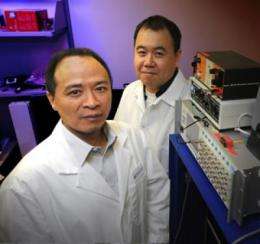
A brain cell type found where habits are formed and movement is controlled has receptors that work like computer processors to translate regular activities into habits, researchers report.
"Habits, for better or worse, basically define who we are," said Dr. Joe Z. Tsien, Co-Director of the Brain & Behavior Discovery Institute at Georgia Health Sciences University. Habits also provide mental freedom and flexibility by enabling many activities to be on autopilot while the brain focuses on more urgent matters, he said.
Research published in the journal Neuron shows that NMDA receptors on dopamine neurons in the brain's basal ganglia are essential to habit formation. These receptors function like gateways to the brain cells, letting in electrically charged ions to increase the activity and communication of neurons. Their pivotal role reminds neuroscientist Dr. Lei Phillip Wang of a computer's central processing unit. "The NMDA receptor is a commander, which is why it's called a master switch for brain cell connectivity," said Wang, the study's first author.
To determine their role in habit formation, GHSU researchers used a genetic trick to selectively disable the NMDA receptors on dopamine neurons and found, for example, mice could be trained to push a lever for food without it becoming an automatic response. If they were full, they wouldn't push the lever. But just as humans can't refrain from flipping a light switch during a power outage, satiated mice with receptors could not pass up the lever.
When they compared the firing of the dopamine neurons in regular versus the mutant mouse, they found a dramatic spike in response to a cue that signals food in the normal mouse and a significantly dampened one in the mutant, Wang said. "We think this reduced response is probably sufficient for other types of learning, but not for habit learning," he said.
The finding that the receptors are critical to turning learned behavior into a habit provides new direction for therapy to better treat diseases such as Parkinson's, which in addition to the hallmark shaking, causes the loss of some old habits and impedes the ability to make new ones. "When Parkinson's disease begins to kick in, your memory of habits begins to go away, often before the uncontrolled movement becomes prominent," Tsien said.
It also opens the door to speeding up the process of forming good habits and, possibly, selectively removing bad ones such as drug addiction or smoking since the same circuits are seemingly involved in both.
"If you know cell circuits controlling a specific habit, it puts you in a better position to devise strategies to hit different points and selectively facilitate the formation of a good habit and maybe even reverse a bad one," Tsien said.
The fact that their mutant mice did not have motor deficits like Parkinson's patients fits with the fact that a precursor to dopamine can reduce motor symptoms in these patients, at least for a while, but does little to help cognitive function, Tsien said. Previous research indicating that just dousing a brain with dopamine doesn't rescue the ability to form habits led GHSU researchers to pursue the more sophisticated regulation that must enable habit formation.
"Dopamine neurons regulate circuits all over the brain but they need to be regulated too," Tsien said. "The questions become how and whether regulation of dopamine neurons is important. Our study shows it's important and it's through the NMDA receptors." Part of that regulation includes proper sequencing: so a habit plays out the same way every time, Tsien noted, much like standard lettering on a keyboard enables typing rather than confusion.
Dopamine is a chemical that helps brain cells communication. Glutamate, another neurotransmitter, brings information to the dopamine neurons to enable learning and memory but the neurons must travel through the gateway NMDA receptors to get properly categorized, the researchers noted.
As pervasive and efficient as habits are, these automatic memories that enable driving a car or typing, are not well studied or understood. "We tend not to pay attention to them because they are so spontaneous and automatic," said Tsien. GHSU scientists want to better understand why, for example, certain actions move from purposeful acts to automatic ones. They also want to know if one way NMDA receptors work is by causing dopamine neurons to release dopamine at the right time, amount and places in the brain.
Habits are generally characterized as procedural rather than declarative memories, such as those of events, people and places, things that require active thought. Declarative memories are more typically lost in Alzheimer's while habits often remain intact, at least for a while.


