How do we learn to speak and read?
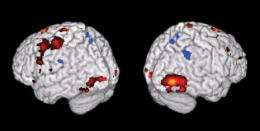
Do you remember how you learned to speak? Most people do not recall learning how to talk, or know how it is that they can understand others. The process involves a complex coordination of moving air from our lungs in coordination with the larynx, palate, jaw, tongue, and lips to form vowels and consonants that express a thought originating in the neural network of the brain.
You may recall the difficult process of learning how to read – associating a letter of the alphabet with a sound and then putting letters together to form words and sentences. In comparison, learning to speak may seem to come to us more naturally.
Ultimately, finding the answers behind how we learn to speak and read could help those who have an impaired ability to speak or understand others, as well as assist those who have difficulty learning to read and write.
UConn’s Experts
UConn faculty and alumni associated with world-renowned Haskins Laboratories in New Haven, Conn., have been working on the science of the spoken and written word for more than four decades. Founded in 1935 by Caryl Haskins and Franklin Cooper, Haskins is an independent, interdisciplinary research center affiliated with UConn and Yale University.
“We have a literacy crisis in this country,” says Philip Rubin ’73 MA, ’75 Ph.D., Haskins chief executive officer and former director of the Division of Behavioral and Cognitive Sciences at the National Science Foundation. “Many of our kids struggle with reading. At the heart, what we do is address those that are struggling. What makes them different than kids who don’t struggle … is the kind of work that we’re doing.”
The National Center for Educational Statistics says about 22 percent of adults in the United States have “minimal literacy skills,” meaning that they can read some words but cannot understand simple forms, such as a job application, or instructions, such as how to operate a computer.
Haskins researchers have been responsible for major scientific advances in speech and reading, including the development of the first reading machine for the blind, which ultimately led to the synthesis of artificial speech in computers. One of the scientists who conducted early research on the device was the late Alvin Liberman, a psychologist who served as director of Haskins for a decade and helped create the Department of Linguistics in the College of Liberal Arts and Sciences (CLAS) in Storrs. Liberman and Donald Shankweiler, professor emeritus of psychology in CLAS, collaborated with other Haskins colleagues in 1967 to produce “Perception of the Speech Code,” a landmark study published in Psychological Review that remains among the most cited papers in the literature of psychology.
“Haskins Labs in the 1950s was beginning to ask the question: What are the bits of sound, physical sound, that are conveying consonants and vowels?” says Shankweiler. “That was not an easy question to answer. Speech recognition is still less than perfect, but it depended very much on the research done at Haskins Labs over the past 40 to 50 years.”
Shankweiler says the link between speech and reading results in literacy, which provides the key to unlocking the ability to learn. “One of the main advantages of reading is that we are not limited by the speech we hear,” he says. “We extend our knowledge through print. A scholar will learn more through print than the spoken word. It’s a way to expand our use of language to increase knowledge.”
Talking Shop
With speech and reading research at the core of Haskins, its scientists have expanded their investigations to include the neural basis of reading development, examination of “birth-to-five” development through a Child Language Studies Laboratory, and increased attention to the cognitive and neurobiological foundations of bilingualism.
“You can do things in this place that you can’t do elsewhere; it’s really an interdisciplinary model,” says Kenneth Pugh, president and director of research, who also serves as a psychology professor in CLAS. “It provides an opportunity for researchers to be involved with really good technology. It’s a very good resource for UConn graduate students and faculty.”
The strength of the connection between the University and Haskins is evident by the cadre of graduate students who have been drawn to Storrs by the opportunity to associate with pioneering faculty researchers that include the late Isabelle Liberman, professor of educational psychology and an authority on reading disabilities, and the late Ignatius Mattingly, professor of linguistics who conducted groundbreaking research on speech synthesis; as well as Michael T. Turvey, Board of Trustees Distinguished Professor of Psychology Emeritus and director of the Center for the Ecological Study of Perception and Action, and Leonard Katz, professor of psychology emeritus in the Department of Psychology.
“It’s tremendously energizing,” says Turvey of the collegial discussions between faculty and students focused on their research. “It’s not just happening when we’re in the laboratories. We’re doing this on Friday night in the pub. The most important graduate students tend to come from UConn.”
Additional audio:
For many of those graduate students, Haskins is where they were mentored and encouraged to continue their research, leading to their own independent research and careers as scientists. While a graduate student in Storrs, Julia Irwin ’98 Ph.D. was nominated to become a Haskins research assistant. She and other UConn students would carpool from Storrs to New Haven each week to work on their projects, a tradition that continues today.
“I came here as a very low-level research assistant and was mentored by a number of UConn faculty and Haskins scientists,” says Irwin, now an assistant professor of psychology at Southern Connecticut State University and senior scientist at Haskins, whose research focuses on the role of the face in audiovisual speech perception. “I’m getting at the very fundamental level of speech sound. When there is a face that accompanies a voice, it’s pretty heavily used. What I’ve argued is that when people are speaking, there’s tons of information on the face.”
Carol Fowler ’73 MA, ’77 Ph.D. first learned of Alvin Liberman’s work as an undergraduate at Brown and became interested in the relation of speech production to speech perception and how phonemes – the smallest segments of speech that distinguish one word from another in a given language – work. Her 1983 paper published in the Journal of Experimental Psychology on how vowels are produced as part of the rhythm of speech, broke new ground in the field.
“We need to understand what it is about the language system that gives it the power that it has,” says Fowler, a former president and director of research at Haskins. “Why can we talk about anything we can think about? Why can we understand sentences we have never heard before in our lives? Why can we generate sentences we’ve never said before in our lives and expect others to understand them?”


