Stopping influenza evolution before it starts
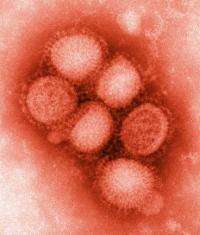
If you get vaccinated against the flu and then become infected with the virus, your body mounts an immune response that prevents you from getting sick. However, that pressure from the immune system can provoke the virus to mutate into a slightly different form — one that could be more infectious.
A new study from MIT reveals the mechanism behind this phenomenon, known as antigenic drift. The researchers, led by Ram Sasisekharan, analyzed the network of amino acids that make up the viral protein hemagglutinin and identified which amino acids are most likely to undergo mutations that improve the viruses’ ability to infect new hosts.
This knowledge could help flu-vaccine designers produce vaccines that don’t induce the evolution of fitter viruses, says Sasisekharan, the Edward Hood Taplin Professor of Health Sciences and Technology and Biological Engineering at MIT, director of the Harvard-MIT Division of Health Sciences and Technology and senior author of a paper on the work appearing in the Dec. 19 online edition of Scientific Reports, an open-access journal published by Nature.
New influenza strains are constantly emerging, so the World Health Organization scours the globe for new strains that should be included in the seasonal influenza vaccine, which is reformulated every year.
Those vaccines stimulate production of antibodies that target a section of the hemagglutinin (HA) protein known as the antigenic site. In 2009, Sasisekharan and researchers at the National Institute of Allergy and Infectious Diseases (NIAID) reported that when a virus encounters such antibodies, it can evolve into a slightly altered strain that can spread to people who have not been vaccinated.
Some of those new strains bind more tightly to receptors found on the surfaces of cells in the respiratory tract of potential flu victims, making them more infectious. This finding puzzled flu researchers because the antigenic site, where the mutations occurred, is far from the HA site where receptor binding takes place. Funded by the National Institutes of Health and the Singapore-MIT Alliance for Research and Technology, Sasisekharan and his colleagues at MIT set out to solve the mystery by analyzing the interactions between the amino acids that make up viral hemagglutinin.
HA, like all proteins, is made of a long chain of amino acids. Those chains twist themselves into complicated structures determined by the interactions between amino acids. The MIT team used an approach called network analysis to examine how each amino acid interacts with every other amino acid in the protein, which is determined by the electric charges and other properties of atoms within the amino acids.
The resulting model yielded data on how strongly each amino acid is linked to others in the protein. The researchers focused on amino acids in the antigenic region, and found that the more highly they were linked to amino acids in the receptor-binding region, the more likely they were to change receptor-binding affinity upon mutating. Weakly linked amino acids in the antigen region were found not to alter receptor binding upon mutation. This provides insight into the mechanism of how selection pressure due to vaccination could contribute to the evolution of fitter influenza strains by producing better-binding HA proteins and hence fitter viruses.
The previous MIT/NIAID study concluded that the more people that get vaccinated, the less opportunity there is for influenza “escape mutants” to spread through the population. “Incomplete vaccination could be causing a lot of these problems and therefore effective vaccinations are key to limiting drift,” Sasisekharan says.
The study represents an innovative approach to understanding how viral proteins evolve in response to immune system pressure, says David Topham, a professor of immunology and microbiology at the University of Rochester School of Medicine. “The idea that hemagglutinin can only accommodate certain mutations without losing fitness is not a new one, but what this paper gives us is a way to understand how changes in distant amino acids affect receptor binding,” says Topham, who was not involved in this research.
Now that there is a way to predict which amino acids are most likely to mutate into a more infectious form, vaccine designers could create vaccines that don’t provoke such mutations, Sasisekharan says. “This understanding of the relationship between the antigenic site and the receptor-binding site could be added to the current methods of vaccine selection and vaccine designs to limit drift,” he says. Continued analysis of circulating influenza HA sequences can potentially accelerate and help in the design of ideal vaccines for each flu season.
This story is republished courtesy of MIT News (web.mit.edu/newsoffice/), a popular site that covers news about MIT research, innovation and teaching.


