Do our medicines boost pathogens?
December 21, 2011 in Diseases, Conditions, Syndromes
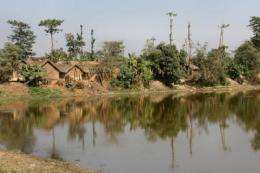
This is a typical village in the Siraha district, Nepal, where leishmaniasis is endemic. Credit: © ITG
Scientists of the Institute of Tropical Medicine (ITG) discovered a parasite that not only had developed resistance against a common medicine, but at the same time had become better in withstanding the human immune system. With some exaggeration: medical practice helped in developing a superbug. For it appears the battle against the drug also armed the bug better against its host. "To our knowledge it is the first time such a doubly armed organism appears in nature", says researcher Manu Vanaerschot, who obtained a PhD for his detective work at ITG and Antwerp University. "It certainly makes you think."
Vanaerschot studies the Leishmania parasite, a unicellular organism that has amazed scientists before. Leishmania is an expert in adaptation to different environments, and the only known organism in nature disregarding a basic rule of biology: that chromosomes ought to come in pairs. (The latter was also discovered by ITG-scientists recently.)
The parasite causes Leishmaniasis, one of the most important parasitic diseases after malaria. It hits some two million people, in 88 countries including European ones and yearly kills fifty thousand of them. The parasite is transmitted by the bite of a sand fly. The combined resistance against a medicine and the human immune system emerged in Leishmania donovani, the species causing the deadly form of the disease.
On the Indian subcontinent, where most cases occur, the disease was treated for decades with antimony compounds. As was to be expected, the parasite adapted to the constant drug pressure, and evolved into a form resisting the antimonials. In 2006 the treatment was switched to another medicine, because two patients out of three did not respond to the treatment. The antimonials closely work together with the human immune system to kill the parasite. This probably has given Leishmania donovani the opportunity to arm itself against both. It not only became resistant against the drug, but also resists better to the macrophages of its host. Macrophages are important cells of our immune system.
There is no absolute proof yet (among other things, because one obviously cannot experiment on humans) but everything suggests that resistant Leishmania not only survive better in humans have a higher "fitness" but also are better at making people ill have a higher "virulence" than their non-resistant counterparts.
Superbug?
It is the first time that science finds an organism that always benefits from its resistance. Normally resistance is only useful when a pathogen is bombarded by drugs; the rest of the time it is detrimental to the organism.
Resistant organisms are a real problem to medicine. More and more pathogens become resistant to our drugs and antibiotics to a large extend because you and I use them too lavishly and improperly. For several microbes, the arsenal of available drugs and antibiotics has so diminished that people may die again from pneumonia, or even from ulcerating wounds.
Luckily for us, resistance helps pathogens only in a drug-filled environment. In the open field their resistance is a disadvantage to them, because they have to invest energy and resources into a property with no use there. Just like a suit of armour is quite useful on the battle field, but a real nuisance the rest of the time.
So the propagation of resistant organisms is substantially slowed down because they are at a disadvantage outside of sick rooms. But this rule, too, is violated by Leishmania: even in absence of the drug, the resistant parasite survives better, instead of worse, and it is more virulent than a non-resistant parasite.
Did our medicines create a superbug? A legitimate question, and the phenomenon has to be investigated, but this sole case doesn't imply we better stop developing new medicines (as a matter of fact, the antimony-resistant Leishmania are still susceptible to a more recent drug, miltefosine). On the contrary, we should develop more new drugs, to give new answers to the adaptive strategies of pathogens, and we should protect those drugs, for instance by using them in combination therapies. In this never-ending arms race we should use our drugs wisely, to minimise the chances for pathogens to develop resistance.
Provided by Institute of Tropical Medicine Antwerp
-
What parasites eat is the key to better drug design
Aug 04, 2011 |
not rated yet |
0
-
New insight in the fight against the Leishmania parasite
Oct 23, 2009 |
not rated yet |
0
-
Different paths to drug resistance in Leishmania
Oct 27, 2011 |
not rated yet |
0
-
Aggressive drug therapy aids superbug evolution
Aug 03, 2011 |
not rated yet |
0
-
Major discovery opens door to leishmania treatment
Oct 06, 2009 |
not rated yet |
0
-
Motion perception revisited: High Phi effect challenges established motion perception assumptions
Apr 23, 2013 |
3 / 5 (2) |
2
-
Anything you can do I can do better: Neuromolecular foundations of the superiority illusion (Update)
Apr 02, 2013 |
4.5 / 5 (11) |
5
-
The visual system as economist: Neural resource allocation in visual adaptation
Mar 30, 2013 |
5 / 5 (2) |
9
-
Separate lives: Neuronal and organismal lifespans decoupled
Mar 27, 2013 |
4.9 / 5 (8) |
0
-
Sizing things up: The evolutionary neurobiology of scale invariance
Feb 28, 2013 |
4.8 / 5 (10) |
14
-
Classical and Quantum Mechanics via Lie algebras
Apr 15, 2011
- More from Physics Forums - Independent Research
More news stories
Report: NPS hantavirus response followed policy
(AP)—Federal investigators probing the hantavirus outbreak blamed for three deaths at Yosemite National Park recommend that design changes to tent cabins and other lodging run by private concessionaires first be reviewed ...
Diseases, Conditions, Syndromes
3 hours ago |
not rated yet |
0
New test better detects elephantiasis worm infection
A new diagnostic test for a worm infection that can lead to severe enlargement and deformities of the legs and genitals is far more sensitive than the currently used test, according to results of a field ...
Diseases, Conditions, Syndromes
4 hours ago |
not rated yet |
0
|
SARS-like virus claims new life in Saudi
A Saudi man who had contracted the coronavirus has died, raising the death toll in the kingdom from the SARS-like virus to 16, the health ministry announced on Monday on its Internet website.
Diseases, Conditions, Syndromes
5 hours ago |
not rated yet |
0
Telerehabilitation allows accurate assessment of patients with low back pain
A new "telerehabilitation" approach lets physical therapists assess patients with low back pain (LBP) over the Internet, with good accuracy compared with face-to-face examinations, reports a study in the May 15 issue of Sp ...
Diseases, Conditions, Syndromes
6 hours ago |
not rated yet |
0
Bronchodilators appear associated with increased risk of cardiovascular events
A study of older patients with chronic obstructive pulmonary disease (COPD) suggests that new use of the long-acting bronchodilators β-agonists and anticholinergics was associated with similar increased risks of cardiovascular ...
Diseases, Conditions, Syndromes
6 hours ago |
not rated yet |
0
The compound in the Mediterranean diet that makes cancer cells 'mortal'
New research suggests that a compound abundant in the Mediterranean diet takes away cancer cells' "superpower" to escape death. By altering a very specific step in gene regulation, this compound essentially re-educates cancer ...
Do salamanders hold the solution to regeneration?
Salamanders' immune systems are key to their remarkable ability to regrow limbs, and could also underpin their ability to regenerate spinal cords, brain tissue and even parts of their hearts, scientists have ...
Scientists identify molecular trigger for Alzheimer's disease
Researchers have pinpointed a catalytic trigger for the onset of Alzheimer's disease – when the fundamental structure of a protein molecule changes to cause a chain reaction that leads to the death of neurons ...
Practice makes perfect? Not so much
Turns out, that old "practice makes perfect" adage may be overblown. New research led by Michigan State University's Zach Hambrick finds that a copious amount of practice is not enough to explain why people ...
Older prostate cancer patients should think twice before undergoing treatment
Older prostate cancer patients with other underlying health conditions should think twice before committing to surgery or radiation therapy for their cancer, according to a multicenter study led by researchers in the UCLA ...
New immune system discovered
(Medical Xpress)—A research team, led by Jeremy Barr, a biology post-doctoral fellow, unveils a new immune system that protects humans and animals from infection.