Neuroscientists visualize neural circuitry at once-unattainable depths
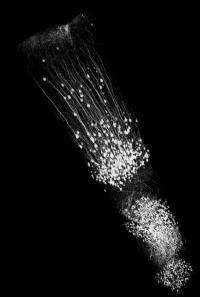
A recent breakthrough in biological sample preparation by scientists at the RIKEN Brain Science Institute in Wako may give Astro Boy’s ‘x-ray vision’ a run for its money. By treating tissue samples with an easy-to-prepare mix of chemicals, Atsushi Miyawaki, Hiroshi Hama and their colleagues can render the brain and other tissues as clear as glass, a reversible transformation that gives researchers an unobstructed view of fluorescently labeled cells residing within1.
For decades, the limits of available technology have thwarted attempts to map the dizzying twists and turns of the brain. Neuroscientists have achieved some success in simpler organisms, such as the worm or fly, by using tiny blades to sequentially peel off ultrathin strips of tissue, which can then be imaged via electron microscopy and reassembled computationally. However, this approach is far too labor-intensive and time-consuming for the reconstruction of a system as complex as the mammalian nervous system.
More recent breakthroughs in optical microscopy technology and a rapidly growing arsenal of multi-colored fluorescent proteins have given researchers potent new tools for brain mapping. By restricting the expression of specific fluorescent labels to particular subsets of cells, one can clearly visualize neural circuits within their natural, three-dimensional context; however, the dense tissue of the brain tends to scatter light, limiting the depth to which such imaging strategies can penetrate.
Several research groups have developed ‘clearing agents’ that improve the transparency of biological samples, such as benzyl-alcohol/benzyl-benzoate (BABB) and a proprietary solution known as FocusClear, but each suffers important limitations. “BABB is an organic solvent that requires dehydration of samples to be cleared,” says Miyawaki. He adds that such treatment can greatly diminish overall sample fluorescence, “and FocusClear does not clear mouse brain samples [readily].” Accordingly, his team’s development of the reagent they call ‘Scale’ could open new frontiers in mouse brain imaging.
Going deeper
Scale initially emerged from the unexpected, chance observation that membranes composed of the material polyvinylidene fluoride, which normally resemble sheets of white paper, become completely transparent when soaked in a high-concentration urea solution. By tinkering with this solution, Miyawaki and colleagues arrived at ScaleA2, a mixture that achieves the same feat with biological tissues.
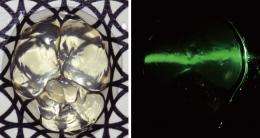
ScaleA2 can render a mouse brain essentially transparent within two weeks (Fig. 1). This treatment also causes the tissue to swell as a result of water uptake, but the researchers determined that specimens maintain their overall shape and proportions, suggesting that this expansion does not significantly affect the arrangement of the cellular structures being imaged.
In an initial test of their imaging approach, Miyawaki and colleagues found that cells within ScaleA2-treated samples fully retained their fluorescent labels, while tissues treated with BABB yielded greatly diminished signal. More importantly, the transparency induced by ScaleA2 allowed the researchers to visualize far deeper within the brain than before, even when using standard ‘one-photon’ microscopic approaches that are typically vulnerable to scattering and background image interference.
“Although the imaging depth limit of two-photon excitation fluorescence microscopy is usually around 0.7 millimeters in the brain, we were able to image fluorescent neurons with Scale down to a depth of 2 millimeters below the brain surface,” says Miyawaki. By designing a specialized microscope lens, they were able to penetrate still farther, to an unprecedented working distance of 4 millimeters below the brain surface (Fig. 2). The level of detail obtained with ScaleA2 proved sufficient for the researchers to map axonal connections between neurons in the corpus callosum, the bridge between the brain’s hemispheres, and also allowed them to analyze the interaction between neural stem cells and the vasculature within the developing mouse brain.
Since not all specimens are created equal, Miyawaki and colleagues also experimented with alternative Scale formulations for specialized imaging applications. One of these, ScaleU2, necessitates longer sample incubation, but results in less tissue expansion so may offer advantages for use with embryonic samples or other fragile tissues. In a preliminary experiment on 13.5-day-old mouse embryos, the researchers used ScaleU2 to visualize regions of active cell division in the diencephalon—a part of the forebrain.
Importantly, the effects of Scale treatment proved fully reversible, and samples that had recovered from clearing proved indistinguishable from their uncleared counterparts, reaffirming the minimal impact of this treatment on tissue structure.
A clear view of the future
Some researchers have designed especially ambitious strategies for neural circuit mapping, such as the ‘Brainbow’ mouse developed at Harvard Medical School, which combines large numbers of different fluorescent proteins to turn the mouse brain into a dazzling light show in which virtually every neuron stands out clearly from its neighbors. Miyawaki believes Scale should prove highly complementary to such efforts. “All the fluorescent proteins we’ve tested so far are resistant to high concentrations of urea, and should be usable,” he says, “and so this approach should be compatible with Brainbow.”
His team is already engaged in collaborations to apply Scale to targeted investigations in mice. Although the work described to date has focused on genetically expressed fluorescent markers, this approach should also be compatible with other labeling methodologies. Once such techniques have been developed, Scale should prove effective for working with larger tissue samples obtained from species that are not readily amenable to genetic modification, such as primates.
The biggest limitation seen by Miyawaki at present is the need to work with ‘dead’ tissue, but he suggests that even this may change. “Scale is currently limited to fixed biological samples,” he says, “but at some point in the future, there may be ‘live Scale’.”


