Personalising the use of chemotherapy in breast cancer treatment
December 15, 2011 in Cancer

Personalising the use of chemotherapy in breast cancer treatment

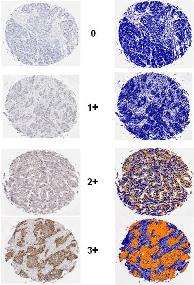
Manual and automated immunohistochemical analysis of CART expression. Immunohistochemical analysis of primary breast cancer with corresponding markup images of automated algorithm used to quantify CART expression. Stromal tissue is mapped in blue on the markup image, and CART expression is mapped on an increasing scale from yellow (low levels of expression) to red (high levels of expression). For manual analysis, CART expression is in brown, with stromal tissue counterstained in purple.

(Medical Xpress) -- UCD researchers have identified a novel biomarker that can identify those women with breast cancer who will have a poor response to tamoxifen, one of the principle anti-hormone drugs used to treat the disease. This may allow clinicians to tailor the treatment of early stage breast cancer patients appropriately.

Conway Fellow, Professor William Gallagher and his team who form part of the Science Foundation Ireland-funded strategic research cluster, Molecular Therapeutics for Cancer Ireland (MTCI), examined the breast cancers of over 1,000 patients. They found that those with high levels of a protein named CART (cocaine-and-amphetamine-regulated transcript) had a significantly poorer outcome when treated with compared to those patients with zero or low levels of the protein.

Tamoxifen works by blocking the growth-promoting action of oestrogen in cells. The results of this research published in a leading scientific journal, Oncogene, describes how CART can intervene and prevent tamoxifen from killing the cancer cells. Commenting on the findings, Dr Darran O’Connor, senior scientist and joint lead author of the research said, “Identifying early stage breast who need additional chemotherapy is a matter of intense clinical interest. We believe that CART profiling will facilitate the stratification of lymph node-negative breast cancer patients into high- and low-risk categories and allow for the personalisation of therapy.”

Dr Donal Brennan, UCD School of Medicine,  National Maternity Hospital and joint lead author of the work added, “We clearly demonstrate that both pre- and post-menopausal, early stage with high CART expressing tumours have a poor outcome and do not respond well to treatment with tamoxifen. Due to this, we believe that they should receive aggressive adjuvant chemotherapy.”

At present, women diagnosed with early stage, hormone receptor-positive, lymph node-negative breast cancer undergo surgery coupled with anti-hormone therapy and chemotherapy. However, current research suggests that many patients would do equally well with surgery and anti-hormone therapy without the addition of debilitating chemotherapeutic regimens.

The findings of the UCD team, in collaboration with colleagues at Lund University in Sweden, could help clinicians to accurately identify those patients who do not require chemotherapy and for whom surgery and anti-hormone therapy alone is sufficient to treat their cancer. In addition to improving the patients’ quality of life, this can also reduce the economic burden associated with unnecessary supplementary treatment. 

While CART has been widely studied in other areas as a key regulator of body weight and the body’s response to drugs such as cocaine, the researchers are the first to demonstrate a link with breast cancer.

Looking to the future for this research, Professor William Gallagher, associate professor of cancer biology, founder and chief scientific officer of Oncomark, a UCD molecular diagnostics spin-out company said, “As translational researchers, our goal is to bring our findings from the laboratory into the clinic. Our intention now is to develop a clinically approved test so that we can identify those patients who will benefit most from tailoring their therapy based upon the CART status of their cancer”.

Provided by University College Dublin

not rated yet  

Rank not rated yet
Relevant PhysicsForums posts

More news stories

New fluorescent tools for cancer diagnosis

In recent years, microRNAs (miRNAs) and other non-coding RNAs are small molecules that help control the expression of specific proteins. In recent years they have emerged as disease biomarkers. miRNA profiles have been used ...

Cancer created 12 hours ago | popularity not rated yet | comments 0

Modulating the immune system to combat metastatic cancer

Cancer cells spread and grow by avoiding detection and destruction by the immune system. Stimulation of the immune system can help to eliminate cancer cells; however, there are many factors that cause the immune system to ...

Cancer created 12 hours ago | popularity not rated yet | comments 0

Scientists put bowel cancer under the microscope

Researchers from London's Kingston University have begun a two-year study which could help prolong the lives of people with colorectal tumours.

Cancer created 15 hours ago | popularity 5 / 5 (1) | comments 0

Researcher identifies breast cancer fighting hormone

Transformative research from Western University has identified new hormones in the body which may suppress breast cancer and stimulate the regression of breast tumors.

Cancer created 16 hours ago | popularity 5 / 5 (1) | comments 0

Ground breaking cancer research finds immune system link

(Medical Xpress)—Curtin University researchers have found evidence that targeting specific cells in the body can reverse the effects of cancer on the immune system.

Cancer created 16 hours ago | popularity 5 / 5 (3) | comments 0


Engineered cytomegalovirus protects monkeys from HIV equivalent

(Medical Xpress)—A new study by researchers in the US has shown that an ancient virus can be modified to help in the fight against the simian immunodeficiency virus SIV, which is the equivalent in monkeys ...

Researchers identify first drug targets in childhood genetic tumor disorder

Two mutations central to the development of infantile myofibromatosis (IM)—a disorder characterized by multiple tumors involving the skin, bone, and soft tissue—may provide new therapeutic targets, according to researchers ...

Hormone levels may provide key to understanding psychological disorders in women

Women at a particular stage in their monthly menstrual cycle may be more vulnerable to some of the psychological side-effects associated with stressful experiences, according to a study from UCL.

Going live: Immune cell activation in multiple sclerosis

Biological processes are generally based on events at the molecular and cellular level. To understand what happens in the course of infections, diseases or normal bodily functions, scientists would need to ...

Help at hand for people with schizophrenia

How can healthy people who hear voices help schizophrenics? Finding the answer for this is at the centre of research conducted at the University of Bergen.

Driving and hands-free talking lead to spike in errors, study shows

Talking on a hands-free device while behind the wheel can lead to a sharp increase in errors that could imperil other drivers on the road, according to new research from the University of Alberta.