New findings about the prion protein and its interaction with the immune system
December 21, 2011 in Immunology
(Medical Xpress) -- Scrapie is a neurodegenerative disease which can function as a model for other diseases caused by an accumulation of proteins resulting in tissue malformations (proteinpathies), such as Alzheimer's and Parkinson's disease.
Many questions regarding these diseases still remain unanswered. A new doctoral study has uncovered a number of factors relating to the uptake of the prion protein (PrPSc) associated with the development of this disease and how this protein interacts with the immune cells in the intestines.
Scrapie in sheep belongs to a group of diseases called Transmissible spongiform encephalopathies(TSE) because they are transmitted between individual animals and produce sponge-like, degenerative changes in the brain. These diseases afflict not only sheep but also cattle (BSE), deer (CWD) and humans (CJD). They can to a certain extent also be transmitted between species, as was the case during the 1990s, when over 200 people were infected by food and contracted CJD.
TSE, otherwise known as prion diseases, are thought to be transmitted by means of a diseased variant of a protein, the prion protein, which is a normal component of body cells and is most prolific in the brain. Generally speaking, prion diseases may be infectious, hereditary or occur sporadically/spontaneously. Disease arises when the normal prion protein mutates to the diseased variant, which differs from the healthy prion proteins by its change in structure. The body's cells have difficulty in breaking down this prion protein due to its different structure, and it therefore accumulates.
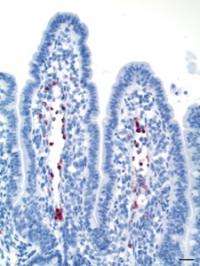
Since PrPSc is to be found in the lymphatic tissue of the intestinal system at an early stage of the disease, it is assumed that transmission occurs via the gastrointestinal tract. During her doctoral research, veterinary scientist Caroline Piercey Åkesson studied the uptake of the prion protein in the intestines, thereby throwing new light on processes occurring during the early phase of the disease's development. Contrary to earlier assumptions, she demonstrated by means of immunoelectron microscopy that the prion protein responsible for the disease is not transported directly from the intestines to lymphatic tissue associated with the intestines. On the contrary, she showed that the protein passed freely or in lymphatic cells outside the organised lymphatic tissue in the intestines.
Dendritic cells are presumed to function as "gatekeepers" which determine what the body can tolerate and which immune defence reactions it needs to instigate when confronted with foreign substances. One of the objectives of Åkesson's project was therefore to examine the interaction of dendritic cells with prion protein uptake. Firstly, it was necessary to characterise dendritic cells in healthy sheep intestines and secondly, to investigate which types of cells were associated with the uptake of the prion protein.
Her findings showed that it was not dendritic cells, but macrophages, which were mainly responsible for the uptake of the protein. Åkesson's study revealed that the prion protein makes use of the normal physiological uptake channel for macromolecules in the intestines and that this may have a significant effect on the body's immunological surveillance system. One possible consequence is that immuno-tolerance is stimulated, thus impeding a normal immuno reaction against the prion protein absorbed via the intestines.
Future studies which can reveal how immunological cells are transported and how the prion protein is processed in the body will be of great interest, not only in order to provide more knowledge about scrapie, but also about other neurodegenerative proteinpathies, both in humans and animals.
Cand.med.vet. Caroline Piercey Åkesson defended her doctoral thesis on 20th December 2011 at The Norwegian School of Veterinary Science. The thesis is entitled: Studies on the uptake of prions and their early interaction with immune cells of the sheep gut.
Provided by
Norwegian School of Veterinary Science
-
Sequence and structure key to prion disease transmission
Jun 14, 2010 |
not rated yet |
0
-
Is there more to prion protein than mad cow disease?
Sep 30, 2008 |
not rated yet |
0
-
Transmitting prion diseases in milk
Apr 08, 2008 |
not rated yet |
0
-
New prion discovery reveals drug target for mad cow disease and related illnesses
Dec 01, 2010 |
not rated yet |
0
-
NIH study describes fast, sensitive blood test for human prion disease
May 09, 2011 |
not rated yet |
0
-
Of mice and mental models: Neuroscientific implications of risk-optimized behavior in the mouse
May 25, 2012 |
not rated yet |
0
-
Limits to growth: Scientists identify key metastasis-enabling enzyme
May 22, 2012 |
5 / 5 (4) |
0
-
Seeing is as seeing does: Spatially-structured retinal input in early development of cortical maps
Apr 26, 2012 |
5 / 5 (4) |
1
-
Dreamless nights: Brain activity during nonrapid eye movement sleep
Apr 09, 2012 |
4.4 / 5 (12) |
0
-
Take your time: Neurobiology sheds light on the superiority of spaced vs. massed learning
Mar 28, 2012 |
4.5 / 5 (21) |
3
-
magnetic field from stream of protons
4 hours ago
-
Force on a particle constrained to move on the surface of a sphere
4 hours ago
-
Force in a magnetic coupling
14 hours ago
-
Sign of scalar product in electric potential integral?
21 hours ago
-
Heat engines: how can we yield work?
22 hours ago
-
Work done by us on the spring
May 25, 2012
- More from Physics Forums - Classical Physics
More news stories
Gene therapy can correct forms of severe combined immunodeficiency
Severe combined immunodeficiency is defect in the immune system that results in a loss of the adaptive immune cells known as B cells and T cells. Mutations in several different genes can lead to the development of severe ...
Immunology
May 24, 2012 |
not rated yet |
0
Research team uncovers mechanism behind drugs that cause altered immunity
(Medical Xpress) -- An Australian research team has opened the door to understanding why certain drugs cause a so called altered immunity response when offered as treatment for certain specific ailments. In their paper published ...
Immunology
May 24, 2012 |
not rated yet |
0
|
Long-distance training teaches proper technique for asthma test
(Medical Xpress) -- Virtual, long-distance training can teach primary-care professionals the proper technique for performing a lung-function test, a University of Washington-led study has shown. The breathing ...
Immunology
May 23, 2012 |
not rated yet |
0
Asthma medication linked with arrhythmias in children, young adults
Use of inhaled anticholinergics (IACs) has been associated with an increased risk of potentially dangerous heart arrhythmias among young asthma patients, according to a study conducted by researchers at the University of ...
Immunology
May 22, 2012 |
not rated yet |
0
Bee pollen supplements can cause anaphylactic reactions
Although many people take bee pollen as a health supplement, it can cause severe anaphylactic reactions. However, most people are unaware of the risks, states an article published in CMAJ (Canadian Medical Association Journal). ...
Immunology
May 22, 2012 |
not rated yet |
1
Keep food safety in mind this memorial day weekend
(HealthDay) -- Picnics, parades and cookouts are as much a part of Memorial Day weekend as tributes to the United States' war veterans.
Travel to high altitudes tied to Crohn's, colitis flare-ups
(HealthDay) -- People with inflammatory bowel disease, which includes Crohn's disease and colitis, may be at increased risk for flare-ups when they fly or travel to high altitudes for skiing or mountain climbing, ...
Family history of Alzheimer's affects functional connectivity
(HealthDay) -- Cognitively normal individuals with a family history of late-onset Alzheimer's disease (AD) may display lower resting state functional connectivity in the default mode network (DMN) of the brain, ...
Transvaginal mesh op restores pelvic organ prolapse at price
(HealthDay) -- Transvaginal mesh (TVM) procedures are effective for anatomical restoration of pelvic organ prolapse (POP), but patients report a worsening of sexual function following surgery, according to ...
Of mice and mental models: Neuroscientific implications of risk-optimized behavior in the mouse
(Medical Xpress) -- Regardless of an organism’s biological complexity, every encephalized animal continuously makes under-informed behavioral choices that can have serious consequences. Despite its ubiquity, ...
Weight struggles? Blame new neurons in your hypothalamus
New nerve cells formed in a select part of the brain could hold considerable sway over how much you eat and consequently weigh, new animal research by Johns Hopkins scientists suggests in a study published in the May issue ...