Push-ups no match for combat
December 1, 2011 in Health
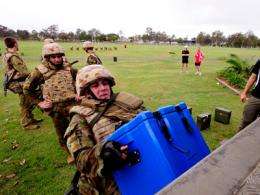
Artillery gunner from 1st Regiment, Royal Australian Artillery (1RGT) performs a box lift and place test
Presenting at the 2011 Defence Human Sciences Symposium, DSTO researcher Greg Carstairs outlined that current generic fitness assessments (including push-ups, sit-ups and chin-ups) are often poor predictors of performance in strength based job tasks.
Assessments that are directly relevant to specific tasks give a better indication of a person's ability to perform a role. This means that the person can perform more effectively with a reduced risk of injury," Mr. Carstairs said.
In a DSTO study involving over 100 soldiers, the effectiveness of push-ups, sit-ups and chin-ups was compared to a 'box lift and place' assessment method (pictured) that involves lifting a weighted box in a manner that replicates what is required in the field.
The results of this assessment method were then recorded against five strength based task simulations, including 'bombing up' a tank, repetitively loading an artillery gun, dragging an injured soldier, building a bridge, and lifting a field pack onto the tray of a truck.
Success with the 'box lift and place' assessment method was closely correlated to success in four of the five strength based tasks, while push-ups and chin-ups correlated with only one of the five job tasks (bridge building).
The box lift assessment is a far superior predictor of job performance, Mr. Carstairs said.
With combat roles scheduled to soon be open to women, these new methods will help us to objectively assess the physical capacity of our soldiers, irrespective of age, sex, height or weight."
This research forms part of the Physical Employment Standards project, which is developing physical tests that are predictive of job performance. As a flow-on effect, it is hoped that PES will help to improve recruitment, training and retention of capable personnel in the Australian Defence Force (ADF).
Provided by Australian Government
-
Majority of Americans think they pay more toward social security and medicare than they do
Jun 29, 2011 |
not rated yet |
0
-
Study: Youths in residential treatment have high rates of health problems
Oct 19, 2011 |
not rated yet |
0
-
Losing weight, keeping it off might require distinct skill sets
Jul 05, 2011 |
not rated yet |
0
-
Microsoft research shows augmented projectors (w/ video)
Nov 02, 2011 |
not rated yet |
0
-
FDA announces new limits on high-dose simvastatin (Zocor)
Jun 09, 2011 |
not rated yet |
0
-
Of mice and mental models: Neuroscientific implications of risk-optimized behavior in the mouse
May 25, 2012 |
not rated yet |
0
-
Limits to growth: Scientists identify key metastasis-enabling enzyme
May 22, 2012 |
5 / 5 (4) |
0
-
Seeing is as seeing does: Spatially-structured retinal input in early development of cortical maps
Apr 26, 2012 |
5 / 5 (4) |
1
-
Dreamless nights: Brain activity during nonrapid eye movement sleep
Apr 09, 2012 |
4.4 / 5 (12) |
0
-
Take your time: Neurobiology sheds light on the superiority of spaced vs. massed learning
Mar 28, 2012 |
4.5 / 5 (21) |
3
-
Classical and Quantum Mechanics via Lie algebras
Apr 15, 2011
- More from Physics Forums - Independent Research
More news stories
Keep food safety in mind this memorial day weekend
(HealthDay) -- Picnics, parades and cookouts are as much a part of Memorial Day weekend as tributes to the United States' war veterans.
Health
4 hours ago |
not rated yet |
0
Most occupational injury and illness costs are paid by the government and private payers
UC Davis researchers have found that workers' compensation insurance is not used nearly as much as it should be to cover the nation's multi-billion dollar price tag for workplace illnesses and injuries. Instead, almost 80 ...
Health
May 25, 2012 |
not rated yet |
0
Early physical therapist treatment associated with reduced risk of healthcare utilization and reduced overall healthcare
A new study published in Spine shows that early treatment by a physical therapist for low back pain (LBP), as compared to delayed treatment, was associated with reduced risk of subsequent healthcare utilization and lower ...
Health
May 25, 2012 |
not rated yet |
0
|
Cancer patients share web info with docs for insight, advice
(HealthDay) -- Cancer patients' primary goal in talking with their doctors about information they've found on the Internet is to get more insight and advice on the online information, new research indicates.
Health
May 25, 2012 |
not rated yet |
0
P&G to add latches to make detergent packs safer
(AP) -- Procter & Gamble says it will change the design of packaging for its miniature laundry detergent product to deter children from eating the brightly colored packets that look like candy.
Health
May 25, 2012 |
not rated yet |
0
Travel to high altitudes tied to Crohn's, colitis flare-ups
(HealthDay) -- People with inflammatory bowel disease, which includes Crohn's disease and colitis, may be at increased risk for flare-ups when they fly or travel to high altitudes for skiing or mountain climbing, ...
Family history of Alzheimer's affects functional connectivity
(HealthDay) -- Cognitively normal individuals with a family history of late-onset Alzheimer's disease (AD) may display lower resting state functional connectivity in the default mode network (DMN) of the brain, ...
Transvaginal mesh op restores pelvic organ prolapse at price
(HealthDay) -- Transvaginal mesh (TVM) procedures are effective for anatomical restoration of pelvic organ prolapse (POP), but patients report a worsening of sexual function following surgery, according to ...
Of mice and mental models: Neuroscientific implications of risk-optimized behavior in the mouse
(Medical Xpress) -- Regardless of an organism’s biological complexity, every encephalized animal continuously makes under-informed behavioral choices that can have serious consequences. Despite its ubiquity, ...
Weight struggles? Blame new neurons in your hypothalamus
New nerve cells formed in a select part of the brain could hold considerable sway over how much you eat and consequently weigh, new animal research by Johns Hopkins scientists suggests in a study published in the May issue ...
Thioridazine kills cancer stem cells in human while avoiding toxic side-effects of conventional cancer treatments
A team of scientists at McMaster University has discovered a drug, thioridazine, successfully kills cancer stem cells in the human while avoiding the toxic side-effects of conventional cancer treatments.
Dec 01, 2011
Rank: not rated yet