Salads you can trust -- safe farm practices get major test
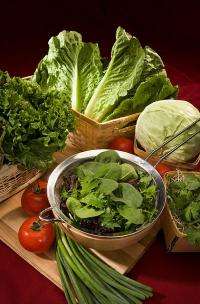
Ever since 2006, when a deadly batch of spinach killed three people and sickened hundreds, U.S. farm producers, packers and others along the distribution line have argued over how best to protect consumers and assure them that leafy greens and tomatoes are safe.
Now, a major, national initiative, led by University of Maryland researchers, may help settle the fight, increase safety and deliver more trustworthy salad fixings. It promises to be one of the most comprehensive studies of fresh produce safety ever conducted.
"Leafy greens and tomatoes remain the produce items most frequently responsible for outbreaks of food-borne illnesses, yet we still don't know what specific safety guidelines are justified scientifically," says principal investigator Robert Buchanan, the University of Maryland professor and director of its Center for Food Safety and Security Systems, who is heading the research initiative.
"Guidelines, standards and regulations need to be based on solid science or we'll end up with legal wrangling rather than safer salads," Buchanan adds.
The research will create the scientific basis for detailed safe, hygienic practices in farming, packing, transporting and storing fresh produce. The idea is to prevent water, air or ground sources of pathogen contamination by setting standards or benchmarks that can be applied in a variety of growing regions and countries.
For example, how far apart do you need to keep a lettuce patch from pigs or other farm animals to prevent bacterial contamination? What kinds of barriers are needed to prevent contaminated water from reaching crops? What kinds of animal-based fertilizers are safe to use?
To get hard, scientific answers, Buchanan has secured a $5.4 million dollar grant from the U.S. Department of Agriculture (USDA), along with substantial industry funding - roughly $9 million in all - for an extensive research project spanning at least three years. The project will involve extensive testing and data collection by industry, supplemented with field experiments involving eight other university and federal laboratories around the country.
"The research team assembled represents a significant portion of the produce safety experts in the United States, and includes expertise in the multiple disciplines needed to address this highly complex problem," Buchanan notes.
The University of Maryland's research partners are Ohio State University; Rutgers University; University of California, Davis; University of Florida; University of Delaware; University of Maryland, Eastern Shore; USDA; and the Food and Drug Administration (FDA).
SCIENTIFIC VALIDATION TO WITHSTAND TRADE CHALLENGES
Continuing outbreaks of illnesses from eating fresh and fresh-cut produce has prompted widespread calls for objective, good-practice standards and benchmarks to ensure that growers, processors and shippers all take adequate safety and hygienic precautions, Buchanan says.
These calls have come from various agricultural production groups, grocers, regulatory agencies, international trading partners and consumer organizations. Additionally, the FDA is required by the Food Safety Modernization Act to develop produce safety standards.
Some agricultural industry groups - including large lettuce and tomato growers - have attempted to enforce their own standards through state and regional regulatory channels, setting off what Buchanan calls a "firestorm of criticism and complaints" challenging the appropriateness and costs associated with these practices.
"No group's protocol will be approved and enforced without scientific validation," Buchanan says. "The science must be solid enough to withstand domestic legal challenges and international trading disputes. Producers, processors and consumers must be assured that the good practice standards apply to their region - that what works on a big farm in California, makes sense on a couple dozen acres on the East Coast," he adds.
RESEARCH TARGETS
The research team says it will give regulators, farmers, packers and others along the supply chain the scientific and technological knowledge needed to develop and defend produce safety protocols, or 'metrics' as the industry calls them.
At the production stage, the research will focus on air, water and other environmental factors related to potential contamination by pathogens; risks during harvesting, packing, and processing; as well as temperature and other handling concerns as produce moves to market.
"This is a massive undertaking because there are hundreds of variations and factors we have to take into account," Buchanan says. "Appropriate practices may vary from one season to another, even in one location. There' no way we could do this without the massive data collection effort the industry has committed to."
INDUSTRY PARTICIPATION
The initiative's industry partners - representing more than 90 percent of the leafy greens and tomato production in the United States - will conduct about 200,000 separate tests during the project to measure the presence of pathogens.
Already, the agriculture producers are testing for pathogens in produce just before and after harvesting. Also, they making environmental tests - for example, in irrigation waters, in fertilizers and other soil amendments - and sanitary conditions in transport and processing facilities. The researchers will then analyze all this data.
The researchers will conduct a series of controlled experiments to see how various agricultural and hygienic practices affect levels of pathogens. By conducting these tests around the country, the team will be able to gauge any variations in the effectiveness of safety practices from region to region.
RAPID SAFETY UPDATES
Industry and government advisory panels will monitor the progress of the research, and this will aid the rapid deployment of updated safety information. "If we find out along the way that an industry practice is particularly risky or beneficial, we'll flash word through our network so that important safety information gets out quickly," Buchanan says.


