Scientists succeed in making the spinal cord transparent
December 26, 2011 in Medical research
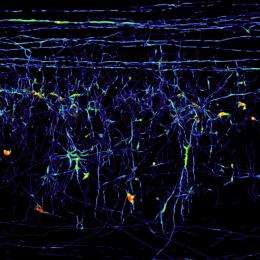
A spinal cord as if made of glass: The new method enables scientists to see nerve cell in the intact cellular network. © MPI of Neurobiology / Ertürk
(Medical Xpress) -- In the event of the spinal cord injury, the long nerve cell filaments, the axons, may become severed. For quite some time now, scientists have been investigating whether these axons can be stimulated to regenerate. Such growth takes place on a scale of only a few millimetres. To date, changes like this could be determined only by cutting the tissue in question into wafer-thin slices and examining these under a microscope. However, the two-dimensional sections provide only an inaccurate picture of the spatial distribution and progression of the cells. Together with an international team, scientists at the Max Planck Institute for Neurobiology in Martinsried have now developed a new method by virtue of which single nerve cells can be both examined in intact tissue and portrayed in all three dimensions.
The spinal cord is the most important pathway for relaying information from the skin, muscles and joints to the brain and back again. Damage to nerve cells in this region usually results in irreversible paralysis and loss of sensation. For many years, scientists have been doing their best to ascertain why nerve cells refuse to regenerate. They search for ways to stimulate these cells to resume their growth.
To establish whether a single cell is growing, the cell must be visible in the first place. Up to now, the procedure has been to cut the area of the spinal cord required for examination into ultra-thin slices. These are then examined under a microscope and the position and pathway of each cell is reconstructed. In exceptional cases, scientists could go to the trouble of first digitizing each slice and then reassembling the images, one by one, to produce a virtual 3D model. However, this is a very time-consuming endeavour, requiring days and sometimes even weeks to process the results of just one examination. Even worse, mistakes can easily creep in and falsify the results: The appendages of individual nerve cells might get squashed during the process of slicing, and the layers might be ever so slightly misaligned when set on top of each other. As Frank Bradke explains: "Although this might not seem dramatic to begin with it prevents us from establishing the length and extent of growth of single cells." Bradke and his team at the Max Planck Institute of Neurobiology have investigated the regeneration of nerve cells following injuries to the spinal cord. Since July he has been working at the German Centre for Neurodegenerative Diseases (DZNE) in Bonn. "However, since changes on this crucial scale are precisely what we need to see, we worked meticulously until we came up with a better technique", he continues.
The new technique is based on a method known as ultramicroscopy, which was developed by Hans Ulrich Dodt from the Technical University of Vienna. The Max Planck neurobiologists and an international team of colleagues have now taken this technique a step further. The principle is relatively straightforward. Spinal cord tissue is opaque due to the fact that the water and the proteins contained in it refract light differently. Thus, the scientists removed the water from a piece of tissue and replaced it by an emulsion that refracts light in exactly the same way as the proteins. This left them with a completely transparent piece of tissue. "It's the same effect as if you were to spread honey onto textured glass", Ali Ertürk, the study's first author adds. The opaque pane becomes crystal clear as soon as the honey has compensated for the surface irregularities.
The new method is a leap forward in regeneration research. By using fluorescent dyes to stain individual nerve cells, scientists can now trace their path from all angels in an otherwise transparent spinal cord section. This enables them to ascertain once and for all whether or not these nerve cells recommenced their growth following injury to the spine – an essential prerequisite for future research. "The really great thing is the fact that this method can also be easily applied to other kinds of tissue", Frank Bradke relates. For example, the blood capillary system or the way a tumour is embedded in tissue could be portrayed and analysed in 3D.
More information: Ali Ertürk, Christoph P. Mauch, Farida Hellal, Friedrich Förstner, Tara Keck, Klaus Becker, Nina Jährling, Heinz Steffens, Melanie Richter, Mark Hübener, Edgar Kramer, Frank Kirchhoff, Hans Ulrich Dodt, Frank Bradke, 3D imaging of the unsectioned adult spinal cord to assess axon regeneration and glial responses after injury, Nature Medicine, online publication, December 25, 2011
Journal reference:
Nature Medicine
Provided by
Max-Planck-Gesellschaft
-
The dormant potential of damaged nerve cells
Jul 13, 2009 |
not rated yet |
0
-
Research offers hope in new treatment for spinal cord injuries
May 03, 2011 |
not rated yet |
0
-
Promising new nanotechnology for spinal cord injury
Apr 02, 2008 |
not rated yet |
0
-
Cancer drug aids cell regeneration after spinal cord injury
Jan 27, 2011 |
not rated yet |
0
-
Unexpected cell repairs injured spinal cord
Jul 07, 2011 |
not rated yet |
0
-
Of mice and mental models: Neuroscientific implications of risk-optimized behavior in the mouse
May 25, 2012 |
not rated yet |
0
-
Limits to growth: Scientists identify key metastasis-enabling enzyme
May 22, 2012 |
5 / 5 (4) |
0
-
Seeing is as seeing does: Spatially-structured retinal input in early development of cortical maps
Apr 26, 2012 |
5 / 5 (4) |
1
-
Dreamless nights: Brain activity during nonrapid eye movement sleep
Apr 09, 2012 |
4.4 / 5 (12) |
0
-
Take your time: Neurobiology sheds light on the superiority of spaced vs. massed learning
Mar 28, 2012 |
4.5 / 5 (21) |
3
-
Potential Breakthrough in Seizure Control
18 hours ago
-
Popping/Cracked sternum.
23 hours ago
-
Which Mental Illness Encompasses This Problem?
23 hours ago
-
A question about drug tolerance
May 23, 2012
-
Poor nutrition leading to overeating?
May 23, 2012
-
Math and dyslexia?
May 21, 2012
- More from Physics Forums - Medical Sciences
More news stories
Implantable pain disk may help those with cancer
An estimated 3.5 million cancer patients around the globe are in severe pain from their disease, but many get no relief.
Medical research
May 25, 2012 |
5 / 5 (1) |
0
|
Energy levels link sleep control mechanisms
Sleep, or lack of it, can determine level of cognitive performance which is linked with accidents as well as increased risk of serious health problems. Links between cell energy levels, gene transcription ...
Medical research
May 25, 2012 |
not rated yet |
0
Researchers identify key brain cell in antidepressant action
(Medical Xpress) -- Antidepressant medications such as Prozac have helped improve mood and lessen anxiety in millions of people with major depression. But scientists know surprisingly little about how these drugs work.
Medical research
May 25, 2012 |
4.7 / 5 (3) |
0
|
Rockefeller scientists pioneer new method to determine mechanisms of drug action
(Medical Xpress) -- Knowing that a drug works is great. Knowing how it works is a luxury. And until now, determining a drugs mechanism of action has been a tedious and difficult process for scientists.
Medical research
May 25, 2012 |
not rated yet |
0
|
Like curry? New biological role identified for compound used in ancient medicine
Scientists have just identified a new reason why some curry dishes, made with spices humans have used for thousands of years, might be good for you.
Medical research
May 25, 2012 |
4.5 / 5 (12) |
2
|
Keep food safety in mind this memorial day weekend
(HealthDay) -- Picnics, parades and cookouts are as much a part of Memorial Day weekend as tributes to the United States' war veterans.
Travel to high altitudes tied to Crohn's, colitis flare-ups
(HealthDay) -- People with inflammatory bowel disease, which includes Crohn's disease and colitis, may be at increased risk for flare-ups when they fly or travel to high altitudes for skiing or mountain climbing, ...
Family history of Alzheimer's affects functional connectivity
(HealthDay) -- Cognitively normal individuals with a family history of late-onset Alzheimer's disease (AD) may display lower resting state functional connectivity in the default mode network (DMN) of the brain, ...
Transvaginal mesh op restores pelvic organ prolapse at price
(HealthDay) -- Transvaginal mesh (TVM) procedures are effective for anatomical restoration of pelvic organ prolapse (POP), but patients report a worsening of sexual function following surgery, according to ...
Of mice and mental models: Neuroscientific implications of risk-optimized behavior in the mouse
(Medical Xpress) -- Regardless of an organism’s biological complexity, every encephalized animal continuously makes under-informed behavioral choices that can have serious consequences. Despite its ubiquity, ...
Weight struggles? Blame new neurons in your hypothalamus
New nerve cells formed in a select part of the brain could hold considerable sway over how much you eat and consequently weigh, new animal research by Johns Hopkins scientists suggests in a study published in the May issue ...
Dec 26, 2011
Rank: not rated yet
Some previous report talks about a technique on a live brain
http://medicalxpr...ble.html
Dec 26, 2011
Rank: 3.4 / 5 (5)
Perhaps the researchers are using a special grade of silicon for the emulsion. They haven't specified what the ingredients are.
from the article: ""Thus, the scientists removed the water from a piece of tissue and replaced it by an emulsion that refracts light in exactly the same way as the proteins. This left them with a completely transparent piece of tissue.""
This is amazing. They have managed to make transparent a piece of carbon-based tissue by removing the water and adding a different concoction. I would like to find out what the ingredients are in that emulsion
Dec 26, 2011
Rank: 3 / 5 (4)
This is obviously a different method and has to do with a mouse brain rather than the spinal cord, but both articles exemplify the important work done in these areas.
However, if they are doing these experiments on chimps and monkeys, the animal rights activists may have something to say about that.
Dec 26, 2011
Rank: 3.4 / 5 (5)
Dec 26, 2011
Rank: 5 / 5 (1)
Dec 26, 2011
Rank: 3.4 / 5 (5)
The images and videos are astonishing.