An inside look at face transplantation
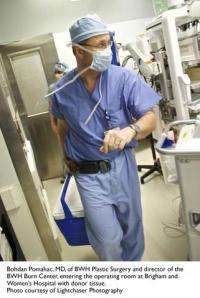
Bohdan Pomahac, M.D., of Brigham and Women's Hospital, enters the operating room with donor tissue. Credit: Brigham and Women's Hospital/Lightchaser Photography
In March 2011, a surgical team at Brigham and Women's Hospital (BWH) performed the first full face transplantation (FFT) in the United States and went on to complete a total of three FFTs this year. Now, in the first research publication to evaluate FFT in the US, and largest series worldwide, the researchers describe details of patient preparation, novel design and execution of the operation as well as unique immunosuppression protocol allowing for lowest long-term maintenance drug regimen. They also share details of the early functional outcomes and demonstrate FFT as a viable option in the treatment of severe facial deformities and injuries. This research is published in the New England Journal of Medicine in the December 27, 2011 issue.
"Unlike conventional reconstruction, facial transplantation seeks to transform severely deformed features to a near-normal appearance and function that conventional reconstructive plastic surgical techniques cannot match," said lead author Dr. Bohdan Pomahac, Director of the Plastic Surgery Transplantation Program at BWH and lead surgeon in all three FFT procedures. "It truly is a life-giving procedure for these patients."
In an effort to advance the field of face transplantation, Pomahac and colleagues document the novel processes involved in a successful face transplant program from screening candidates to the transplant procedure itself and the follow up management of the recipients.
Researchers describe the rigorous screening and consent process that each patient must pass, which includes evaluation by a team of physicians who determine whether the patient is physically and mentally prepared for the procedure through numerous clinical and psychological evaulations. Once a candidate is approved by the face transplant team and the Institutional Review Board at BWH, BWH physicians work closely with the New England Organ Bank (NEOB) to identify the criteria for suitable donors and the process for obtaining consent for this unique transplantation.
Next, researchers outline the details of the surgeries with a focus on the multi-disciplinary collaborative efforts of an entire team of clinicians. Surgeons and staff coordinate their tasks while preparing the recipient and simultaneously retrieving the donor tissue within a limited time frame. The researchers describe the similarities and difference between each procedure, noting the various differences that occurred in the one FFT recipient who also concurrently received a bilateral hand transplant.
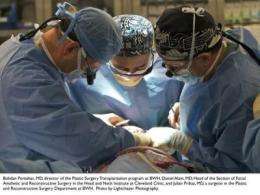
Pictured are Bohdan Pomahac, M.D., Daniel Alam, M.D., and Julian Pribaz, M.D., during face transplantation surgery performed at Brigham and Women's Hospital. Credit: Brigham and Women's Hospital/Lightchaser Photography
Lastly, researchers explain the care of the recipient post-transplant. Following the surgery, physicians monitor and adjust immunosuppressants (anti-rejection medications) while methodically screening for any signs of organ rejection. The researchers discuss occurrences of single episodes of rejection in two patients, as well as describe other complications following surgery, like occurrence of infection. Pomahac and colleagues discuss how the transplanted tissue transformed and adapted to match the features of the recipient in each case.
"Our focus moving forward continues to be on monitoring and documenting the progress of patients who have undergone FFT, and refining the use of immunosuppressants, with the hope that one day patients will eventually need to take little or none," said Pomahac. We are also learning how brain reintegrates the new parts, and follow closely motor and sensory return. Important part of the study is also calculation of cost-effectiveness.
Journal reference:
New England Journal of Medicine
Provided by Brigham and Women's Hospital
-
7th surgery shows face transplants gaining ground
Apr 11, 2009 |
not rated yet |
0
-
On the cusp of new transplant era
Sep 28, 2011 |
not rated yet |
0
-
UCLA performs first hand transplant in the western United States
Mar 08, 2011 |
not rated yet |
0
-
Integrated 3-D imaging facilitates human face transplantation
Nov 28, 2011 |
not rated yet |
0
-
First bilateral hand transplant performed at the Hospital of the University of Pennsylvania
Nov 01, 2011 |
not rated yet |
0
-
Motion perception revisited: High Phi effect challenges established motion perception assumptions
Apr 23, 2013 |
3 / 5 (2) |
2
-
Anything you can do I can do better: Neuromolecular foundations of the superiority illusion (Update)
Apr 02, 2013 |
4.5 / 5 (11) |
5
-
The visual system as economist: Neural resource allocation in visual adaptation
Mar 30, 2013 |
5 / 5 (2) |
9
-
Separate lives: Neuronal and organismal lifespans decoupled
Mar 27, 2013 |
4.9 / 5 (8) |
0
-
Sizing things up: The evolutionary neurobiology of scale invariance
Feb 28, 2013 |
4.8 / 5 (10) |
14
-
Classical and Quantum Mechanics via Lie algebras
Apr 15, 2011
- More from Physics Forums - Independent Research
More news stories
Survey points out deficiencies in addictions training for medical residents
A 2012 survey of internal medicine residents at Massachusetts General Hospital (MGH) – one of the nation's leading teaching hospitals – found that more than half rated the training they had received in addiction and other ...
Other
11 hours ago |
not rated yet |
0
Early use of tracheostomy for mechanically ventilated patients not associated with improved survival
For critically ill patients receiving mechanical ventilation, early tracheostomy (within the first 4 days after admission) was not associated with an improvement in the risk of death within 30 days compared to patients who ...
Other
May 21, 2013 |
not rated yet |
0
Decisions to forgo life support may depend heavily on the ICU where patients are treated
The decision to limit life support in patients in the intensive care unit (ICU) appears to be significantly influenced by physician practices and/or the culture of the hospital, suggests new findings from researchers at the ...
Other
May 21, 2013 |
not rated yet |
0
People on higher incomes are happier with new knees
Knee replacement surgery is a very common procedure. However, it does not always resolve function or pain in all the recipients of new knees. A study by Robert Barrack, MD and his colleagues from the Washington University ...
Other
May 21, 2013 |
not rated yet |
0
New search engine finds rare diagnoses
Doctors are trained to think "common disease" when they meet patients in their practices, and as they rarely or never meet a rare disease, it often takes many years to reach the right diagnosis. A new search tool called FindZebra ...
Other
May 21, 2013 |
not rated yet |
0
Rate of bicycle-related fatalities significantly lower in states with helmet laws
Existing research shows that bicyclists who wear helmets have an 88 percent lower risk of brain injury, but researchers at Boston Children's Hospital found that simply having bicycle helmet laws in place showed a 20 percent ...
Slowing the aging process—only with antibiotics
Swiss scientists reveal the mechanism responsible for aging hidden deep within mitochondria—and dramatically slow it down in worms by administering antibiotics to the young.
Researchers complete largest genetic sequencing study of human disease
Researchers from Queen Mary, University of London have led the largest sequencing study of human disease to date, investigating the genetic basis of six autoimmune diseases.
Brain can be trained in compassion, study shows
Until now, little was scientifically known about the human potential to cultivate compassion—the emotional state of caring for people who are suffering in a way that motivates altruistic behavior.
Having both migraines, depression may mean smaller brain
(HealthDay)—Migraines and depression can each cause a great deal of suffering, but new research indicates the combination of the two may be linked to something else entirely—a smaller brain.
Novel approach for influenza vaccination shows promise in early animal testing
A new approach for immunizing against influenza elicited a more potent immune response and broader protection than the currently licensed seasonal influenza vaccines when tested in mice and ferrets. The vaccine ...
