99-year-old woman regains mobility following spinal procedures
December 23, 2011 in Other
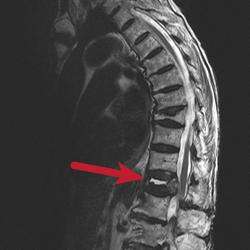
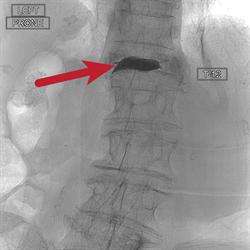
Scans of Elizabeth DiGennaro's spine show the compression fracture, above, and the results, below, after doctors at University of Rochester Medical Center performed kyphoplasty to repair the bone.
(Medical Xpress) -- A 99-year-old woman has returned to her daily routine after doctors repaired three separate compression fractures in her spine three times in a month. Specialists at the University of Rochester Medical Center repaired the brittle vertebra using bone glue while the patient was under sedation, which is easier for elderly patients.
Elizabeth DiGennaro of Scottsville is the oldest person to undergo the procedure at URMC exemplifying doctors commitment to providing comprehensive care for the fast-growing elderly population. She believes the injury occurred during routine chores that may have been too much for her aging, osteoporotic bones.
She will celebrate her 100th birthday Jan. 3.
Looking at the scans, you can see that bone had crumbled into pieces, said Per-Lennart Westesson, M.D., D.D.S., Ph.D., a neuroradiologist who collaborated with Orthopedic surgeon Susan V. Bukata, M.D., and Freda B. Hannafon, FNP-C,MSN, of The Center for Bone Health, to care for DiGennaro.
After several weeks of being bedridden with back pain, DiGennaros family worried that she would never recover. They sought help from Bukata, who suggested balloon kyphoplasty. The procedure involves injecting bone cement directly into the compression fracture and using balloons to shift the vertebrae back into place to relieve pain and hasten healing.
This procedure has been used for decades by doctors in Orthopedics, Neurosurgery and Interventional Radiology. Bukata recognized that traditional surgery under general anesthesia may not be best for DiGennaro, because it can elevate a risk of stroke in elderly patients. Bukata suggested Westesson perform kyphoplasty using sedation in an interventional radiology suite, rather than an operating room.
This was a better option for Mrs. DiGennaro and other elderly patients who suffer these types of injuries, said Westesson, professor of Imaging Sciences.
The near-centenarian has always been an active, strong-willed woman, according to her daughter, Barbara Galbraith. And the spinal fracture was very painful and the medications to control the pain made her confused and exhausted, and as a result, she was bedridden
We were really worried that shed never be able to enjoy her life again, Galbraith said. That was no way for her to live.
The pain went away immediately and she was back to her normal self again. Two days later she was in pain again, and it was a break, but not the same place. And then there was a third one. Each time we went back and had the second and third procedures she did really well.
DiGennaro had the first surgery on Sept. 30, followed by a second on Oct. 12, and the third on Nov. 23. Each procedure was a success; the pain was gone and she was able to resume her normal life.
URMC doctors perform more than 100 kyphoplasty procedures each year, providing much needed relief for aging adults with compression fractures.
This is something well do more and more often with sedation as we see the baby boomer generation age further, Westesson said.
Provided by
University of Rochester Medical Center
-
Controversial Studies Trigger Dropoff in Osteoporosis Treatment
Feb 22, 2010 |
not rated yet |
0
-
Surgical technique relieves painful spine fractures in patients with metastatic cancer
Oct 09, 2010 |
not rated yet |
0
-
National research study to assess new treatment for painful vertebral fractures
Oct 28, 2010 |
not rated yet |
0
-
When doctors own or lease MRI, back scans and surgery more likely
Apr 26, 2011 |
not rated yet |
0
-
New treatment method reduces pain in patients with vertebral compression fractures
Jul 22, 2009 |
not rated yet |
0
-
Of mice and mental models: Neuroscientific implications of risk-optimized behavior in the mouse
May 25, 2012 |
not rated yet |
0
-
Limits to growth: Scientists identify key metastasis-enabling enzyme
May 22, 2012 |
5 / 5 (4) |
0
-
Seeing is as seeing does: Spatially-structured retinal input in early development of cortical maps
Apr 26, 2012 |
5 / 5 (4) |
1
-
Dreamless nights: Brain activity during nonrapid eye movement sleep
Apr 09, 2012 |
4.4 / 5 (12) |
0
-
Take your time: Neurobiology sheds light on the superiority of spaced vs. massed learning
Mar 28, 2012 |
4.5 / 5 (21) |
3
-
Classical and Quantum Mechanics via Lie algebras
Apr 15, 2011
- More from Physics Forums - Independent Research
More news stories
Transvaginal mesh op restores pelvic organ prolapse at price
(HealthDay) -- Transvaginal mesh (TVM) procedures are effective for anatomical restoration of pelvic organ prolapse (POP), but patients report a worsening of sexual function following surgery, according to ...
Other
11 hours ago |
not rated yet |
0
Tongue analysis software uses ancient Chinese medicine to warn of disease
For 5,000 years, the Chinese have used a system of medicine based on the flow and balance of positive and negative energies in the body. In this system, the appearance of the tongue is one of the measures used to classify ...
Other
May 25, 2012 |
1 / 5 (1) |
0
|
Neck strength, cervical spine mobility don't predict pain
(HealthDay) -- Neither isometric neck muscle strength nor passive mobility of the cervical spine, two physical capacity parameters found to be associated with neck pain in other studies, predicts later neck ...
Other
May 25, 2012 |
not rated yet |
0
Pool access for the disabled sparks controversy
(AP) -- The Obama administration is sidestepping an election-year confrontation with the hotel industry and other pool owners to give them more time to comply with access rules for the disabled.
Other
May 25, 2012 |
not rated yet |
0
Chile to cover sex change operations
Chile will soon cover sex change surgeries under its public health plan in order to allow citizens of limited means to "recover their true sexual identity," Health Minister Jaime Manalich said.
Other
May 25, 2012 |
not rated yet |
0
Keep food safety in mind this memorial day weekend
(HealthDay) -- Picnics, parades and cookouts are as much a part of Memorial Day weekend as tributes to the United States' war veterans.
Travel to high altitudes tied to Crohn's, colitis flare-ups
(HealthDay) -- People with inflammatory bowel disease, which includes Crohn's disease and colitis, may be at increased risk for flare-ups when they fly or travel to high altitudes for skiing or mountain climbing, ...
Family history of Alzheimer's affects functional connectivity
(HealthDay) -- Cognitively normal individuals with a family history of late-onset Alzheimer's disease (AD) may display lower resting state functional connectivity in the default mode network (DMN) of the brain, ...
Of mice and mental models: Neuroscientific implications of risk-optimized behavior in the mouse
(Medical Xpress) -- Regardless of an organism’s biological complexity, every encephalized animal continuously makes under-informed behavioral choices that can have serious consequences. Despite its ubiquity, ...
Weight struggles? Blame new neurons in your hypothalamus
New nerve cells formed in a select part of the brain could hold considerable sway over how much you eat and consequently weigh, new animal research by Johns Hopkins scientists suggests in a study published in the May issue ...
Thioridazine kills cancer stem cells in human while avoiding toxic side-effects of conventional cancer treatments
A team of scientists at McMaster University has discovered a drug, thioridazine, successfully kills cancer stem cells in the human while avoiding the toxic side-effects of conventional cancer treatments.