Appetite accomplice: Ghrelin receptor alters dopamine signaling
January 25, 2012 in Neuroscience
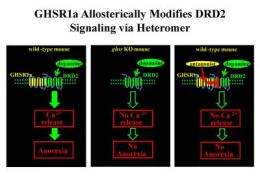
GHSR1a allosterically modifies DRD2 signaling via a heteromer. Credit: Roy G. Smith, The Scripps Research Institute
New research reveals a fascinating and unexpected molecular partnership within the brain neurons that regulate appetite. The study, published by Cell Press in the January 26 issue of the journal Neuron, resolves a paradox regarding a receptor without its hormone and may lead to more specific therapeutic interventions for obesity and disorders of dopamine signaling.
Ghrelin is an appetite-stimulating hormone produced by the stomach. Although the ghrelin receptor (GHSR1a) is broadly distributed in the brain, ghrelin itself is nearly undetectable there. This intriguing paradox was investigated by Dr. Roy G. Smith, Dr. Andras Kern, and colleagues from The Scripps Research Institute in Florida. "We identified subsets of neurons in the brain that express both GHSR1a and the dopamine receptor subtype-2 (DRD2)," explains Dr. Smith. "Dopamine signaling in the hypothalamus is linked with feeding behavior, and mutations in DRD2 that attenuate dopamine signaling are associated with obesity in humans. We speculated that expression of both receptors in the same neurons might lead to interactions between GHSR1a and DRD2 that modify dopamine signaling."
The researchers showed that when GHSR1a and DRD2 were coexpressed, the receptors physically interacted with one another. Further, the GHSR1a:DRD2 complex was present in native hypothalamic neurons that regulate appetite. When mice were treated with a molecule (cabergoline) that selectively activates DRD2, they exhibited anorexia. Interestingly, the cabergoline-stimulated anorexia did not require ghrelin but was dependent on GHSR1a and the GHSR1a:DRD2 interaction. These findings suggest that in neurons expressing both GHSR1a and DRD2, GHSR1a alters classical DRD2 dopamine signaling.
"Perhaps most importantly, we showed that a GHSR1a-selective antagonist blocks dopamine signaling in neurons with both DRD2 and GHSR1a, which allows neuronal selective fine-tuning of dopamine signaling because neurons expressing DRD2 alone will be unaffected," concludes Dr. Smith. "This provides exciting opportunities for designing next-generation therapeutics with fewer side effects for both obesity and psychiatric disorders associated with abnormal dopamine signaling."
More information: Kern et al.: Apo-ghrelin receptor forms heteromers with DRD2 in hypothalamic neurons and is essential for anorexigenic effects of DRD2 agonism. Neuron, January 26, 2012.
Journal reference:
Neuron
Provided by
Cell Press
-
MicroRNAs play a role in cocaine addiction
Jul 27, 2010 |
not rated yet |
0
-
Feeding hormone ghrelin modulates ability of rewarding food to evoke dopamine release
Jul 12, 2011 |
not rated yet |
0
-
Hormone ghrelin can boost resistance to Parkinson's disease
Nov 25, 2009 |
not rated yet |
0
-
Researchers discover possible markers for mental illness
Dec 03, 2007 |
not rated yet |
0
-
Researchers find 'switch' for brain's pleasure pathway
Mar 22, 2006 |
not rated yet |
0
-
Motion perception revisited: High Phi effect challenges established motion perception assumptions
Apr 23, 2013 |
3 / 5 (2) |
2
-
Anything you can do I can do better: Neuromolecular foundations of the superiority illusion (Update)
Apr 02, 2013 |
4.5 / 5 (11) |
5
-
The visual system as economist: Neural resource allocation in visual adaptation
Mar 30, 2013 |
5 / 5 (2) |
9
-
Separate lives: Neuronal and organismal lifespans decoupled
Mar 27, 2013 |
4.9 / 5 (8) |
0
-
Sizing things up: The evolutionary neurobiology of scale invariance
Feb 28, 2013 |
4.8 / 5 (10) |
14
-
Why is zone 1 in liver more prone to ischemic injury?
3 hours ago
-
How can there be villous adenoma in colon, if there are no villi there
May 22, 2013
-
How can there be a term called "intestinal metaplasia" of stomach
May 21, 2013
-
Pressure-volume curve: Elastic Recoil Pressure don't make sense
May 18, 2013
-
If you became brain-dead, would you want them to pull the plug?
May 17, 2013
-
MRI bill question
May 15, 2013
- More from Physics Forums - Medical Sciences
More news stories
Having both migraines, depression may mean smaller brain
(HealthDay)—Migraines and depression can each cause a great deal of suffering, but new research indicates the combination of the two may be linked to something else entirely—a smaller brain.
Neuroscience
15 hours ago |
4.3 / 5 (3) |
0
|
Researchers analyse hunting behaviour of fish larvae in virtual reality
Moving objects attract greater attention – a fact exploited by video screens in public spaces and animated advertising banners on the Internet. For most animal species, moving objects also play a major ...
Neuroscience
17 hours ago |
not rated yet |
0
|
Signs of motor disorders can appear years before disease manifestation
It is known that signs of neurological disorders such as Alzheimer's and Huntington's disease can appear years before the disease becomes manifest; these signs take the form of subtle changes in the brain and behavior of ...
Neuroscience
17 hours ago |
not rated yet |
0
Taming suspect gene reverses schizophrenia-like abnormalities in mice
Scientists have reversed behavioral and brain abnormalities in adult mice that resemble some features of schizophrenia by restoring normal expression to a suspect gene that is over-expressed in humans with ...
Neuroscience
19 hours ago |
5 / 5 (2) |
0
|
Scientists uncover molecular roots of cocaine addiction in the brain
Researchers at Johns Hopkins have unraveled the molecular foundations of cocaine's effects on the brain, and identified a compound that blocks cravings for the drug in cocaine-addicted mice. The compound, already proven safe ...
Neuroscience
19 hours ago |
not rated yet |
0
|
US teen birth rate drops to record low
US teen births have dropped to a record low, but the country still has one of the highest rates among developed nations, the US Centers for Disease Control and Prevention said Thursday.
Slowing the aging process—only with antibiotics
Swiss scientists reveal the mechanism responsible for aging hidden deep within mitochondria—and dramatically slow it down in worms by administering antibiotics to the young.
Researchers complete largest genetic sequencing study of human disease
Researchers from Queen Mary, University of London have led the largest sequencing study of human disease to date, investigating the genetic basis of six autoimmune diseases.
Brain can be trained in compassion, study shows
Until now, little was scientifically known about the human potential to cultivate compassion—the emotional state of caring for people who are suffering in a way that motivates altruistic behavior.
Rate of bicycle-related fatalities significantly lower in states with helmet laws
Existing research shows that bicyclists who wear helmets have an 88 percent lower risk of brain injury, but researchers at Boston Children's Hospital found that simply having bicycle helmet laws in place showed a 20 percent ...
Novel approach for influenza vaccination shows promise in early animal testing
A new approach for immunizing against influenza elicited a more potent immune response and broader protection than the currently licensed seasonal influenza vaccines when tested in mice and ferrets. The vaccine ...