Briton with locked-in syndrome wants right to die
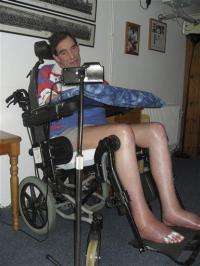
(AP) -- Former rugby player Tony Nicklinson had a high-flying job as a corporate manager in Dubai, where he went skydiving and bridge-climbing in his free time.
Seven years ago, he suffered a paralyzing stroke. Today he can only move his head, cannot speak and needs constant care.
And he wants to die.
To try to ensure that whoever ends his life won't be jailed, the 57-year-old Nicklinson recently asked Britain's High Court to declare that any doctor who gives him a lethal injection with his consent won't be charged with murder. This week, the court will hold its first hearing on the case.
"Most people who want to die, who are physically able to do so, can lawfully commit suicide," said Nicklinson's lawyer, Saimo Chahal.
But that's not the case for Nicklinson, who has "locked-in syndrome" - a condition in which a person's body is paralyzed but mind intact.
Under U.K. law, anyone who helps Nicklinson die could be charged with murder, even if they are carrying out his wishes. A murder charge has a mandatory life sentence, regardless of the motive or circumstances.
No one suspected of aiding a loved one's suicide has been charged with such a crime in Britain in recent years. But Nicklinson doesn't want to take any chances. Instead he wants to change the legal definition of murder to exclude euthanasia, arguably a long shot.
Emily Jackson, a medical law expert at London's School of Economics, said Nicklinson may have a plausible case. "He is making a very interesting argument," she said.
Euthanasia is legal in the Netherlands but requires a long-term relationship between doctors and patients, a rule that excludes most foreigners. Assisted suicide is legal in Switzerland, including for foreigners, but Nicklinson does not want to go there to die.
Nicklinson argues that British law hinders his right to "private and family life" - guaranteed by the European Convention on Human Rights - on the grounds that being able to choose how to die is a matter of personal autonomy.
"He argues that it's unfair on him and that a humane legal system would enable somebody in his circumstances, with considerable safeguards, to get help from a doctor to exercise a right, which he has in theory, but is deprived of in practice," Chahal said.
The Ministry of Justice has applied to dismiss Nicklinson's suit since it could involve changing the law - which must be done by Parliament, not the High Court.
Nicklinson communicates mostly by using a computer that detects his blinking. In a statement, he described his life as "dull, miserable, demeaning, undignified and intolerable."
He has refused since 2007 to take any life-prolonging drugs recommended by doctors, including heart drugs or blood thinners. He only takes medicines to make himself more comfortable, such as those to reduce muscle spasms. His wife, Jane, a trained nurse, said he could be at risk of another stroke or a heart attack.
Jane described her husband as "a real alpha male" who was very active before his stroke. "He was tall, dark and handsome," she says of the night they met on a blind date in Dubai. The two later also lived in Hong Kong, Malaysia and Britain with their two daughters. Nicklinson chaired a sports club that ran rugby events in the United Arab Emirates, mixing with elite players and officials.
"It was a dream come true for him," his wife said.
Jane said she and their two grown daughters didn't initially agree with her husband's choice to die. "It was very upsetting and obviously it's not what we want, but it's what he wants and it's his life," she said.
Nicklinson spends most of his days at a computer he controls by blinking, writing emails and surfing the web. Jane said he rarely leaves his room in their bungalow in rural Wiltshire, southwest England, except to watch television in the evenings. He's also writing his memoirs.
"It's amazing what he remembers," his wife said. "His mind is completely unaffected."
Like the renowned physicist Stephen Hawking, who recently turned 70, Nicklinson has not lost any of his intellectual capacities. Hawking has Lou Gehrig's disease, a degenerative condition that kills most people within a few years. He has repeatedly said he doesn't think about his physical limitations, which haven't prevented him from revolutionizing the understanding of black holes and the origins of the universe.
A recent British commission headed by a former justice secretary concluded there was a strong case for allowing assisted suicide under strict criteria. The commission was set up and funded by campaigners who want the current law changed. The report did not support euthanasia and recommended assisted suicide only be allowed for terminally ill people, which would exclude Nicklinson.
In 2009, the British government's top prosecutor said people who helped terminally ill relatives and friends die were unlikely to be charged if they acted out of compassion. From 2009 to 2011, 40 cases of people suspected of helping loved ones die were reported to the government prosecutor; none was charged.
In 2002, the Netherlands became the first country to legalize euthanasia, allowing doctors to end the lives of patients whose suffering is "unbearable and hopeless" - not just those with terminal illnesses. In recent years, the country's rates of euthanasia and physician-assisted suicide have risen slightly, but still account for less than 3 percent of all deaths.
Switzerland allows doctors to prescribe a fatal dose of medicine for patients to take themselves. Since 2001, more than 160 Britons have traveled to the Dignitas clinic, near Zurich, to die.
Nicklinson considered going to Switzerland, but his wife said he decided against it for several reasons, including the approximately 6,500 pound ($10,000) cost. Nicklinson is currently receiving legal aid from the government to cover most of his lawyer's fees.
Euthanasia is also legal in Belgium, Luxembourg and the state of Oregon in the United States.
Critics of euthanasia say the U.K. should focus more on improving care for the chronically and terminally ill instead of legislating mercy killing.
"I'm massively sympathetic to (Nicklinson's) situation, but I don't think we should change the law when it will impact hundreds of thousands of other people," said Dr. John Wiles, chairman of Care Not Killing, an alliance that opposes euthanasia. He warned that legalizing euthanasia might worsen treatment of elderly people and the terminally ill.
Wiles doubted enough safeguards could ever be in place. "However narrow you try to make it, in principle, we would be allowing the killing of other members of society for the first time," he said. "If we change the law, we'll be saying to people, `If you don't like the care you're getting, you can just end it.'"
The British Medical Association also opposes any changes that would permit assisted suicide or euthanasia. While patients have the right to their medical records, the group advises doctors to refuse to share such reports if they suspect the information will be used to commit assisted suicide abroad.
Nicklinson's wife, Jane, said her husband simply wants the right to choose when to end his life. She said he began asking to die as soon as he could start communicating after his stroke, once he realized he wouldn't improve.
"I've tried many times to change his mind, but he is adamant to see this through," she said.
©2012 The Associated Press. All rights reserved. This material may not be published, broadcast, rewritten or redistributed.


