New automated imaging to greatly speed whole-brain mapping efforts
January 15, 2012 in Medical research
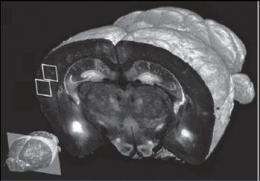
3-D rendering of coronal section of a mouse brain imaged with STP tomography at 20x at a resolution of half a micron. GFP-expressing pyramidal neurons in hippocampus and cortex are targeted.
A new technology developed by neuroscientists at Cold Spring Harbor Laboratory (CSHL) transforms the way highly detailed anatomical images can be made of whole brains. Until now, means of obtaining such images used in cutting-edge projects to map the mammalian brain -- have been painstakingly slow and available only to a handful of highly specialized research teams.
By automating and standardizing the process in which brain samples are divided into sections and then imaged sequentially at precise spatial orientations in two-photon microscopes, the team, led by Assoc. Prof. Pavel Osten and consisting of scientists from his CSHL lab and the Massachusetts Institute of Technology, has opened the door to making whole-brain mapping routine.
Specifically, says Osten, "the new technology should greatly facilitate the systematic study of neuroanatomy in mouse models of human brain disorders such as schizophrenia and autism."
The new technology, developed in concert with TissueVision of Cambridge, Mass. and reported on in a paper appearing online Jan. 15 in Nature Methods, is called Serial Two-Photon Tomography, or STP tomography. Tomography refers to any process (including the familiar CAT and PET scans used in medical diagnostics) that images an object section by section, by shooting penetrating waves through it. Computers powered by mathematical formulae reassemble the results to produce a three-dimensional rendering. Two-photon imaging is a type used in biology laboratories, particularly in conjunction with fluorescent biomarkers, which can be mobilized to illuminate specific cell types or other anatomical features. The two-photon method allows deeper optical penetration into the tissue being sampled than conventional confocal microscopy.
As Osten explains, STP tomography achieves high-throughput fluorescence imaging of whole mouse brains via robotic integration of the two fundamental steps -- tissue sectioning and fluorescence imaging. In their paper, his team reports on the results of several mouse-brain imaging experiments, which indicate the uses and sensitivity of the new tool. They conclude that it is sufficiently mature to be used in whole-brain mapping efforts such as the ongoing Allen Mouse Brain Atlas project.
One set of experiments tested the technology at different levels of resolution. At 10x magnification of brain tissue samples, they performed fast imaging "at a resolution sufficient to visualize the distribution and morphology of green-fluorescent protein-labeled neurons, including their dendrites and axons," Osten reports.
A full set of data, including final images, could be obtained by the team in 6.5 to 8.5 hours per brain, depending on the resolution. These sets each were comprised of 260 top-to-bottom, or coronal, slices of mouse brain tissue, which were assembled by computer into three-dimensional renderings themselves capable of a wide range of "warping," i.e., artificial manipulation, to reveal hidden structures and features.
"The technology is a practical one that can be used for scanning at various levels of resolution, ranging from 1 to 2 microns to less than a micron," Osten says. Scans at the highest resolution level take about 24 hours to collect. This makes possible an impressive saving of time, Osten says, compared to methods that are now in use. Using these, it would take an experienced technician about a week to collect a set of whole-brain images at high resolution, he noted.
"What is most exciting about this tool is its application in the study of mouse models of human illness, which we are already doing in my lab," Osten says. "We are focusing on making comparisons between different mouse models of schizophrenia and autism. Many susceptibility genes have been identified in both disorders one recent estimate by Dr. Mike Wigler's team here at CSHL put the figure at over 250 for autism spectrum disorders, for instance. Dr. Alea Mills at CSHL has published a mouse model of one genetic aberration in autism a region on chromosome 16 and soon we will have tens of models, each showing a different aberration.
"We will want to compare these mice, and that is essentially why we designed STP tomography to automate and standardize the process of collecting whole-brain images in which different cell-types or circuit tracings have been performed. This makes possible comparisons across different mouse models in an unbiased fashion."
More information: "Serial two-photon tomography: an automated method for mouse brain imaging," Nature Methods on January 15, 2012.
Journal reference:
Nature Methods
Provided by
Cold Spring Harbor Laboratory
-
New chemical reagent turns mouse brain transparent
Aug 31, 2011 |
not rated yet |
0
-
Scientists create 3-D models of whole mouse organs (w/ Video)
Jun 24, 2010 |
not rated yet |
0
-
3D View of the Brain
Jan 12, 2010 |
not rated yet |
0
-
New evidence for genetic basis of autism found
Oct 03, 2011 |
not rated yet |
0
-
Better Insight into Brain Anatomical Structures
May 29, 2007 |
not rated yet |
0
-
Motion perception revisited: High Phi effect challenges established motion perception assumptions
Apr 23, 2013 |
3 / 5 (2) |
2
-
Anything you can do I can do better: Neuromolecular foundations of the superiority illusion (Update)
Apr 02, 2013 |
4.5 / 5 (11) |
5
-
The visual system as economist: Neural resource allocation in visual adaptation
Mar 30, 2013 |
5 / 5 (2) |
9
-
Separate lives: Neuronal and organismal lifespans decoupled
Mar 27, 2013 |
4.9 / 5 (8) |
0
-
Sizing things up: The evolutionary neurobiology of scale invariance
Feb 28, 2013 |
4.8 / 5 (10) |
14
-
How can there be a term called "intestinal metaplasia" of stomach
10 hours ago
-
Pressure-volume curve: Elastic Recoil Pressure don't make sense
May 18, 2013
-
If you became brain-dead, would you want them to pull the plug?
May 17, 2013
-
MRI bill question
May 15, 2013
-
Ratio of Hydrogen of Oxygen in Dessicated Animal Protein
May 13, 2013
-
Alcohol and acetaminophen
May 13, 2013
- More from Physics Forums - Medical Sciences
More news stories
Common food supplement fights degenerative brain disorders
Widely available in pharmacies and health stores, phosphatidylserine is a natural food supplement produced from beef, oysters, and soy. Proven to improve cognition and slow memory loss, it's a popular treatment for older ...
Medical research
4 hours ago |
5 / 5 (1) |
0
|
Finding a family for a pair of orphan receptors in the brain
Researchers at Emory University have identified a protein that stimulates a pair of "orphan receptors" found in the brain, solving a long-standing biological puzzle and possibly leading to future treatments for neurological ...
Medical research
5 hours ago |
not rated yet |
0
|
Insight into the dazzling impact of insulin in cells
Australian scientists have charted the path of insulin action in cells in precise detail like never before. This provides a comprehensive blueprint for understanding what goes wrong in diabetes.
Medical research
5 hours ago |
4.5 / 5 (2) |
0
|
Do men's and women's hearts burn fuel differently?
Researchers at the University of Illinois at Chicago College of Medicine will study gender differences in how the heart uses and stores fat—its main energy source—and how changes in fat metabolism play ...
Medical research
8 hours ago |
not rated yet |
0
Study suggests new source of kidneys for transplant
Nearly 20 percent of kidneys that are recovered from deceased donors in the U.S. are refused for transplant due to factors ranging from scarring in small blood vessels of the kidney's filtering units to the organ going too ...
Medical research
May 20, 2013 |
5 / 5 (2) |
0
|
Antidepressant reduces stress-induced heart condition
A drug commonly used to treat depression and anxiety may improve a stress-related heart condition in people with stable coronary heart disease, according to researchers at Duke Medicine.
Americans still making unhealthy choices, CDC reports
(HealthDay)—The overall health of Americans isn't improving much, with about six in 10 people either overweight or obese and large numbers engaging in unhealthy behaviors like smoking, heavy drinking or ...
CDC presents recent trends in health behaviors of US adults
(HealthDay)—In 2008 to 2010, the prevalence of key health behaviors among U.S. adults varied, with about one in five adults current smokers and 62.1 percent overweight or obese, according to a report presented ...
Study examines outbreak of spinal infections in Michigan
(HealthDay)—Factors such as increased case finding may explain why Michigan had half of the total spinal infections associated with contaminated methylprednisolone acetate in the recent fungal meningitis ...
Early use of tracheostomy for mechanically ventilated patients not associated with improved survival
For critically ill patients receiving mechanical ventilation, early tracheostomy (within the first 4 days after admission) was not associated with an improvement in the risk of death within 30 days compared to patients who ...
CDC says high number of public pools contain microbes
(HealthDay)—Three-quarters of public schools in the metro Atlanta area contain microbes, including bacteria indicating the presence of fecal matter, according to research published in the May 17 issue of ...
Jan 15, 2012
Rank: 1.3 / 5 (4)
Jan 15, 2012
Rank: 5 / 5 (6)
Classic response. This happens all the time around here. He starts off by acknowledging is ignorance on the topic: "One hopes". Then procedes to condemn the whole thing based on that ignorance: "but this is very unlikely" To top it off he completely reveals his bias to all: "More do with grant gaming by animal researchers".
So lets get to the heart of the matter: Do such models exist and are they helpful?
http://www.scienc...3308.htm
mice with schizophrenia
http://www.nature...324.html
mice with autism.
Both point out obvious shortcomings but also all the extra insight they given human researchers.
@Squirrel: Maybe before you accuse a research team of incompetence and deception you should resolve your acknowledged ignorance on the topic.
Jan 16, 2012
Rank: not rated yet