Diet supplemented with specific probiotic bacterial strain increases mice lifespan
January 6, 2012 in Medical research
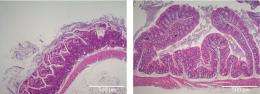
Figure 1: Compared with untreated aging mice (left), LKM512 maintains a healthy gut lining in treated aging mice (right) (scale bar, 500 μm). Credit: Reproduced from Ref. 1 © 2011 Mitsuharu Matsumoto et al.
The mammalian gut is home to hundreds of bacterial species that contribute to food digestion and, in some cases, inflammatory gut diseases. Probiotics, beneficial bacterial species, can enhance gut health by keeping the resident bacteria in check. Now, a team of researchers at the RIKEN Innovation Center in Wako, including Mitsuharu Matsumoto, report that administration of the probiotic bacterial strain Bifidobacterium animalis subspecies lactis LKM512 to mice can lengthen their lifespan.
Matsumoto and colleagues previously showed that LKM512 could reduce inflammatory markers in elderly humans and modify the makeup of intestinal bacteria, but the effects of it on lifespan still required investigation. After starting 10-month-old mice on a diet including LKM512 for 11 months, the researchers found that LKM512-treated mice lived longer, had fewer skin lesions, and had better hair quality than untreated mice.
Analyses of the gut of these mice revealed elevated gene expression in some bacterial species compared with control mice, indicating that LKM512 may improve gut health indirectly by regulating the levels of other bacterial species. The LKM512 treatment also prevented some age-related changes in bacterial composition of the gut, suggesting that the probiotic treatment protects the gut from developing characteristics associated with aging.
Acting as a barrier between the bacteria and food within the gut and the rest of the human body is an important role of the gut lining. Breakdown of this lining can cause infectious or inflammatory diseases. The researchers found that the gut of LKM512-treated mice served as a stronger barrier than the gut of control mice. LKM512 seemed to perform this function by increasing the expression of various proteins that maintain the tight connection between gut epithelial cells.
Polyamines are chemicals that reduce inflammation, and their levels decrease as an individual ages. Matsumoto and colleagues observed increases in intestinal polyamine levels in LKM512-treated mice, which may be caused by the greater numbers of bacteria promoted by LKM512. The increase in polyamines caused by LKM512 appeared to reduce inflammation in the body of the mice, as inflammatory markers in the blood and urine were lower in LKM512-treated mice compared with controls. In aged mice treated with LKM512, inflammatory marker levels were similar to those observed in younger mice, indicating that adults can benefit from probiotics.
In future work, we hope to clarify the effectiveness of LKM512 in humans, explains Matsumoto. If the findings extend to humans, inclusion of LKM512 into the human diet could enhance overall health and increase the human lifespan.
More information: Matsumoto, M., et al. Longevity in mice is promoted by probiotic-induced suppression of colonic senescence dependent on upregulation of gut bacterial polyamine production. PLoS ONE 6, e23652 (2011).
Matsumoto, M., Ohishi, H. & Benno, Y. Impact of LKM512 yogurt on improvement of intestinal environment of the elderly. FEMS Immunology & Medical Microbiology 31, 181186 (2001).
Provided by
RIKEN
-
Gastrointestinal inflammation prevented by protein sorting factor found in cells lining the gut
Oct 14, 2011 |
not rated yet |
0
-
Overweight? Get someone else's gut bacteria
Mar 18, 2011 |
not rated yet |
0
-
Researchers find gut bacteria teaches immune cells to see them as friendly
Sep 22, 2011 |
not rated yet |
0
-
Gut microbe makeup affected by diet: study
Sep 02, 2011 |
not rated yet |
0
-
That anxiety may be in your gut, not in your head
May 17, 2011 |
not rated yet |
0
-
Of mice and mental models: Neuroscientific implications of risk-optimized behavior in the mouse
May 25, 2012 |
not rated yet |
0
-
Limits to growth: Scientists identify key metastasis-enabling enzyme
May 22, 2012 |
5 / 5 (4) |
0
-
Seeing is as seeing does: Spatially-structured retinal input in early development of cortical maps
Apr 26, 2012 |
5 / 5 (4) |
1
-
Dreamless nights: Brain activity during nonrapid eye movement sleep
Apr 09, 2012 |
4.4 / 5 (12) |
0
-
Take your time: Neurobiology sheds light on the superiority of spaced vs. massed learning
Mar 28, 2012 |
4.5 / 5 (21) |
3
-
Potential Breakthrough in Seizure Control
15 hours ago
-
Popping/Cracked sternum.
20 hours ago
-
Which Mental Illness Encompasses This Problem?
20 hours ago
-
A question about drug tolerance
May 23, 2012
-
Poor nutrition leading to overeating?
May 23, 2012
-
Math and dyslexia?
May 21, 2012
- More from Physics Forums - Medical Sciences
More news stories
Implantable pain disk may help those with cancer
An estimated 3.5 million cancer patients around the globe are in severe pain from their disease, but many get no relief.
Medical research
May 25, 2012 |
5 / 5 (1) |
0
|
Energy levels link sleep control mechanisms
Sleep, or lack of it, can determine level of cognitive performance which is linked with accidents as well as increased risk of serious health problems. Links between cell energy levels, gene transcription ...
Medical research
May 25, 2012 |
not rated yet |
0
Researchers identify key brain cell in antidepressant action
(Medical Xpress) -- Antidepressant medications such as Prozac have helped improve mood and lessen anxiety in millions of people with major depression. But scientists know surprisingly little about how these drugs work.
Medical research
May 25, 2012 |
4.7 / 5 (3) |
0
|
Rockefeller scientists pioneer new method to determine mechanisms of drug action
(Medical Xpress) -- Knowing that a drug works is great. Knowing how it works is a luxury. And until now, determining a drugs mechanism of action has been a tedious and difficult process for scientists.
Medical research
May 25, 2012 |
not rated yet |
0
|
Like curry? New biological role identified for compound used in ancient medicine
Scientists have just identified a new reason why some curry dishes, made with spices humans have used for thousands of years, might be good for you.
Medical research
May 25, 2012 |
4.5 / 5 (12) |
2
|
Keep food safety in mind this memorial day weekend
(HealthDay) -- Picnics, parades and cookouts are as much a part of Memorial Day weekend as tributes to the United States' war veterans.
Travel to high altitudes tied to Crohn's, colitis flare-ups
(HealthDay) -- People with inflammatory bowel disease, which includes Crohn's disease and colitis, may be at increased risk for flare-ups when they fly or travel to high altitudes for skiing or mountain climbing, ...
Family history of Alzheimer's affects functional connectivity
(HealthDay) -- Cognitively normal individuals with a family history of late-onset Alzheimer's disease (AD) may display lower resting state functional connectivity in the default mode network (DMN) of the brain, ...
Transvaginal mesh op restores pelvic organ prolapse at price
(HealthDay) -- Transvaginal mesh (TVM) procedures are effective for anatomical restoration of pelvic organ prolapse (POP), but patients report a worsening of sexual function following surgery, according to ...
Of mice and mental models: Neuroscientific implications of risk-optimized behavior in the mouse
(Medical Xpress) -- Regardless of an organism’s biological complexity, every encephalized animal continuously makes under-informed behavioral choices that can have serious consequences. Despite its ubiquity, ...
Weight struggles? Blame new neurons in your hypothalamus
New nerve cells formed in a select part of the brain could hold considerable sway over how much you eat and consequently weigh, new animal research by Johns Hopkins scientists suggests in a study published in the May issue ...
Jan 06, 2012
Rank: not rated yet