Dried licorice root fights the bacteria that cause tooth decay and gum disease
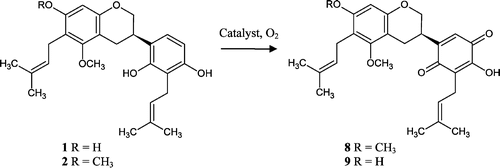
Scientists are reporting identification of two substances in licorice used extensively in Chinese traditional medicine that kill the major bacteria responsible for tooth decay and gum disease, the leading causes of tooth loss in children and adults. In a study in ACS' Journal of Natural Products, they say that these substances could have a role in treating and preventing tooth decay and gum disease.
Stefan Gafner and colleagues explain that the dried root of the licorice plant is a common treatment in Chinese traditional medicine, especially as a way to enhance the activity of other herbal ingredients or as a flavoring. Despite the popularity of licorice candy in the U.S., licorice root has been replaced in domestic candy with anise oil, which has a similar flavor. Traditional medical practitioners use dried licorice root to treat various ailments, such as respiratory and digestive problems, but few modern scientific studies address whether licorice really works. (Consumers should check with their health care provider before taking licorice root because it can have undesirable effects and interactions with prescription drugs.) To test whether the sweet root could combat the bacteria that cause gum disease and cavities, the researchers took a closer look at various substances in licorice.
They found that two of the licorice compounds, licoricidin and licorisoflavan A, were the most effective antibacterial substances. These substances killed two of the major bacteria responsible for dental cavities and two of the bacteria that promote gum disease. One of the compounds licoricidin also killed a third gum disease bacterium. The researchers say that these substances could treat or even prevent oral infections.
More information: Isoflavonoids and Coumarins from Glycyrrhiza uralensis: Antibacterial Activity against Oral Pathogens and Conversion of Isoflavans into Isoflavan-Quinones during Purification, J. Nat. Prod., 2011, 74 (12), pp 25142519. DOI: 10.1021/np2004775
Abstract
Phytochemical investigation of a supercritical fluid extract of Glycyrrhiza uralensis has led to the isolation of 20 known isoflavonoids and coumarins, and glycycarpan (7), a new pterocarpan. The presence of two isoflavan-quinones, licoriquinone A (8) and licoriquinone B (9), in a fraction subjected to gel filtration on Sephadex LH-20 is due to suspected metal-catalyzed oxidative degradation of licoricidin (1) and licorisoflavan A (2). The major compounds in the extract, as well as 8, were evaluated for their ability to inhibit the growth of several major oral pathogens. Compounds 1 and 2 showed the most potent antibacterial activities, causing a marked growth inhibition of the cariogenic species Streptococcus mutans and Streptococcus sobrinus at 10 μg/mL and the periodontopathogenic species Porphyromonas gingivalis (at 5 μg/mL) and Prevotella intermedia (at 5 μg/mL for 1 and 2.5 μg/mL for 2). Only 1 moderately inhibited growth of Fusobacterium nucleatum at the highest concentration tested (10 μg/mL).
Journal reference:
Journal of Natural Products
Provided by
American Chemical Society
-
Licorice may block effectiveness of drug widely used by transplant patients
Mar 24, 2009 |
not rated yet |
0
-
Injections of licorice ingredient show promise as treatment for cocaine addiction
Feb 20, 2009 |
not rated yet |
0
-
Sweet magnolia: Tree bark extract fights bad breath and tooth decay
Nov 19, 2007 |
not rated yet |
0
-
Enjoy candy without the cavities thanks to a UCLA professor of dentistry
Jan 29, 2008 |
not rated yet |
0
-
Little-known mouth fluid may lead to test for gum disease
May 26, 2010 |
not rated yet |
0
-
Motion perception revisited: High Phi effect challenges established motion perception assumptions
Apr 23, 2013 |
3 / 5 (2) |
2
-
Anything you can do I can do better: Neuromolecular foundations of the superiority illusion (Update)
Apr 02, 2013 |
4.5 / 5 (11) |
5
-
The visual system as economist: Neural resource allocation in visual adaptation
Mar 30, 2013 |
5 / 5 (2) |
9
-
Separate lives: Neuronal and organismal lifespans decoupled
Mar 27, 2013 |
4.9 / 5 (8) |
0
-
Sizing things up: The evolutionary neurobiology of scale invariance
Feb 28, 2013 |
4.8 / 5 (10) |
14
-
Classical and Quantum Mechanics via Lie algebras
Apr 15, 2011
- More from Physics Forums - Independent Research
More news stories
Life expectancy gap widens between those with mental illness and general population
The gap between life expectancy in patients with a mental illness and the general population has widened since 1985 and efforts to reduce this gap should focus on improving physical health, suggest researchers in a paper ...
Health
3 hours ago |
not rated yet |
0
Failure to use linked health records may lead to biased disease estimates
Failure to use linked electronic health records may lead to biased estimates of heart attack incidence and outcome, warn researchers in a paper published in BMJ today.
Health
3 hours ago |
not rated yet |
0
Dietary advice on added sugar is damaging our health, warns heart expert
Dietary advice on added sugar is damaging our health, warns a cardiologist in BMJ today. Dr. Aseem Malhotra believes that "not only has this advice been manipulated by the food industry for profit but it is actually a risk ...
Health
3 hours ago |
5 / 5 (1) |
0
CDC presents recent trends in health behaviors of US adults
(HealthDay)—In 2008 to 2010, the prevalence of key health behaviors among U.S. adults varied, with about one in five adults current smokers and 62.1 percent overweight or obese, according to a report presented ...
Health
6 hours ago |
5 / 5 (1) |
0
Americans still making unhealthy choices, CDC reports
(HealthDay)—The overall health of Americans isn't improving much, with about six in 10 people either overweight or obese and large numbers engaging in unhealthy behaviors like smoking, heavy drinking or ...
Health
6 hours ago |
not rated yet |
0
If you can remember it, you can remember it wrong
(Medical Xpress)—Native peoples in regions where cameras are uncommon sometimes react with caution when their picture is taken. The fear that something must have been stolen from them to create the photo ...
B vitamins could delay dementia
(Medical Xpress)—Despite spending billions of dollars on research and development, drug companies have been unable to come up with effective treatments for dementia and Alzheimer's Disease (AD). Now, A. ...
New sleeping pill poised to hit US markets
An experimental sleeping pill from US drug company Merck is effective at helping people fall and stay asleep, according to reviewers at the US Food and Drug Administration, which could soon approve the new drug.
Reducing caloric intake delays nerve cell loss
Activating an enzyme known to play a role in the anti-aging benefits of calorie restriction delays the loss of brain cells and preserves cognitive function in mice, according to a study published in the May ...
Insight into the dazzling impact of insulin in cells
Australian scientists have charted the path of insulin action in cells in precise detail like never before. This provides a comprehensive blueprint for understanding what goes wrong in diabetes.
Antidepressant reduces stress-induced heart condition
A drug commonly used to treat depression and anxiety may improve a stress-related heart condition in people with stable coronary heart disease, according to researchers at Duke Medicine.
Jan 04, 2012
Rank: not rated yet