Researchers identify facial expression for anxiety
January 16, 2012 in Psychology & Psychiatry
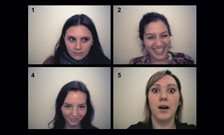
Anxiety (1); Happiness (2); Surprise (5); Interest (4)
(Medical Xpress) -- Researchers from the Institute of Psychiatry (IoP) at King's College London have, for the first time, identified the facial expression of anxiety. The facial expression for the emotion of anxiety comprises an environmental scanning look that appears to aid risk assessment. The research was published this week in the Journal of Personality and Social Psychology.
Dr. Adam Perkins, lead author of the study at the IoP at King's says: 'Our research group focuses on understanding the causes of anxiety. No one knows exactly what anxiety is. However many animal studies link it to risk assessment behaviour, suggesting anxiety can be explained as a defensive adaptation. We wanted to see if this was also the case in humans.'
The researchers described specific scenarios likely to elicit standard emotions, such as happiness, sadness, anger, disgust and surprise to a group of participants. They also described scenarios containing ambiguous threats, which are known to elicit risk assessment and anxiety in rodents. Participants were asked to pose whatever facial expression they judged appropriate to the scenarios. A second group of individuals were shown photos and videos of the facial expressions generated in response to the scenarios and asked to match the facial expressions back to the original selection of scenarios. They were also asked to generate an emotion label for each facial expression that they matched to a scenario.
This video is not supported by your browser at this time.
Facial expression images were correctly matched in 89% of emotive scenario presentations on average. The facial expression generated in response to an ambiguous threat scenario was correctly matched to ambiguously threatening scenarios in 90% of scenario presentations.A third group of participants preferentially matched this facial expression with the label anxiety, not fear or any other major emotion. The characteristics of the facial expression for anxiety comprised darting eyes and head swivels that echoed the risk assessment behaviour of anxious rodents. These results suggest that the anxious facial expression in humans serves to increase information gathering and knowledge of the potentially threatening environment through expanding the individuals visual and auditory fields. Therefore the anxious facial expression appears to have both functional and social components - its characteristics help assess our surrounding environment, and communicate to others our emotional state.
Dr. Perkins adds: 'We hope our findings will in due course help doctors more effectively diagnose anxiety in their patients. We also think the findings may also help security personnel identify individuals engaged in wrongdoing by means of their anxious, risk assessing facial expression.'
To watch the video associated with the study, please click here.
More information: Perkins, A. A facial expression for anxiety Journal of Personality and Social Psychology (January 2012) doi: 10.1037/a0026825
Journal reference:
Journal of Personality and Social Psychology
Provided by
King's College London
-
Brain takes just 200 milliseconds to interpret facial expressions
May 26, 2009 |
not rated yet |
0
-
Researcher develops image processing system that detects moods
Dec 02, 2008 |
not rated yet |
0
-
Study: Facial expressions of emotion are innate, not learned
Dec 29, 2008 |
not rated yet |
0
-
Expressionless faces provide clues on how we read emotions
Apr 15, 2010 |
not rated yet |
0
-
A facial expression is worth a thousand words
Dec 28, 2009 |
not rated yet |
0
-
Motion perception revisited: High Phi effect challenges established motion perception assumptions
Apr 23, 2013 |
3 / 5 (2) |
2
-
Anything you can do I can do better: Neuromolecular foundations of the superiority illusion (Update)
Apr 02, 2013 |
4.5 / 5 (11) |
5
-
The visual system as economist: Neural resource allocation in visual adaptation
Mar 30, 2013 |
5 / 5 (2) |
9
-
Separate lives: Neuronal and organismal lifespans decoupled
Mar 27, 2013 |
4.9 / 5 (8) |
0
-
Sizing things up: The evolutionary neurobiology of scale invariance
Feb 28, 2013 |
4.8 / 5 (10) |
14
-
Why is zone 1 in liver more prone to ischemic injury?
May 23, 2013
-
How can there be villous adenoma in colon, if there are no villi there
May 22, 2013
-
How can there be a term called "intestinal metaplasia" of stomach
May 21, 2013
-
Pressure-volume curve: Elastic Recoil Pressure don't make sense
May 18, 2013
-
If you became brain-dead, would you want them to pull the plug?
May 17, 2013
-
MRI bill question
May 15, 2013
- More from Physics Forums - Medical Sciences
More news stories
Storm chasers: born to be wild?
(HealthDay)—We've all seen them: the surfers who race to the beach when a hurricane hits, the guy who decides to ride out the storm in his overmatched boat, the tornado chasers who fearlessly steer their ...
Psychology & Psychiatry
10 hours ago |
not rated yet |
0
Hormone levels may provide key to understanding psychological disorders in women
Women at a particular stage in their monthly menstrual cycle may be more vulnerable to some of the psychological side-effects associated with stressful experiences, according to a study from UCL.
Psychology & Psychiatry
11 hours ago |
3.7 / 5 (3) |
0
|
Are there atheists in foxholes? Study says they're the minority
Ernie Pyle – an iconic war correspondent in World War II – reportedly said "There are no atheists in foxholes." A new joint study between two brothers at Cornell and Virginia Wesleyan found that only ...
Psychology & Psychiatry
14 hours ago |
2.5 / 5 (4) |
1
Breathing exercises help veterans find peace after war, scholar says
(Medical Xpress)—Research by Stanford scholar Emma Seppala at the Center for Compassion and Altruism Research and Education found that post-traumatic stress disorder decreased in veterans who participated ...
Psychology & Psychiatry
14 hours ago |
5 / 5 (1) |
0
Depression raises diabetics' risk of severe low blood sugar episodes
(Medical Xpress)—Patients with diabetes who are depressed are much more likely to develop episodes of dangerously low blood sugars, or hypoglycemia, than are those who are not depressed, a new study has ...
Psychology & Psychiatry
15 hours ago |
not rated yet |
0
|
Engineered cytomegalovirus protects monkeys from HIV equivalent
(Medical Xpress)—A new study by researchers in the US has shown that an ancient virus can be modified to help in the fight against the simian immunodeficiency virus SIV, which is the equivalent in monkeys ...
Researchers identify first drug targets in childhood genetic tumor disorder
Two mutations central to the development of infantile myofibromatosis (IM)—a disorder characterized by multiple tumors involving the skin, bone, and soft tissue—may provide new therapeutic targets, according to researchers ...
Going live: Immune cell activation in multiple sclerosis
Biological processes are generally based on events at the molecular and cellular level. To understand what happens in the course of infections, diseases or normal bodily functions, scientists would need to ...
Driving and hands-free talking lead to spike in errors, study shows
Talking on a hands-free device while behind the wheel can lead to a sharp increase in errors that could imperil other drivers on the road, according to new research from the University of Alberta.
Help at hand for people with schizophrenia
How can healthy people who hear voices help schizophrenics? Finding the answer for this is at the centre of research conducted at the University of Bergen.
Alzheimer's disease, the soft target of the euthanasia debate
(Medical Xpress)—The way Alzheimer's disease is portrayed by advocacy groups and the media is having undue influence on the euthanasia debate, according to a Deakin University nursing ethics professor.
Jan 16, 2012
Rank: 5 / 5 (2)
Jan 16, 2012
Rank: 1 / 5 (1)
This.
Jan 23, 2012
Rank: not rated yet
Experience is one prerequisite.
Empathy is another prerequisite.
You have asserted an objective measure of anxiety.
What is the height...?(*)
(*)...of the tightrope above the ground you tread?(**)
(**)Before your anxiety is no longer a part of your act.
You know as much as about this as the article reporting this 'research' about anxiety(***)
(***)Nothing.