Mouse brains keyed to speed
January 25, 2012 by R. Alan Leo in Neuroscience
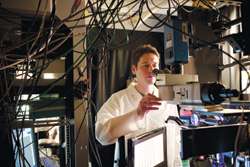
Research Fellow Marc Andermann studies mouse vision in the lab of Neurobiology Professor Clay Reid
(Medical Xpress) -- Its hard to be a mouse. Youre a social animal, but your fellows are small and scattered. Youre a snack to a bestiary of fast, eagle-eyed predators, not least the eagle. Youre fast too, but your spatial vision is poor around 20/200. So whats a mouse to do?
For starters, pay attention.
Or specifically, pay attention to small, slow-moving shapes like other mice and big, fast ones the kind you see when youre running for your life. Evolve specialized regions of the brain to process such cues. And keep moving.
Those regions are the subject of imaging research at Harvard Medical School aimed at revealing how distinct brain areas respond to different visual stimuli in the visual cortex of mice. The findings not only shed new light on mammalian vision, but also open a new avenue for exploring the mysteries of the brain.
The cortex is really the crowning glory of brain evolution; its what allows us to think and be human, said Clay Reid, HMS professor of neurobiology and senior author on a paper reporting the findings Dec. 22 in the journal Neuron. And we know that one of the hallmarks of our cortex is that there are dozens of distinct cortical areas that do different things. And the best studied part of the cortex in any species, is the visual system, particularly the multiple visual areas in primates, including ourselves.
To explore how the mouse brain responded to different visual stimuli, the researchers tagged neurons in and around the primary visual cortex with a chemical that fluoresced when the neurons fired. They then showed the mice patterns that moved across a screen at different speeds, recording neural activity as the mice watched. The researchers found that the primary visual cortex contained a mix of neurons that responded to various types of stimuli, while adjacent areas were more specialized, some for larger, faster visual cues, others for smaller, slower ones.
The types of specialization made sense, the researchers said, when one considers the challenges mice face, such as identifying other mice, or navigating at high speeds. You have to think like a mouse to ask what the different mouse visual areas might be doing, said Mark Andermann, a neurobiology postdoctoral fellow in the Reid laboratory, and lead author on the paper.
The research, among the first to examine how different cortical areas in the mouse are specialized for processing different aspects of visual inputs, draws together two key areas of brain science: On the one hand, vision studies in humans and other primates have propelled the field of cognitive neuroscience over the last half century. Scientists know today that primates, including humans, have 20 or more different areas that are specialized to perceive such things as color, motion and complex forms like faces.
At the same time, the mouse is rapidly becoming the best-studied species in neuroscience, including studies of the cortex. So discovering that, like us, mice have distinct processing streams in visual cortical areas lays the foundation for new efforts in cognitive neuroscience that can exploit the powerful genetic tools available only in the mouse. As a result, researchers can explore more deeply the neurological basis of behavior.
The mouse brain has other features that make it attractive to researchers. Where the human brain resembles a giant, wrinkly walnut, the peanut-sized mouse brain is also peanut smooth, the better for imaging. And where the human brain has about 100 billion neurons with about 5 billion in visual areas, the mouse has only 100 million neurons, with a less daunting figure of 1 million to 2 million in visual areas.
Even though the visual cortex is more than 1,000 times smaller in mice than in humans, Reid said, its amazing that we have so many things in common.
Provided by
Harvard Medical School
-
Scientists map the frontiers of vision
Jan 06, 2012 |
not rated yet |
0
-
Picower research finds unexpected activity in visual cortex
Mar 16, 2006 |
not rated yet |
0
-
Scientists make brain signal discovery
Jul 06, 2011 |
not rated yet |
0
-
Filters that reduce 'brain clutter' identified
Apr 14, 2011 |
not rated yet |
0
-
Timing is key in the proper wiring of the brain: study
Dec 19, 2011 |
not rated yet |
0
-
Motion perception revisited: High Phi effect challenges established motion perception assumptions
Apr 23, 2013 |
3 / 5 (2) |
2
-
Anything you can do I can do better: Neuromolecular foundations of the superiority illusion (Update)
Apr 02, 2013 |
4.5 / 5 (11) |
5
-
The visual system as economist: Neural resource allocation in visual adaptation
Mar 30, 2013 |
5 / 5 (2) |
9
-
Separate lives: Neuronal and organismal lifespans decoupled
Mar 27, 2013 |
4.9 / 5 (8) |
0
-
Sizing things up: The evolutionary neurobiology of scale invariance
Feb 28, 2013 |
4.8 / 5 (10) |
14
-
Pressure-volume curve: Elastic Recoil Pressure don't make sense
May 18, 2013
-
If you became brain-dead, would you want them to pull the plug?
May 17, 2013
-
MRI bill question
May 15, 2013
-
Ratio of Hydrogen of Oxygen in Dessicated Animal Protein
May 13, 2013
-
Alcohol and acetaminophen
May 13, 2013
-
Marie Curie's leukemia
May 13, 2013
- More from Physics Forums - Medical Sciences
More news stories
Leading researchers report on the elusive search for biomarkers in Huntington's disease
While Huntington's disease (HD) is currently incurable, the HD research community anticipates that new disease-modifying therapies in development may slow or minimize disease progression. The success of HD research depends ...
Neuroscience
7 hours ago |
not rated yet |
0
Study shows premature birth interrupts vital brain development processes leading to reduced cognitive abilities
Researchers from King's College London have for the first time used a novel form of MRI to identify crucial developmental processes in the brain that are vulnerable to the effects of premature birth. This new study, published ...
Neuroscience
10 hours ago |
not rated yet |
0
|
Researchers find far-reaching, microvascular damage in uninjured side of brain after stroke
While the effects of acute stroke have been widely studied, brain damage during the subacute phase of stroke has been a neglected area of research. Now, a new study by the University of South Florida reports that within a ...
Neuroscience
12 hours ago |
not rated yet |
0
|
Neurons that can multitask greatly enhance the brain's computational power, study finds
Over the past few decades, neuroscientists have made much progress in mapping the brain by deciphering the functions of individual neurons that perform very specific tasks, such as recognizing the location ...
Neuroscience
15 hours ago |
4.9 / 5 (9) |
1
|
For combat veterans suffering from post-traumatic stress disorder, 'fear circuitry' in the brain never rests
Chronic trauma can inflict lasting damage to brain regions associated with fear and anxiety. Previous imaging studies of people with post-traumatic stress disorder, or PTSD, have shown that these brain regions can over-or ...
Neuroscience
May 18, 2013 |
5 / 5 (1) |
0
|
Early-life traffic-related air pollution exposure linked to hyperactivity
Early-life exposure to traffic-related air pollution was significantly associated with higher hyperactivity scores at age 7, according to new research from the University of Cincinnati (UC) and Cincinnati Children's Hospital ...
Resistance to last-line antibiotic makes bacteria resistant to immune system
Bacteria resistant to the antibiotic colistin are also commonly resistant to antimicrobial substances made by the human body, according to a study in mBio, the online open-access journal of the American Society for Microb ...
New immune system discovered
(Medical Xpress)—A research team, led by Jeremy Barr, a biology post-doctoral fellow, unveils a new immune system that protects humans and animals from infection.
The compound in the Mediterranean diet that makes cancer cells 'mortal'
New research suggests that a compound abundant in the Mediterranean diet takes away cancer cells' "superpower" to escape death. By altering a very specific step in gene regulation, this compound essentially re-educates cancer ...
Scientists identify molecular trigger for Alzheimer's disease
Researchers have pinpointed a catalytic trigger for the onset of Alzheimer's disease – when the fundamental structure of a protein molecule changes to cause a chain reaction that leads to the death of neurons ...
Do salamanders hold the solution to regeneration?
Salamanders' immune systems are key to their remarkable ability to regrow limbs, and could also underpin their ability to regenerate spinal cords, brain tissue and even parts of their hearts, scientists have ...