Newly identified type of immune cell may be important protector against sepsis
January 12, 2012 in Immunology

Newly identified type of immune cell may be important protector against sepsis

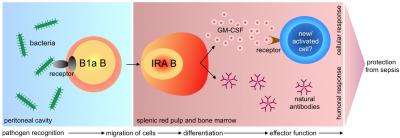
The precursors of IRA-B cells, B1a B cells, reside in the peritoneal cavity. When B1a cells recognize bacteria infecting the peritoneal cavity, they migrate out of the peritoneal cavity, accumulate in the red pulp of the spleen or the bone marrow, and become IRA-B cells that secrete abundant amounts of GM-CSF. This growth factor acts on cells expressing its receptor, arming the innate immune response for efficient bacterial clearance. Credit: Filip Swirski, Ph.D., MGH Center for Systems Biology

Investigators in the Massachusetts General Hospital (MGH) Center for Systems Biology have discovered a previously unknown type of immune cell, a B cell that can produce the important growth factor GM-CSF, which stimulates many other immune cells. They also found that these novel cells may help protect against the overwhelming, life-threatening immune reaction known as sepsis.

"B cells are a family of that secrete antibodies, and GM-CSF induces the production or activation of granulocytes and , other white blood cells that have specific roles in the immune system," says Filip Swirski, PhD, of the Center for , senior author of the report that is to be published in the journal Science and is receiving advance release on the Science Express website. "Our findings are surprising not only because B cells were not previously known to produce GM-CSF in vivo but also because they indicate these novel cells initiate an important immune response."

As part of a separate investigation, Swirski and his team analyzed production of GM-CSF (granulocyte macrophage colony-stimulating factor) in tissue from several important organs. They were surprised to find that application of a bacterial molecule known to produce a powerful immune response induced GM-CSF production by what turned out to be a previously unknown family of B cells in the spleen. Because GM-CSF is known to activate white blood cells as part of the – the body's first line defence against pathogens – the novel cells were named innate response activator (IRA) B cells.

The researchers went on to identify distinguishing characteristics of IRA-B cells, including gene expression patterns not seen in other B cells. They also determined that IRA-B cells derive from B cells known as B1a B cells. These IRA-B cell precursors originally reside in the peritoneal cavity but, after detecting the presence of invading bacteria, travel to the spleen or bone marrow where they differentiate into IRA-B cells that can either produce antibodies or release GM-CSF.

"While the IRA-B cell shares many attributes with other B cells, it is unique in its involvement with GM-CSF production," explains Clinton Robbins, PhD, co-lead author of the Science article. "Instead of the classic way that B cells recognize antigens, B1a B cells produce IRA-B cells after recognizing bacteria via a type of receptor known to be involved in the first steps of inflammation. The IRA-B cell, therefore, appears to be an early orchestrator of the immune system."

To test the potential role of IRA-B cells in sepsis, the researchers developed a mouse model in which were totally unable to produce GM-CSF, preventing the generation of IRA-B cells. Those mice were unable to mount a defense against induced sepsis and died much earlier and in greater numbers than did control animals. Inflammatory markers in the infected mice lacking IRA-B cells suggested a defect in the ability to clear bacteria.

"We think that IRA-B cells sound a distress call when they deliver GM-CSF to the spleen, an organ where known to be important to the recognition and clearance of bacteria reside," explains Swirski, an immunologist who is an assistant professor of Radiology at Harvard Medical School. " is an immunological conundrum. On the one hand it results from failure of the immune system to control infection. On the other hand, that do respond inflict damage and contribute to complications such as leakage of blood vessel walls and septic shock. Striking a balance between controlling infection and controlling inflammation is a major therapeutic goal, and we believe the IRA-B cell is a critical, previously unrecognized component in that balance."

Provided by Massachusetts General Hospital search and more info website

5 /5 (1 vote)  

Rank 5 /5 (1 vote)
Relevant PhysicsForums posts

More news stories

New immune system discovered

(Medical Xpress)—A research team, led by Jeremy Barr, a biology post-doctoral fellow, unveils a new immune system that protects humans and animals from infection.

Immunology created May 20, 2013 | popularity 4.8 / 5 (23) | comments 8 | with audio podcast

Vitamin D could provide new and effective treatments for asthma

(Medical Xpress)—Scientists at King's College London have discovered that Vitamin D has the potential to significantly reduce the symptoms of asthma. The study, led by Professor Catherine Hawrylowicz from ...

Immunology created May 20, 2013 | popularity 5 / 5 (1) | comments 0 | with audio podcast

Immune protein could stop diabetes in its tracks

Melbourne researchers have identified an immune protein that has the potential to stop or reverse the development of type 1 diabetes in its early stages, before insulin-producing cells have been destroyed.

Immunology created May 20, 2013 | popularity 5 / 5 (5) | comments 0 | with audio podcast

Stem-cell-based strategy boosts immune system in mice

Raising hopes for cell-based therapies, UC San Francisco researchers have created the first functioning human thymus tissue from embryonic stem cells in the laboratory. The researchers showed that, in mice, ...

Immunology created May 16, 2013 | popularity 4.8 / 5 (5) | comments 0 | with audio podcast

Resistance to visceral leishmaniasis: New mechanisms involved

Researchers from CNRS, Université Toulouse III - Paul Sabatier and IRD have elucidated new molecular mechanisms involved in resistance to visceral leishmaniasis, a serious parasitic infection. They have shown that dectin-1 ...

Immunology created May 16, 2013 | popularity not rated yet | comments 0


Rate of bicycle-related fatalities significantly lower in states with helmet laws

Existing research shows that bicyclists who wear helmets have an 88 percent lower risk of brain injury, but researchers at Boston Children's Hospital found that simply having bicycle helmet laws in place showed a 20 percent ...

Slowing the aging process—only with antibiotics

Swiss scientists reveal the mechanism responsible for aging hidden deep within mitochondria—and dramatically slow it down in worms by administering antibiotics to the young.

Researchers complete largest genetic sequencing study of human disease

Researchers from Queen Mary, University of London have led the largest sequencing study of human disease to date, investigating the genetic basis of six autoimmune diseases.

Brain can be trained in compassion, study shows

Until now, little was scientifically known about the human potential to cultivate compassion—the emotional state of caring for people who are suffering in a way that motivates altruistic behavior.

Having both migraines, depression may mean smaller brain

(HealthDay)—Migraines and depression can each cause a great deal of suffering, but new research indicates the combination of the two may be linked to something else entirely—a smaller brain.

Novel approach for influenza vaccination shows promise in early animal testing

A new approach for immunizing against influenza elicited a more potent immune response and broader protection than the currently licensed seasonal influenza vaccines when tested in mice and ferrets. The vaccine ...