Project to improve radiotherapy planning
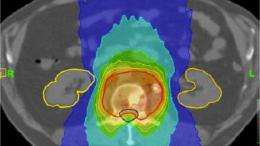
A collaborative project between physicists, oncologists and computer scientists at Oxford and Cambridge Universities, launched last month, will develop improved tools for the planning of high precision radiotherapy. Accel-RT will also help overcome time constraints that currently limit the use of complex radiotherapy treatment.
Radiation therapy (radiotherapy) is an essential part of cancer treatment and is used in the treatment of 40 per cent of all patients who are cured of their disease. All radiotherapy treatments work by the application of ionising radiation to malignant cells in tumors. The free radicals released by this process damage the DNA of the exposed tissue, killing off the cancerous cells. By targeting the radiation to the tumor, the damage to surrounding healthy tissue is minimized.
Modern radiotherapy machines can now deliver highly targeted radiotherapy treatment. However, the use of high precision radiotherapy techniques is extremely demanding in terms of hours spent, from the physician who defines the tumor target and healthy tissues, to the physicist who has to calculate a plan of optimum beam angles and trajectories for the treatment, and the radiographer, who must ensure that the treatment is delivered accurately to the target every day during a six or seven week course of radiotherapy.
Accel-RT is an innovative partnership between oncologists, physicists and computer scientists at the Universities of Cambridge and Oxford. Over the next three years the collaborators will develop software tools and processes that will speed up the process of planning of radiotherapy. Once completed, free software tools will be available to radiotherapy treatment centres. These tools will increase patient access to high precision radiotherapy by reducing the bottle-necks in the clinical workflow. The system will operate as a ‘virtual oncologist’, observing what the oncologist is treating and using novel search algorithms to recall similar cases from a clinical archive. Models of tissue structures will be used to help outline normal tissue automatically, as well as to track the movement of these structures during the course of radiotherapy treatment.
Accel-RT is being funded by the Science and Technologies Facilities Council (STFC) and will benefit from the support of Siemens Healthcare, a leading supplier of imaging technology and radiotherapy treatment devices throughout the world.
The key players in the project are established leaders in their fields. At the Cambridge of University, Dr Neil Burnet has been an ‘early adopter’ of novel radiotherapy technologies at Addenbrooke’s, from the commissioning of the first in-house 3D computerised treatment planning system, through to the evaluation of the TomoTherapy image guided intensity modulated radiotherapy system conducted for the Department of Health. At Oxford University, Professor Jim Davies and his team from the Computer Laboratory have experience in the handling of ‘smart’ data systems – using metadata elements to allow data to be searched and processed in more intuitive ways.
Professor Andy Parker and his team at the High Energy Physics group in Cambridge have extensive experience in the storage and handling of large quantities of image data, and the use of grid computing techniques to accelerate this process. “In essence, Accel-RT is helping to identify tumours and surrounding organs during the planning and delivery of radiotherapy treatment. Tracking the change in position and volume of these structures is a complex problem. To perform these calculations in real time for a single patient would require up to 16 Teraflops of processing power – approximately 100 times the power of a standard PC workstation,” said Professor Parker, who is Professor of High Energy Physics at the Cavendish Laboratory and Principal Investigator for Accel-RT.
More information: For more details about the project, and to register for project news emails, go to www.accelrt.org


