Receptor for tasting fat identified in humans (w/ Audio)
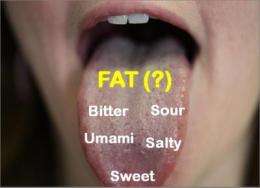
Why do we like fatty foods so much? We can blame our taste buds.
Our tongues apparently recognize and have an affinity for fat, according to researchers at Washington University School of Medicine in St. Louis. They have found that variations in a gene can make people more or less sensitive to the taste of fat.
The study is the first to identify a human receptor that can taste fat and suggests that some people may be more sensitive to the presence of fat in foods. The study is available online in the Journal of Lipid Research.
Investigators found that people with a particular variant of the CD36 gene are far more sensitive to the presence of fat than others.
"The ultimate goal is to understand how our perception of fat in food might influence what foods we eat and the quantities of fat that we consume," says senior investigator Nada A. Abumrad, PhD, the Dr. Robert A. Atkins Professor of Medicine and Obesity Research. "In this study, we've found one potential reason for individual variability in how people sense fat. It may be, as was shown recently, that as people consume more fat, they become less sensitive to it, requiring more intake for the same satisfaction. What we will need to determine in the future is whether our ability to detect fat in foods influences our fat intake, which clearly would have an impact on obesity."
People who made more CD36 protein could easily detect the presence of fat. In fact, study subjects who made the most CD36 were eight times more sensitive to the presence of fat than those who made about 50 percent less of the protein.
The researchers studied 21 people with a body mass index (BMI) of 30 or more, which is considered to be obese. Some participants had a genetic variant that led to the production of more CD36. Others made much less. And some were in between.
Participants were asked to taste solutions from three different cups. One contained small amounts of a fatty oil. The other two contained solutions that were similar in texture to the oil but were fat-free. Subjects were asked to choose the cup that was different.
"We did the same three-cup test several times with each subject to learn the thresholds at which individuals could identify fat in the solution," explains first author M. Yanina Pepino, PhD, research assistant professor of medicine. "If we had asked, 'does it taste like fat to you?' that could be very subjective. So we tried to objectively measure the lowest concentration of fat at which someone could detect a difference."
Her team masked input that might help participants identify fat by sight or smell. To eliminate visual cues, they lit the testing area with a red lamp. Study subjects also wore nose clips so that they could not smell the solutions.
Fat is an important component of the diet, and both humans and animals usually prefer high-fat, energy-dense foods. Scientists have believed that people identify those high-fat foods mainly by texture, but this study suggests that the presence of fat can change the way our tongues perceive the food, just as it does for the tastes sweet, sour, bitter, salty and savory (umami).
The CD36 discovery follows research that had identified a role for the gene in rats and mice. Scientists had learned that when animals are genetically engineered without a working CD36 gene, they no longer display a preference for fatty foods. In addition, animals that can't make the CD36 protein have difficulty digesting fat.
Up to 20 percent of people are believed to have the variant in the CD36 gene that is associated with making significantly less CD36 protein. That, in turn, could mean they are less sensitive to the presence of fat in food.
Abumrad was the first to identify CD36 as the protein that facilitates the uptake of fatty acids. She says better understanding of how the protein works in people could be important in the fight against obesity.
People with obesity are at an elevated risk for cardiovascular disease, stroke, type 2 diabetes, certain cancers, arthritis and other problems. Obesity rates have risen dramatically over the past 30 years as more people have become sedentary, and diets incorporate more hamburgers, French fries, fried chicken and other high-fat foods.
"Diet can affect sensitivity to fat, and in animals, diet also influences the amount of CD36 that's made," Pepino says. "If we follow the results in animals, a high-fat diet would lead to less production of CD36, and that, in turn, could make a person less sensitive to fat. From our results in this study, we would hypothesize that people with obesity may make less of the CD36 protein. So it would seem logical that the amounts of the protein we make can be modified, both by a person's genetics and by the diet they eat."
Our diet contains fat, mainly in the form of triglycerides, which are made of fatty acids linked to glyerol. In the tast test, the researchers presented subjects with two types of fat. Some cups contained a free fatty acid. Others contained triglyerides.
Pepino and Abumrad knew from animal studies that CD36 is activated by fatty acids but not triglycerides. Human subjects, however, were able to taste both. Pepino believes that's probably due to the activity of an enzyme called lipase in the saliva that breaks the triglycerides, releasing the fatty acids while the fat is still in the mouth.
"Rats, for example, can produce salivary lipase, and the lipase quickly will begin to digest the triglyceride and convert it into a fatty acid," she explains. "In humans, the role of lipase hasn't been as clear. In our experiments, people could detect fat whether it was a triglyceride or a fatty acid."
But when the researchers added the diet drug orlistat, subjects could still taste the fatty acids but were less able to detect the triglycerides. Orlistat inhibits lipase in the mouth, stomach and intestine and is often prescribed to people who are obese to prevent them from absorbing fat in foods.
"Orlistat made it more difficult for people to taste fat," Pepino says. "The solution had to contain higher amounts of triglyceride before they could detect fat. With free fatty acid, however, there was no difference."


