Do hand sanitizers really work? And if so, how?
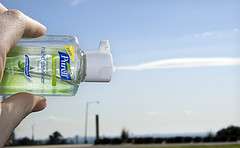
Everywhere you turn of late, it seems you’re confronted with a bottle of alcohol-based hand sanitizer. We asked Professor James Scott whether these formulations work—and if so, how?
Professor James Scott is an associate professor in the Division of Occupational & Environmental Health at the Dalla Lana School of Public Health. He is cross-appointed to the Department of Medicine, Division of Clinical Pharmacology and Toxicology, and holds hospital appointments at St. Michael’s Hospital and the Hospital for Sick Kids. We originally spoke to him in the fall of 2009. This is an updated version of our original interview, reflecting some new research on the topic.
Does hand sanitizer work?
I was one of the skeptics. But as I have looked critically at the research that has come out, I can say yes, it really works. It works exceedingly well for most bacteria and viruses. It reduces the skin burden of bacteria much more effectively than soap and water and the amount of bacteria on the skin tends to remain lower for much longer than when soap and water is used. It also tends to be less damaging to skin because it has built-in emollients. People who are in occupations where there is a lot of hand washing, have skin that tends to dry out easily and it can crack and become more prone to carrying bacteria. Hand sanitizer doesn’t replace soap and water if your hands are dirty, but along with regular hand washing, it definitely helps fight many important germs.
How does it work?
It works by killing cells—not human cells. It kills microbial cells. It’s based on the use of 70 per cent isopropanol alcohol, which is rubbing alcohol. That’s the concentration of rubbing alcohol that is most effective in killing germs—it’s even more effective than 100 per cent. Because it has a little bit of water in it, it improves penetration. For a virus, sanitizers work by disrupting the virus’s outer coat. For a bacterium, they work by disrupting its cell membrane. It is not a panacea, though, since certain viruses lacking an outer coat (like the one that causes cruise ship diarrhea) or spore forming bacteria (like C.difficle) are not very susceptible.
Some people say that using hand sanitizer is bad because it prevents us from building up natural resistance to bugs.
Show me the evidence.
Physicians used to tell their patients if they didn’t want their kids to be allergic to cats, then don’t have a cat. Physicians have told their patients this for the last 50 years. Now there’s growing evidence that if you have the cat, you might actually have some protection against allergies. What you’re saying is a similar idea. But the reality is we just don’t have that information. There’s no evidence to support it one way or another.
So for things like H1N1 you recommend people use hand sanitizer.
This is the absolute best front-line protection for those kinds of diseases. These products appear to be a highly effective part of flu control programs.
Is it only colds and flus that hand sanitizers fight?
They work on a range of bacterial and viral illness. Depending on what the agent is, it may be more or less tolerant or susceptible to hand sanitizers, but for most of the things that people need to worry about in day-to-day life—upper respiratory infections, gastrointestinal infections, those kinds of things—most agents that cause those diseases are highly susceptible to modern hand sanitizers.
What about health care workers? How much does our health depend on them using these products?
In occupations where there’s a lot of human contact there’s the potential for the practitioner to act as an intermediary, transferring germs from one patient to the next. Anything that’s effective and increases the compliance of the practitioner in going through the motions of infection control and prevention is helpful.
There have always been difficulties with compliance, getting health care workers to wash hands on a sufficiently frequent basis, between patients and between tasks. Compliance was always difficult because handwashing is often inconvenient and takes time. The introduction of hand sanitizers improved hand hygiene tremendously, not only because it was so effective, but it was also easier and faster than regular handwashing. It’s really helped in terms of reducing germ transmission. It’s often cited as an example of an improved infection control measure that is a runaway success on all fronts.
So you’re not a skeptic any longer.
No. In the past several years, as I’ve seen evidence build up, I’ve ceased to be a skeptic. This stuff really does work. I doubted it, but it works.


