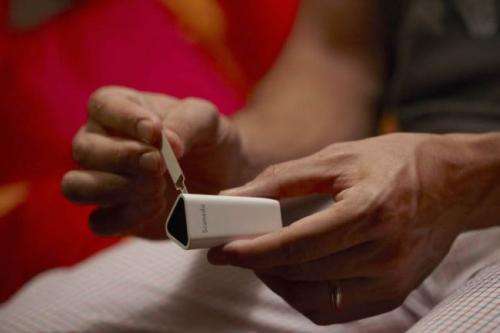
Scanadu developing a Medical Tricorder
January 3, 2012
by Deborah Braconnier
in Medical research
(Medical Xpress) -- Do you remember the scenes from your favorite Star Trek episode where Dr. McCoy simple waves his scanner across an injured patient to diagnose the problem? Well, that technology may not be too far from becoming a reality as medical tech startup company Scanadu is creating a Tricorder.
The company was founded in January 2011 by Walter De Brouwer and is based out of the NASA Ames Research Center in Mountain View, California.
In May of 2011, the X-PRIZE Foundation announced a $10 million Tricorder X-PRIZE to encourage medical companies to work on producing devices that would help consumers assess their own health. With their developing Tricorder, Scanadu is the first potential contestant for the prize.
This video is not supported by your browser at this time.
Once the competing Tricorders are ready for use, they will be placed against a panel of physicians to test their diagnosing capabilities in a variety of different diseases.Based on the trailer by Scanadu, the new device will be able to read your vital signs, including blood pressure, pulmonary function and temperature. It will include an onboard camera that will be able to analyze things such as rashes and infections. An onboard processing lab would be able to accept samples of blood or other body fluids for analysis.
Based on the results, the Tricorder would then inform you of the possible course of action. If it was something that needed immediate medical attention, your physician would be notified with the information.
Based on their progress so far, Scanadu just received $2 million in funding from a group of private investors which includes Sebastien De Halleux, the co-founder of the social network gaming company Playfish.
Their first Tricorder is set to be targeted to parents of small children as a way to better monitor their health. It will provide alerts for things such as immunization needs and potential outbreaks of viruses in the local area. If an appointment is needed with your physician, you would be able to set one up directly through the system.
With smartphones and technology a part of everyday life, the idea behind this Tricorder is to make personal medical monitoring as simple and as easy as checking your email on a daily basis.
More information: www.scanadu.com/
via SingularityHub
© 2011 PhysOrg.com
-
Triage technology with a Star Trek twist
May 27, 2009 |
not rated yet |
0
-
Star Trek movie inspires apps
May 13, 2009 |
not rated yet |
0
-
'Ultrawideband' could be future of medical monitoring
Jun 16, 2011 |
not rated yet |
0
-
Scientists develop 'tricorder' sensor
Jul 12, 2006 |
not rated yet |
0
-
Computer with info on 4M patients stolen in Calif.
Nov 17, 2011 |
not rated yet |
0
-
Motion perception revisited: High Phi effect challenges established motion perception assumptions
Apr 23, 2013 |
3 / 5 (2) |
2
-
Anything you can do I can do better: Neuromolecular foundations of the superiority illusion (Update)
Apr 02, 2013 |
4.5 / 5 (11) |
5
-
The visual system as economist: Neural resource allocation in visual adaptation
Mar 30, 2013 |
5 / 5 (2) |
9
-
Separate lives: Neuronal and organismal lifespans decoupled
Mar 27, 2013 |
4.9 / 5 (8) |
0
-
Sizing things up: The evolutionary neurobiology of scale invariance
Feb 28, 2013 |
4.8 / 5 (10) |
14
-
Pressure-volume curve: Elastic Recoil Pressure don't make sense
15 hours ago
-
If you became brain-dead, would you want them to pull the plug?
May 17, 2013
-
MRI bill question
May 15, 2013
-
Ratio of Hydrogen of Oxygen in Dessicated Animal Protein
May 13, 2013
-
Alcohol and acetaminophen
May 13, 2013
-
Marie Curie's leukemia
May 13, 2013
- More from Physics Forums - Medical Sciences
More news stories
Now we know why old scizophrenia medicine works on antibiotics-resistant bacteria
In 2008 researchers from the University of Southern Denmark showed that the drug thioridazine, which has previously been used to treat schizophrenia, is also a powerful weapon against antibiotic-resistant bacteria such as ...
Medical research
May 17, 2013 |
3.7 / 5 (3) |
0
|
SUMO wrestling cells reveal new protective mechanism target for stroke
Scientists investigating the interaction of a group of proteins in the brain responsible for protecting nerve cells from damage have identified a new target that could increase cell survival.
Medical research
May 17, 2013 |
5 / 5 (1) |
0
How serotonin receptors can shape drug effects, from LSD to migraine medication
New findings by researchers carrying out experiments at the U.S. Department of Energy Office of Science's Advanced Photon Source (APS) help explain why some drugs that interact with two kinds of human serotonin ...
Medical research
May 17, 2013 |
not rated yet |
0
|
Preventing blood poisoning
Peptide molecules derived from the body's natural immune system can help boost the body's defence against life-threatening blood poisoning, joint University research has uncovered.
Medical research
May 17, 2013 |
4 / 5 (1) |
0
|
New mechanism to prevent type 2 diabetes in obese individuals
A new Montréal study conducted by Dr. May Faraj, associate research professor at the Université de Montréal and invited scientist at the IRCM, along with her research team and medical collaborators, shows ...
Medical research
May 17, 2013 |
not rated yet |
0
|
New research identifies risks, interventions for children's GI health
An increasing number of U.S. children are experiencing gastrointestinal issues that require interventions to resolve, according to research presented at Digestive Disease Week (DDW).
US psychiatry gets makeover in new manual
The latest makeover to a massive psychiatric tome honored by some, reviled by others and even called the "Bible" of mental disorders is being released Saturday with a host of new changes.
New case of SARS-like virus in Saudi: ministry
A new case of the deadly coronavirus has been detected in Saudi Arabia where 15 people have already died after contracting it, the health ministry announced on Saturday on its Internet website.
AIDS science at 30: 'Cure' now part of lexicon
Big names in medicine are set to give an upbeat assessment of the war on AIDS on Tuesday, 30 years after French researchers identified the virus that causes the disease.
For combat veterans suffering from post-traumatic stress disorder, 'fear circuitry' in the brain never rests
Chronic trauma can inflict lasting damage to brain regions associated with fear and anxiety. Previous imaging studies of people with post-traumatic stress disorder, or PTSD, have shown that these brain regions can over-or ...
New colonoscope provides ground-breaking view of colon
A ground-breaking advance in colonoscopy technology signals the future of colorectal care, according to research presented today at Digestive Disease Week(DDW). Additional research focuses on optimizing the minimal withdrawal ...
Jan 03, 2012
Rank: not rated yet
Seriously though, a great first step toward a real medical tricorder. Of course the tricorder could also take brain activity scans, check blood type and composition without contact and even check your DNA without physically contacting you. Let me know when you get one of those!
Jan 03, 2012
Rank: not rated yet
Jan 03, 2012
Rank: not rated yet
I'm screwed.
Jan 03, 2012
Rank: 1 / 5 (1)
Addtionally, it would help people get the tests they REALLY need in "mystery diagnosis" situations, where the incompetent medical industry never seems to do the right tests, or in those odd intermittent symptoms situations, where the symptom seems to go away by the time you reach the doctor, etc.
Also, I think this would actually CURE Hypochondriasis, since it would give the individual a quick and easy way to reassure themselves that there is nothing wrong with them.
Jan 04, 2012
Rank: 1 / 5 (2)
Regardless, this is awesome though! The medical industry is becoming incompetent and to a degree personal health should be taken back into the household domain, at least partially. We still need our experts, but if it takes me 3 weeks to get an appointment with a gp to diagnose a flu, why wait when there's a simple app that can do it? And imagine what this can do for mobile doctors in third world countries?