Seeing what's inside a tumor
January 12, 2012 by Anne Trafton in Medical research
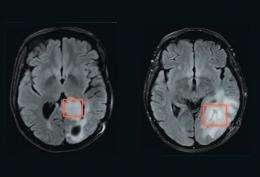
Using MR spectroscopy, a team of researchers has developed a way to measure whether brain tumors have a mutation in a gene called IDH. The tissue being analyzed is inside the red boxes. The tumor on the left has the mutation, while the tumor on the right does not. Image courtesy of the researchers
Gliomas, the most common types of brain tumor, are also among the deadliest cancers: Their mortality rate is nearly 100 percent, in part because there are very few treatments available.
A team of researchers from MIT, Harvard University, Massachusetts General Hospital (MGH) and Agios Pharmaceuticals has now developed a way to identify a particular subset of brain tumors, which may help doctors choose treatments and create new drugs that target the diseases underlying genetic mutation.
Scientists have known for several years that many brain tumors involve a mutation in the gene for an enzyme called isocitrate dehydrogenase (IDH). This enzyme is involved in cell metabolism the process of breaking down sugar molecules to extract energy from them. IDH mutations are found in up to 86 percent of low-grade gliomas, which have a better prognosis than high-grade gliomas, also called glioblastomas. Patients with low-grade gliomas can survive for years, though the tumors almost always prove fatal.
Several pharmaceutical companies are now pursuing drugs that target IDH, in hopes of halting tumor growth. Some of those drugs may enter clinical trials within the year, says Matthew Vander Heiden, a member of the David H. Koch Institute for Integrative Cancer Research at MIT.
Vander Heiden is part of the team that developed imaging technology to reveal whether brain tumors have the IDH mutation, which could help researchers monitor whether potential drugs are having the desired effect. The researchers described their technique in the Jan. 11 online edition of Science Translational Medicine.
Unambiguous detection
When IDH is mutated, a tumor cell begins to produce vast quantities of a molecule called 2-hydroxyglutarate (2-HG). Previous research has shown that 2-HG interferes with the regulation of DNA expression, causing the cell to revert to an immature state conducive to uncontrolled growth. (IDH mutations are also found in some forms of leukemia and, rarely, in other cancers.)
The new imaging technique uses magnetic resonance (MR) spectroscopy, which analyzes the magnetic properties of atomic nuclei, to locate 2-HG in the brain. Other researchers have tried to image 2-HG with MR spectroscopy, but found it difficult to distinguish 2-HG from some of the brains common metabolites, such as glutamate and glutamine.
MGH researchers led by George Sorensen and Ovidiu Andronesi, the lead author of the Science Translational Medicine paper, found a way to unambiguously detect 2-HG by doing the MR scans in two dimensions, which gives enough information to conclusively distinguish 2-HG from similar compounds. The imaging technique does not require any specialized equipment; it can be done with the clinical MRI scanners already found in most hospitals.
The most exciting thing about this is it opens up the possibility that as drugs against gliomas come online, you could know which patients with brain tumors to put in the clinical trials, and you would know if the drug youre giving them is actually doing what its supposed to do, says Vander Heiden, the Howard S. and Linda B. Stern Career Development Professor of Biology at MIT.
Currently, the only way to measure 2-HG levels is by taking a brain biopsy and doing mass spectrometry on the tissue. This is commonly done when a brain tumor is first diagnosed, but cant be done on a regular basis, says Hai Yan, an assistant professor of pathology at Duke University.
If you can detect [2-HG] in the tissue or blood, it would allow physicians to tell if treatments for the tumor have been effective or not, says Yan, who was not involved in this research.
Journal reference:
Science Translational Medicine
Provided by
Massachusetts Institute of Technology
This story is republished courtesy of MIT News (http://web.mit.edu/newsoffice/), a popular site that covers news about MIT research, innovation and teaching.
-
Newly discovered gene could be a prime target in the most lethal brain cancer
Feb 18, 2009 |
not rated yet |
0
-
Altered cell metabolism has role in brain tumor development
Jan 31, 2011 |
not rated yet |
0
-
Metabolite common among cancers
Feb 08, 2010 |
not rated yet |
0
-
Insight offers new angle of attack on variety of brain tumors
Dec 15, 2010 |
not rated yet |
0
-
Elusive gene mutations found for malignant brain tumor
Aug 04, 2011 |
not rated yet |
0
-
Of mice and mental models: Neuroscientific implications of risk-optimized behavior in the mouse
May 25, 2012 |
not rated yet |
0
-
Limits to growth: Scientists identify key metastasis-enabling enzyme
May 22, 2012 |
5 / 5 (4) |
0
-
Seeing is as seeing does: Spatially-structured retinal input in early development of cortical maps
Apr 26, 2012 |
5 / 5 (4) |
1
-
Dreamless nights: Brain activity during nonrapid eye movement sleep
Apr 09, 2012 |
4.4 / 5 (12) |
0
-
Take your time: Neurobiology sheds light on the superiority of spaced vs. massed learning
Mar 28, 2012 |
4.5 / 5 (21) |
3
-
Potential Breakthrough in Seizure Control
19 hours ago
-
Popping/Cracked sternum.
May 25, 2012
-
Which Mental Illness Encompasses This Problem?
May 25, 2012
-
A question about drug tolerance
May 23, 2012
-
Poor nutrition leading to overeating?
May 23, 2012
-
Math and dyslexia?
May 21, 2012
- More from Physics Forums - Medical Sciences
More news stories
Implantable pain disk may help those with cancer
An estimated 3.5 million cancer patients around the globe are in severe pain from their disease, but many get no relief.
Medical research
May 25, 2012 |
5 / 5 (1) |
0
|
Energy levels link sleep control mechanisms
Sleep, or lack of it, can determine level of cognitive performance which is linked with accidents as well as increased risk of serious health problems. Links between cell energy levels, gene transcription ...
Medical research
May 25, 2012 |
not rated yet |
0
Researchers identify key brain cell in antidepressant action
(Medical Xpress) -- Antidepressant medications such as Prozac have helped improve mood and lessen anxiety in millions of people with major depression. But scientists know surprisingly little about how these drugs work.
Medical research
May 25, 2012 |
4.7 / 5 (3) |
0
|
Rockefeller scientists pioneer new method to determine mechanisms of drug action
(Medical Xpress) -- Knowing that a drug works is great. Knowing how it works is a luxury. And until now, determining a drugs mechanism of action has been a tedious and difficult process for scientists.
Medical research
May 25, 2012 |
not rated yet |
0
|
Like curry? New biological role identified for compound used in ancient medicine
Scientists have just identified a new reason why some curry dishes, made with spices humans have used for thousands of years, might be good for you.
Medical research
May 25, 2012 |
4.5 / 5 (12) |
2
|
Keep food safety in mind this memorial day weekend
(HealthDay) -- Picnics, parades and cookouts are as much a part of Memorial Day weekend as tributes to the United States' war veterans.
Travel to high altitudes tied to Crohn's, colitis flare-ups
(HealthDay) -- People with inflammatory bowel disease, which includes Crohn's disease and colitis, may be at increased risk for flare-ups when they fly or travel to high altitudes for skiing or mountain climbing, ...
Family history of Alzheimer's affects functional connectivity
(HealthDay) -- Cognitively normal individuals with a family history of late-onset Alzheimer's disease (AD) may display lower resting state functional connectivity in the default mode network (DMN) of the brain, ...
Transvaginal mesh op restores pelvic organ prolapse at price
(HealthDay) -- Transvaginal mesh (TVM) procedures are effective for anatomical restoration of pelvic organ prolapse (POP), but patients report a worsening of sexual function following surgery, according to ...
Of mice and mental models: Neuroscientific implications of risk-optimized behavior in the mouse
(Medical Xpress) -- Regardless of an organism’s biological complexity, every encephalized animal continuously makes under-informed behavioral choices that can have serious consequences. Despite its ubiquity, ...
Weight struggles? Blame new neurons in your hypothalamus
New nerve cells formed in a select part of the brain could hold considerable sway over how much you eat and consequently weigh, new animal research by Johns Hopkins scientists suggests in a study published in the May issue ...