Cochlear implants may be safe, effective for organ transplant patients
February 10, 2012 in Other

Cochlear implants may be safe, effective for organ transplant patients

Enlarge

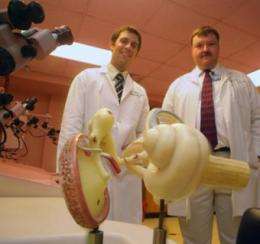
Cochlear implants may be a safe, effective option for some organ transplant patients who've lost their hearing as an unfortunate consequence of their transplant-related drug regime, report Dr. Brian J. McKinnon, otologist and neurotologist (right), and Dr. Kenneth C. Iverson, Chief Resident in otolaryngology, at the Medical College of Georgia at Georgia Health Sciences University. Credit: Phil Jones, GHSU Photographer

Cochlear implants may be a safe, effective option for some organ transplant patients who've lost their hearing as an unfortunate consequence of their transplant-related drug regime, researchers report.

The antibiotics and required by organ can cause deafness, said Dr. Brian J. McKinnon, otologist and neurotologist at the Medical College of Georgia at Georgia Health Sciences University.

Antibiotics can destroy the finite number of dark cells in the . These cells produce the minute amount of fluid needed to help convert to the brain can interpret. Apparently these dark cells are very metabolically active and antibiotics are designed to interfere with bacteria's .

"When you destroy the ability to make fluid, the system no longer functions," McKinnon said. Any sound patients may hear is incomprehensible.

Drugs that keep the immune system from attacking a transplanted organ can also leave the inner ear vulnerable to infection. In fact, cochlear implant patients typically get vaccinations to bolster their immune response to common infections since an electrode, connecting the device to the inner ear, can become a highway for bacteria and viruses. "If you do make the immune system work better, they may reject their organ," McKinnon notes.

Consequently, only a few transplant patients worldwide have gotten .

However, the new, small retrospective study provides more evidence that patients can restore their hearing without additional health risks if they wait at least six months after the and take the right antibiotic before and after the cochlear implant procedure, McKinnon said. He and Dr. Kenneth C. Iverson, Chief Resident in otolaryngology at MCG, are co-authors of the study published in the American Journal of Otolaryngology. Two previous studies described experience with less than a dozen total patients.

The GHSU study focuses on two patients, including a 47-year-old woman who developed profound hearing loss five years after receiving a kidney from a living family member when a severe infection put her in intensive care and required several powerful antibiotics. She received a cochlear implant 18 months after the infection and six years after her transplant; her treatment included an intravenous antibiotic before the surgery and an oral antibiotic for a week afterward as well as continuation of her usual transplant-related medications. Her hearing was essentially normal 13 months later. She died two years after her implant from an unrelated health problem.

A 50-year-old man, who received a kidney from a deceased donor, experienced profound hearing loss six weeks after a severe brain infection. He received a cochlear implant seven months after his transplant and similar antibiotic therapy. About 75 percent of his hearing was restored 14 months later.

"This study adds to the growing evidence that successful cochlear implantation can be achieved in appropriately selected renal transplant patients," McKinnon and Iverson write. They have continued to use the device selectively in transplant patients and plan a larger, .

Cochlear implants, which today are less than an inch in diameter, are placed behind the ear in between the scalp and skull. A short lead is inserted through the skull to the inner ear, located near the base of the brain. The devices are used in patients when other methods, such as traditional hearing aids, have failed. The device is costly and often not fully covered by private or federal health insurance, which has limited its use.

About 20 adults per 100,000 are deaf by the time they reach their senior years, primarily as a result of infections or repeated exposure to loud noise; 1-2 children per 1,000 are born with hearing loss.

Provided by Georgia Health Sciences University

5 /5 (1 vote)  

Rank 5 /5 (1 vote)
Relevant PhysicsForums posts

More news stories

Early use of tracheostomy for mechanically ventilated patients not associated with improved survival

For critically ill patients receiving mechanical ventilation, early tracheostomy (within the first 4 days after admission) was not associated with an improvement in the risk of death within 30 days compared to patients who ...

Other created 14 hours ago | popularity not rated yet | comments 0

Decisions to forgo life support may depend heavily on the ICU where patients are treated

The decision to limit life support in patients in the intensive care unit (ICU) appears to be significantly influenced by physician practices and/or the culture of the hospital, suggests new findings from researchers at the ...

Other created 16 hours ago | popularity not rated yet | comments 0

People on higher incomes are happier with new knees

Knee replacement surgery is a very common procedure. However, it does not always resolve function or pain in all the recipients of new knees. A study by Robert Barrack, MD and his colleagues from the Washington University ...

Other created 18 hours ago | popularity not rated yet | comments 0

New search engine finds rare diagnoses

Doctors are trained to think "common disease" when they meet patients in their practices, and as they rarely or never meet a rare disease, it often takes many years to reach the right diagnosis. A new search tool called FindZebra ...

Other created 18 hours ago | popularity not rated yet | comments 0

Delayed transfer to the ICU increases risk of death in hospital patients

Delayed transfer to the intensive care unit (ICU) in hospitalized patients significantly increases the risk of dying in the hospital, according to a new study from researchers in Chicago.

Other created 20 hours ago | popularity not rated yet | comments 0


Study says empathy plays a key role in moral judgments

Is it permissible to harm one to save many? Those who tend to say "yes" when faced with this classic dilemma are likely to be deficient in a specific kind of empathy, according to a report published in the scientific journal ...

Phthalates: Study links chemicals widely found in plastics, processed food to elevated blood pressure in children, teens

Plastic additives known as phthalates (pronounced THAL-ates) are odorless, colorless and just about everywhere: They turn up in flooring, plastic cups, beach balls, plastic wrap, intravenous tubing and—according to the ...

If you can remember it, you can remember it wrong

(Medical Xpress)—Native peoples in regions where cameras are uncommon sometimes react with caution when their picture is taken. The fear that something must have been stolen from them to create the photo ...

B vitamins could delay dementia

(Medical Xpress)—Despite spending billions of dollars on research and development, drug companies have been unable to come up with effective treatments for dementia and Alzheimer's Disease (AD). Now, A. ...

Insight into the dazzling impact of insulin in cells

Australian scientists have charted the path of insulin action in cells in precise detail like never before. This provides a comprehensive blueprint for understanding what goes wrong in diabetes.

Reducing caloric intake delays nerve cell loss

Activating an enzyme known to play a role in the anti-aging benefits of calorie restriction delays the loss of brain cells and preserves cognitive function in mice, according to a study published in the May ...