Effects of a concussion may last longer than symptoms, study shows
February 29, 2012 in Neuroscience
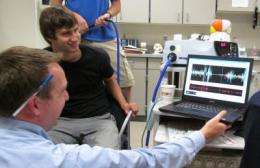
Director of the UK Concussion Assessment Research Lab Scott Livingston (bottom left) shows the results of MEP testing to UK men's soccer player Marco Bordon. Credit: University of Kentucky Public Relations
A study recently published by the University of Kentucky's Scott Livingston shows that physiological problems stemming from a concussion may continue to present in the patient even after standard symptoms subside.
Currently, concussions are diagnosed and monitored through a patient's self-reported symptoms (including headache, confusion or disorientation, poor concentration, and memory loss) and through computerized neuropsychological testing programs, which measure cognitive abilities including attention and concentration, cognitive processing, learning and memory, and verbal fluency. Post-concussion abnormalities in either of these markers typically return to a normal level within five to 10 days following the injury.
Conducted while he was a graduate student at the University of Virginia, Livingston's study was just published in the February 2012 issue of the Journal of Clinical Neurophysiology. The study used motor-evoked potentials (MEPs) an electrophysiological measurement that can provide hard evidence for changes in brain function to determine if any physiological abnormalities followed a similar recovery pattern to self-reported symptoms and neuropsychological testing.
During an MEP test, subjects have electrodes placed on a limb such as the hand or foot. A magnetic stimulating device is placed over the head, and they receive a brief pulse of magnetic stimulation to the brain. The "reaction time" the amount of time it takes for the subject's limb to receive the response from the brain after the stimulation is recorded.
Livingston's study enrolled 18 collegiate athletes nine who had been concussed within the previous 24 hours, and nine who had not experienced a concussion. Each concussed subject was matched with a non-concussed subject using age, gender, sport, position played, prior concussion history, and history of learning disability or attention deficit-hyperactivity disorder as inclusion criteria.
Subjects were evaluated for evidence of concussion based on self-reported symptoms, computerized neurocognitive test performance, and MEPs for a period of 10 days. Post-concussion symptoms were more frequent and greater in severity in the immediate timeframe after the injury (24-72 hours) and decreased in the following days. Some subjects reported no symptoms by day 10, though others did not have complete symptoms resolution by that time. Neurocognitive deficits followed a similar pattern, proving greater just after the injury and returning to normal (or closer to normal) by day 10.
MEPs, however, showed delays in response time and smaller MEP size which continued up to day 10, with these physiological changes actually increasing as the concussed athletes' symptoms decreased and cognitive functioning improved.
This video is not supported by your browser at this time.
The University of Kentucky's Scott Livingston discusses preseason baseline testing for concussions in athletes. A recently published study performed by Livingston while he was at the University of Virginia used motor-evoked potential testing to show evidence that the physiological effects of a concussion may last longer than its symptoms. Livingston's research lab at UK recently began a new program to study motor-evoked potentials in athletes pre- and post-concussion. At UK, all athletes who participate in a contact sport — including football, soccer, volleyball, diving, gymnastics, and basketball — are assessed preseason using MEP and neurocognitive testing to estbalish a baseline measure for each athlete. If an athlete receives a concussion, he or she will come back to the lab as soon as possible after the injury for follow-up testing. This approach allows researchers to get a clearer idea of the extent of an athlete's injury. Credit: University of Kentucky Public Relations
Livingston, director of the UK Concussion Assessment Research Lab and assistant professor in the Department of Rehabilitation Sciences, says these findings are significant for both athletes and sports medicine clinicians."Further investigation of MEPs in concussed athletes is needed, especially to assess how long the disturbances in physiological functioning continue after those initial ten days post-injury," Livingston said. "But in the meantime, sports medicine personnel caring for concussed athletes should be cautious about relying solely on self-reported symptoms and neurocognitive test performances when making return-to-play decisions."
Livingston's research lab recently began a new program to further study MEPs in athletes pre- and post-concussion. At UK, all athletes who participate in a contact sport including football, soccer, volleyball, diving, gymnastics, and basketball are assessed preseason using MEP and neurocognitive testing to establish a baseline measure for each athlete.
If an athlete receives a concussion, he or she will come back to the lab as soon as possible after the injury for follow-up testing. This approach allows researchers to get a clearer idea of the extent of an athlete's injury, Livingston says.
Neurocognitive tests, such as the Immediate Post-Concussion Assessment and Testing (ImPACT), are a valuable component of concussion management. While major professional sports organizations like the NFL and NHL, as well as hundreds of colleges, universities, and high schools across the United States follow this standard, UK Athletics did not have a formal, standardized neurocognitive testing protocol in place until last year. The addition of the MEP assessment in the preseason testing and post-concussion management are unique UK is the first and only collegiate athletics program to implement a baseline physiologic measure of brain function.
"No other college of university in the country is currently assessing physiologic brain responses and using this information to determine the extent of the functional brain injury," Livingston said. "This type of information enables us to closely track recovery, which may not correspond to the decrease in concussion symptoms or recovery of memory and other cognitive functions."
Provided by University of Kentucky
-
MNI researchers locate neurological basis of depression following sports concussion
Jan 18, 2008 |
not rated yet |
0
-
Does baseline concussion testing really reduce risks to athletes?
Jun 01, 2011 |
not rated yet |
0
-
Concussed high school athletes who receive neuropsychological testing sidelined longer
Dec 15, 2010 |
not rated yet |
0
-
Study flags over-reliance on computer tests in return-to-plan decisions after concussion
Feb 02, 2012 |
not rated yet |
0
-
Simple test may help judge concussion in athletes
Feb 15, 2010 |
not rated yet |
0
-
Motion perception revisited: High Phi effect challenges established motion perception assumptions
Apr 23, 2013 |
3 / 5 (2) |
2
-
Anything you can do I can do better: Neuromolecular foundations of the superiority illusion (Update)
Apr 02, 2013 |
4.5 / 5 (11) |
5
-
The visual system as economist: Neural resource allocation in visual adaptation
Mar 30, 2013 |
5 / 5 (2) |
9
-
Separate lives: Neuronal and organismal lifespans decoupled
Mar 27, 2013 |
4.9 / 5 (8) |
0
-
Sizing things up: The evolutionary neurobiology of scale invariance
Feb 28, 2013 |
4.8 / 5 (10) |
14
-
Pressure-volume curve: Elastic Recoil Pressure don't make sense
6 hours ago
-
If you became brain-dead, would you want them to pull the plug?
22 hours ago
-
MRI bill question
May 15, 2013
-
Ratio of Hydrogen of Oxygen in Dessicated Animal Protein
May 13, 2013
-
Alcohol and acetaminophen
May 13, 2013
-
Marie Curie's leukemia
May 13, 2013
- More from Physics Forums - Medical Sciences
More news stories
For combat veterans suffering from post-traumatic stress disorder, 'fear circuitry' in the brain never rests
Chronic trauma can inflict lasting damage to brain regions associated with fear and anxiety. Previous imaging studies of people with post-traumatic stress disorder, or PTSD, have shown that these brain regions can over-or ...
Neuroscience
8 hours ago |
not rated yet |
0
|
Temporal processing in the olfactory system
The neural machinery underlying our olfactory sense continues to be an enigma for neuroscience. A recent review in Neuron seeks to expand traditional ideas about how neurons in the olfactory bulb might encode information about ...
Neuroscience
19 hours ago |
not rated yet |
0
|
Melon focus headband turns to Kickstarter for rollout plans
(Medical Xpress)—What if the quality of your work depends more on your focus on the piano keys or canvas or laptop than your musical or painting or computing skills? If target users can be convinced, they ...
Neuroscience
19 hours ago |
3.7 / 5 (3) |
0
|
Deep brain stimulation: A fix when the drugs don't work
Neurological disorders can have a devastating impact on the lives of sufferers and their families.
Neuroscience
May 17, 2013 |
5 / 5 (1) |
0
|
Brain makes call on which ear is used for cell phone
If you're a left-brain thinker, chances are you use your right hand to hold your cell phone up to your right ear, according to a newly published study from Henry Ford Hospital in Detroit.
Neuroscience
May 16, 2013 |
2 / 5 (2) |
0
|
AIDS science at 30: 'Cure' now part of lexicon
Big names in medicine are set to give an upbeat assessment of the war on AIDS on Tuesday, 30 years after French researchers identified the virus that causes the disease.
Now we know why old scizophrenia medicine works on antibiotics-resistant bacteria
In 2008 researchers from the University of Southern Denmark showed that the drug thioridazine, which has previously been used to treat schizophrenia, is also a powerful weapon against antibiotic-resistant bacteria such as ...
23 dead in initiation rites in South Africa
(AP)—Twenty-three youths have died in the past nine days at initiation ceremonies that include circumcisions and survival tests, South African police said Friday.
Individuals who drink heavily and smoke may show 'early aging' of the brain
Treatment for alcohol use disorders works best if the patient actively understands and incorporates the interventions provided in the clinic. Multiple factors can influence both the type and degree of neurocognitive abnormalities ...
College women exceed NIAAA drinking guidelines more frequently than college men
In order to avoid harms associated with alcohol consumption, in 2009 the National Institute on Alcohol Abuse and Alcoholism issued guidelines that define low-risk drinking. These guidelines differ for men and women: no more ...
Study identifies new approach to improving treatment for MS and other conditions
(Medical Xpress)—Working with lab mice models of multiple sclerosis (MS), UC Davis scientists have detected a novel molecular target for the design of drugs that could be safer and more effective than current FDA-approved ...