New evidence touch-sensing nerve cells may fuel 'ringing in the ears'
February 1, 2012 in Neuroscience
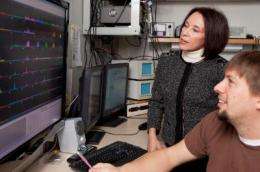
U-M researcher Susan Shore and graduate student Seth Koehler discuss hearing data. Credit: University of Michigan Health System
We all know that it can take a little while for our hearing to bounce back after listening to our iPods too loud or attending a raucous concert. But new research at the University of Michigan Health System suggests over-exposure to noise can actually cause more lasting changes to our auditory circuitry changes that may lead to tinnitus, commonly known as ringing in the ears.
U-M researchers previously demonstrated that after hearing damage, touch-sensing "somatosensory" nerves in the face and neck can become overactive, seeming to overcompensate for the loss of auditory input in a way the brain interprets or "hears" as noise that isn't really there.
The new study, which appears in the Feb. 1 issue of The Journal of Neuroscience, found that somatosensory neurons maintain a high level of activity following exposure to loud noise, even after hearing itself returns to normal.
The findings were made in guinea pigs, but mark an important step toward potential relief for people plagued by tinnitus, says lead investigator Susan E. Shore, Ph.D., of U-M's Kresge Hearing Research Institute and a professor of otolaryngology and molecular and integrative physiology at the U-M Medical School.
"The animals that developed tinnitus after a temporary loss in their hearing after loud noise exposure were the ones who had sustained increases in activity in these neural pathways," Shore says. "In the future it may be possible to treat tinnitus patients by dampening the hyperactivity by reprogramming these auditory-touch circuits in the brain."
In normal hearing, a part of the brain called the dorsal cochlear nucleus is the first stop for signals arriving from the ear via the auditory nerve. But it's also a hub where "multitasking" neurons process other sensory signals, such as touch, together with hearing information.
During hearing loss, the other sensory signals entering the dorsal cochlear nucleus are amplified, Shore's earlier research found. This overcompensation by the somatosensory neurons, which carry information about touch, vibration, skin temperature and pain, is believed to fuel tinnitus in many cases.
Tinnitus affects up to 50 million people in the United States and millions more worldwide, according to the American Tinnitus Association. It can range from intermittent and mildly annoying to chronic, severe and debilitating. There is no cure.
It especially affects baby boomers, who, as they reach an age at which hearing tends to diminish, increasingly find that tinnitus moves in. The condition most commonly occurs with hearing loss, but can also follow head and neck trauma, such as after an auto accident, or dental work. Tinnitus is the number one disability afflicting members of the armed forces.
The involvement of touch sensing (or "somatosensory") nerves in the head and neck explains why many tinnitus sufferers can change the volume and pitch of the sound by clenching their jaw, or moving their head and neck, Shore explains.
While the new study builds on previous discoveries by Shore and her team, many aspects are new.
"This is the first research to show that, in the animals that developed tinnitus after hearing returned to normal, increased excitation from the somatosensory nerves in the head and neck continued. This dovetails with our previous research, which suggests this somatosensory excitation is a major component of tinnitus," says Shore, who serves on the scientific advisory committee of the American Tinnitus Association.
"The better we understand the underlying causes of tinnitus, the better we'll be able to develop new treatments," she adds.
More information: "Noise over-exposure alters long-term somatosensory-auditory processing in the dorsal cochlear nucleus possible basis for tinnitus-related hyperactivity?" Journal of Neuroscience, Feb. 1, 2012.
Journal reference:
Journal of Neuroscience
Provided by
University of Michigan
-
Silence may lead to phantom noises misinterpreted as tinnitus
Jan 01, 2008 |
not rated yet |
0
-
A million people suffer from tinnitus -- in province of Quebec alone
Oct 27, 2008 |
not rated yet |
0
-
Tinnitus caused by too little inhibition of brain auditory circuits, study says
Apr 18, 2011 |
not rated yet |
0
-
Soldiers screened for potential vulnerability to tinnitus
Mar 29, 2011 |
not rated yet |
0
-
Tinnitus is much more than a 'hearing problem', researcher says
Jan 12, 2011 |
not rated yet |
0
-
Motion perception revisited: High Phi effect challenges established motion perception assumptions
Apr 23, 2013 |
3 / 5 (2) |
2
-
Anything you can do I can do better: Neuromolecular foundations of the superiority illusion (Update)
Apr 02, 2013 |
4.5 / 5 (11) |
5
-
The visual system as economist: Neural resource allocation in visual adaptation
Mar 30, 2013 |
5 / 5 (2) |
9
-
Separate lives: Neuronal and organismal lifespans decoupled
Mar 27, 2013 |
4.9 / 5 (8) |
0
-
Sizing things up: The evolutionary neurobiology of scale invariance
Feb 28, 2013 |
4.8 / 5 (10) |
14
-
How can there be a term called "intestinal metaplasia" of stomach
8 hours ago
-
Pressure-volume curve: Elastic Recoil Pressure don't make sense
May 18, 2013
-
If you became brain-dead, would you want them to pull the plug?
May 17, 2013
-
MRI bill question
May 15, 2013
-
Ratio of Hydrogen of Oxygen in Dessicated Animal Protein
May 13, 2013
-
Alcohol and acetaminophen
May 13, 2013
- More from Physics Forums - Medical Sciences
More news stories
B vitamins could delay dementia
(Medical Xpress)—Despite spending billions of dollars on research and development, drug companies have been unable to come up with effective treatments for dementia and Alzheimer's Disease (AD). Now, A. ...
Neuroscience
1 hour ago |
4.7 / 5 (3) |
0
|
Waiting for a sign? Researchers find potential brain 'switch' for new behavior
You're standing near an airport luggage carousel and your bag emerges on the conveyor belt, prompting you to spring into action. How does your brain make the shift from passively waiting to taking action when ...
Neuroscience
2 hours ago |
not rated yet |
0
|
If you can remember it, you can remember it wrong
(Medical Xpress)—Native peoples in regions where cameras are uncommon sometimes react with caution when their picture is taken. The fear that something must have been stolen from them to create the photo ...
Neuroscience
3 hours ago |
4 / 5 (3) |
0
|
Study shows where scene context happens in our brain
In a remote fishing community in Venezuela, a lone fisherman sits on a cliff overlooking the southern Caribbean Sea. This man –– the lookout –– is responsible for directing his comrades on the water, ...
Neuroscience
5 hours ago |
4 / 5 (1) |
0
|
Clouds in the head
Many brain researchers cannot see the forest for the trees. When they use electrodes to record the activity patterns of individual neurons, the patterns often appear chaotic and difficult to interpret.
Neuroscience
7 hours ago |
not rated yet |
0
Drugs found to both prevent and treat Alzheimer's disease in mice
Researchers at USC have found that a class of pharmaceuticals can both prevent and treat Alzheimer's Disease in mice.
Decisions to forgo life support may depend heavily on the ICU where patients are treated
The decision to limit life support in patients in the intensive care unit (ICU) appears to be significantly influenced by physician practices and/or the culture of the hospital, suggests new findings from researchers at the ...
Better behavior after tonsil/adenoid surgery for kids with sleep breathing trouble?
Children with obstructive sleep apnea who had a common surgery to remove their tonsils and adenoids showed notable improvements in behavior, quality of life and other symptoms compared to those treated with "watchful waiting" ...
Insight into the dazzling impact of insulin in cells
Australian scientists have charted the path of insulin action in cells in precise detail like never before. This provides a comprehensive blueprint for understanding what goes wrong in diabetes.
Enrichment therapy effective among children with autism, study finds
Children with autism showed significant improvement after six months of simple sensory exercises at home using everyday items such as scents, spoons and sponges, according to UC Irvine neurobiologists.
Finding a family for a pair of orphan receptors in the brain
Researchers at Emory University have identified a protein that stimulates a pair of "orphan receptors" found in the brain, solving a long-standing biological puzzle and possibly leading to future treatments for neurological ...
Feb 01, 2012
Rank: 4.5 / 5 (2)
Feb 02, 2012
Rank: not rated yet