Hepatitis C deaths up, baby boomers most at risk
February 20, 2012 By LAURAN NEERGAARD , AP Medical Writer in Diseases, Conditions, Syndromes
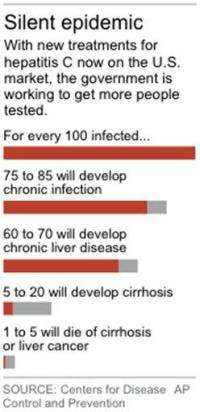
Graphic shows the expected outcomes per one hundred people infected with Hepatitis C
(AP) -- Deaths from liver-destroying hepatitis C are on the rise, and new data shows baby boomers especially should take heed - they are most at risk.
Federal health officials are considering whether anyone born between 1945 and 1965 should get a one-time blood test to check if their livers harbor this ticking time bomb. The reason: Two-thirds of people with hepatitis C are in this age group, most unaware that a virus that takes a few decades to do its damage has festered since their younger days.
The issue has taken new urgency since two drugs hit the market last summer that promise to cure many more people than ever was possible. And research published Monday says testing millions of the middle-aged to find those who need the pricey treatment would be worth the cost, saving thousands of lives.
"One of every 33 baby boomers are living with hepatitis C infection," says Dr. John Ward, hepatitis chief at the Centers for Disease Control and Prevention. "Most people will be surprised, because it's a silent epidemic."
Don't think you need to worry? Yes, sharing a needle while injecting illegal drugs is the biggest risk factor for becoming infected with this blood-borne virus. But before 1992, when widespread testing of the blood supply began, hepatitis C commonly was spread through blood transfusions. Plus, a one-time experiment with drugs way back in high school or college could have been enough.
"Asking someone about a risk that happened 20 to 30 years ago is a lot to ask," says Ward. Hence the quest for a new strategy.
About 3.2 million Americans are estimated to have chronic hepatitis C, but at least half of them may not know it. The virus, which affects 170 million people worldwide, can gradually scar the liver and lead to cirrhosis or liver cancer. It is a leading cause of liver transplants.
A CDC study published Monday analyzed a decade of death records and found an increase in death rates from hepatitis C. In fact, in 2007 there were 15,000 deaths related to hepatitis C, higher than previous estimates - and surpassing the nearly 13,000 deaths caused by the better-known AIDS virus.
Perhaps more surprising, three-fourths of the hepatitis deaths occurred in the middle-aged, people 45 to 64, researchers reported in Annals of Internal Medicine.
"Mortality will continue to grow for the next 10 to 15 years at least unless we do something different" to find and treat the silent sufferers, Ward says.
CDC's current guidelines recommend testing people known to be at high risk, and until last summer there wasn't much enthusiasm even for that step: the reasons are the year-long, two-drug treatment promised to cure only 40 percent of people; treatment was so grueling that many patients refused to try it and treatment could cost up to $30,000.
Two new drugs - Vertex Pharmaceuticals' telaprevir and Merck & Co.'s boceprevir - are starting to change that pessimism. Research suggests adding one of them to standard therapy can boost cure rates as high as 75 percent. While still full of side effects, they can allow some people to finish treatment in just six months. They add to the price, however, another $1,000 to $4,000 a week. Drugs that promise to work even better have begun testing.
Those advances are fueling CDC deliberations of whether to change testing guidelines to recommend that anyone born between 1945 and 1965 get a one-time screening. A second CDC-funded study published Monday analyzed models of that option, and concluded it had the potential to save 82,000 lives.
A third study published Monday from Stanford University looked more closely at the price tag, and concluded the new triple-therapy would be cost-effective for people with advanced disease. It's still cheaper than a transplant costing well over $100,000. But not everyone with hepatitis C will go on to suffer serious liver damage. For those with mild disease, that analysis concluded some gene testing to predict who might really need the costlier triple therapy rather than the older drugs would be a good next step.
It's not clear how quickly the CDC will settle the boomer-screening question. But doctors at New York's Montefiore Medical Center have started raising the issue with boomers. And Montefiore internist Dr. Gary Rogg says a number of patients have sought testing after seeing hepatitis-awareness ads from the drugs' manufacturers.
"Now it's considered a curable disease, that makes all the difference," says Rogg, who was surprised at some longtime patients' test results. Even a nurse he knows learned she had it, and the only risk she could recall was a blood transfusion during surgery when she was 10 years old.
More information:
Online: Centers for Disease Control and Prevention: http://www.cdc.gov/
Montefiore Medical Center: http://bit.ly/u6scH0
©2012 The Associated Press. All rights reserved. This material may not be published, broadcast, rewritten or redistributed.
-
New hope for hepatitis C, an often hidden disease
Jan 17, 2011 |
not rated yet |
0
-
FDA says Merck drug successfully fights hepatitis
Apr 25, 2011 |
not rated yet |
0
-
US regulators approve new hepatitis C drug
May 14, 2011 |
not rated yet |
0
-
FDA panel endorses Vertex hepatitis C drug
Apr 28, 2011 |
not rated yet |
0
-
Birth cohort screening for hepatitis C is cost effective, could save thousands of lives each year
Nov 04, 2011 |
not rated yet |
0
-
Motion perception revisited: High Phi effect challenges established motion perception assumptions
Apr 23, 2013 |
3 / 5 (2) |
2
-
Anything you can do I can do better: Neuromolecular foundations of the superiority illusion (Update)
Apr 02, 2013 |
4.5 / 5 (11) |
5
-
The visual system as economist: Neural resource allocation in visual adaptation
Mar 30, 2013 |
5 / 5 (2) |
9
-
Separate lives: Neuronal and organismal lifespans decoupled
Mar 27, 2013 |
4.9 / 5 (8) |
0
-
Sizing things up: The evolutionary neurobiology of scale invariance
Feb 28, 2013 |
4.8 / 5 (10) |
14
-
Classical and Quantum Mechanics via Lie algebras
Apr 15, 2011
- More from Physics Forums - Independent Research
More news stories
Little evidence for prediction rules for low back pain
(HealthDay)—Few randomized clinical trials have been done to assess clinical prediction rules for patients with lower back pain, and the trials that have been done are of low quality and do not provide ...
Diseases, Conditions, Syndromes
16 hours ago |
not rated yet |
0
|
New malaria test kit gives a boost to elimination efforts worldwide
A new, highly sensitive blood test that quickly detects even the lowest levels of malaria parasites in the body could make a dramatic difference in efforts to tackle the disease in the UK and across the world, according to ...
Diseases, Conditions, Syndromes
20 hours ago |
not rated yet |
0
WHO says single yellow fever shot is enough
(AP)—The World Health Organization says a yellow fever booster vaccination given 10 years after the initial shot isn't necessary.
Diseases, Conditions, Syndromes
21 hours ago |
not rated yet |
0
23 dead in initiation rites in South Africa
(AP)—Twenty-three youths have died in the past nine days at initiation ceremonies that include circumcisions and survival tests, South African police said Friday.
Diseases, Conditions, Syndromes
21 hours ago |
5 / 5 (1) |
3
Expert questions US public health agency advice on influenza vaccines
The United States government public health agency, the CDC, pledges "To base all public health decisions on the highest quality scientific data, openly and objectively derived." But Peter Doshi, a postdoctoral fellow at Johns ...
Diseases, Conditions, Syndromes
May 16, 2013 |
not rated yet |
0
AIDS science at 30: 'Cure' now part of lexicon
Big names in medicine are set to give an upbeat assessment of the war on AIDS on Tuesday, 30 years after French researchers identified the virus that causes the disease.
For combat veterans suffering from post-traumatic stress disorder, 'fear circuitry' in the brain never rests
Chronic trauma can inflict lasting damage to brain regions associated with fear and anxiety. Previous imaging studies of people with post-traumatic stress disorder, or PTSD, have shown that these brain regions can over-or ...
Melon focus headband turns to Kickstarter for rollout plans
(Medical Xpress)—What if the quality of your work depends more on your focus on the piano keys or canvas or laptop than your musical or painting or computing skills? If target users can be convinced, they ...
Temporal processing in the olfactory system
The neural machinery underlying our olfactory sense continues to be an enigma for neuroscience. A recent review in Neuron seeks to expand traditional ideas about how neurons in the olfactory bulb might encode information about ...
Now we know why old scizophrenia medicine works on antibiotics-resistant bacteria
In 2008 researchers from the University of Southern Denmark showed that the drug thioridazine, which has previously been used to treat schizophrenia, is also a powerful weapon against antibiotic-resistant bacteria such as ...
Individuals who drink heavily and smoke may show 'early aging' of the brain
Treatment for alcohol use disorders works best if the patient actively understands and incorporates the interventions provided in the clinic. Multiple factors can influence both the type and degree of neurocognitive abnormalities ...
Feb 21, 2012
Rank: not rated yet
"Phlebotomy improves therapeutic response to interferon in patients with chronic hepatitis C: a meta-analysis of six prospective randomized controlled trials."
"Normalization of Elevated Hepatic 8-Hydroxy-2'-Deoxyguanosine Levels in Chronic Hepatitis C Patients by Phlebotomy and Low Iron Diet"
"Effects of Dietary Iron Reduction Versus Phlebotomy in Patients with Chronic Hepatitis C: Results from a Randomized, Controlled Trial on 40 Japanese Patients."
"A significant reduction in serum alanine aminotransferase levels after 3-month iron reduction therapy for chronic hepatitis C: a multicenter, prospective, randomized, controlled trial in Japan."
"Maintenance Phlebotomy Slows Disease Progression in Patients with Chronic Hepatitis C"
"Hepatocellular carcinoma caused by iron overload: A possible mechanism of direct hepatocarcinogenicity".
Feb 21, 2012
Rank: not rated yet
"Phlebotomy improves therapeutic response to interferon in patients with chronic hepatitis C: a meta-analysis of six prospective randomized controlled trials."
"Normalization of Elevated Hepatic 8-Hydroxy-2'-Deoxyguanosine Levels in Chronic Hepatitis C Patients by Phlebotomy and Low Iron Diet"
"Effects of Dietary Iron Reduction Versus Phlebotomy in Patients with Chronic Hepatitis C: Results from a Randomized, Controlled Trial on 40 Japanese Patients."
"A significant reduction in serum alanine aminotransferase levels after 3-month iron reduction therapy for chronic hepatitis C: a multicenter, prospective, randomized, controlled trial in Japan."
"Maintenance Phlebotomy Slows Disease Progression in Patients with Chronic Hepatitis C"
"Hepatocellular carcinoma caused by iron overload: A possible mechanism of direct hepatocarcinogenicity".
Feb 25, 2012
Rank: not rated yet
It is $49.00 at ANY LAB TEST NOW and you will have results next day!!!
You can do it on your own without the doctor's prescription.