High doses of 'load' slows loss of bone in spinal cord injury
Loss of bone density leads to brittle bones that fracture easily. It is a major complication of spinal cord injury (SCI), which affects about 250,000 Americans every year.
A new clinical trial conducted by University of Iowa researchers shows that delivering high doses of "load," or stress, to bone through programmed electrical stimulation of the muscle significantly slows the loss of bone density in patients with SCI.
The focus on quantifying the effective dose of load is one of the study's most important aspects, says Richard Shields, P.T., Ph.D., a professor and director of the UI Physical Therapy and Rehabilitation Science Graduate Programs. The study also is the first to carefully test the impact of different doses of load in humans with paralysis.
Previous research had suggested that stressing or loading bone through muscle contractions could slow the loss of bone density, but results from clinical trials have been mixed.
"Thirty years ago a clinical trial concluded that putting patients with SCI in an upright weight-bearing position with braces or standing frames did nothing to prevent loss of bone density," Shields says. "The novelty of our study is we have designed a method for individuals with paralysis to stand (bear weight) while superimposing a dose of muscle force using programmed electrical stimulation of the muscle."
The study findings, published in the journal Osteoporosis International in December 2011, reveal that only high "doses" of muscle force are effective for significantly reducing bone loss.
"The previous studies, without muscle activation, were like doing a drug trial where the dose of drug was too low, or below 'therapeutic threshold,' to cause an effect," Shields explains.
The UI researchers have also recently shown that the electrical stimulation strengthens muscle by activating genes that promote muscle growth and endurance, and improve glucose metabolism.
Testing doses of load
The clinical trial developed by Shields and his team is based on biomechanical modeling and information from bone biology studies that show that bone cells, called osteoblasts, produce new bone only when the load is high enough.
The study compared the effect of "high dose" loads of 150 percent of body weight (induced by electrically stimulating the quadriceps muscle in one leg while the patient was supported in a standing position) with "low dose" load of 40 percent body weight (assisted standing with no electrical stimulation) and "no dose" loads of 0 percent body weight (sitting). Participants were asked to perform their training five times per week for three years and had their bone mineral density and muscle strength tested several times over the study period.
"When we applied a load of 1.5 times their body weight using electrical stimulation of the quadriceps muscle we saw a significant impact on the bone density as well as the expected growth of the skeletal muscle," says Shields.
Specifically, the study found that after three years, average bone density in the femur was almost 40 percent lower in patients who received low dose or no dose load compared to patients who received high dose. The study also showed that high dose load slows the deterioration of the trabecular bone -- the type of bone found at the joint ends of long bones where fractures most often occur.
"Keeping 40 percent of the bone material in the bone should translate into improved overall health along several dimensions, including reducing the risk of fracture, as well as reducing other common complications stemming from SCI, like kidney stones and diabetes," says Shields.
A unique feature of the study was that patients in the high dose group only received muscle stimulation on one leg. This meant that the patients' non-treated leg provided a "within subject" control that clearly contrasted the effect of high dose compared to low dose when all other factors were the same.
Usability key for translating study findings to therapy
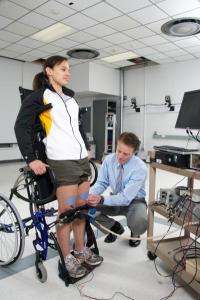
Shields notes that for any treatment regimen to be truly useful for patients, it must be something that a patient can easily incorporate in his or her daily life. The study suggested that participants found it fairly easy to stick with the training program. In addition, six of the seven participants on the high-dose protocol were able to participate from home using a specially modified wheelchair that raised them to a standing position and custom-designed stimulators that automatically logged the participant's training.
"It is much harder to make brittle bones strong again. So in a situation where we know that loss of bone density will occur, like SCI, we need an intervention that prevents or at least slows down the loss of bone density," Shields says. "This study provides evidence that there is a mechanical dose of load through muscle force that the skeleton can respond to that has an effect."


