'Life and activity monitor' provides portable, constant recording of vital signs
February 1, 2012 in Medical research
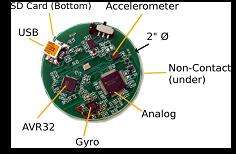
This small device, only about two inches wide, can monitor vital signs while being worn outside the body. (Photo courtesy of Oregon State University)
Researchers have developed a type of wearable, non-invasive electronic device that can monitor vital signs such as heart rate and respiration at the same time it records a person's activity level, opening new opportunities for biomedical research, diagnostics and patient care.
The device is just two inches wide, comfortable, does not have to be in direct contact with the skin and can operate for a week without needing to be recharged. Data can then be downloaded and assessed for whatever medical or research need is being addressed.
The technology has been reported at a professional conference, and research is continuing to make it even smaller and less costly.
"When this technology becomes more miniaturized and so low-cost that it could almost be disposable, it will see more widespread adoption," said Patrick Chiang, an assistant professor of computer engineering at Oregon State University. "It's already been used in one clinical research study on the effects of micronutrients on aging, and monitoring of this type should have an important future role in medicine."
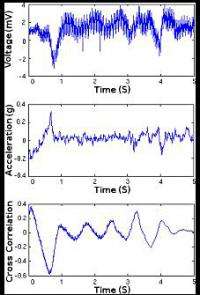
Vital sign data can be relayed by the small electronic device worn on the body. (Image courtesy of Oregon State University)
Called a "life and activity monitor," the system uses different sensors to detect heart rate, respiration, movement and similar vital signs. It will provide doctors, researchers and clinicians a continuous flow of data over time, reduce the need for more frequent office visits, and ultimately provide better care at lower cost.The system was developed by scientists and engineers at Oregon State University and the University of California at San Diego.
Final designs of the technology may be as small as a disposable bandage, researchers say.
Provided by
Oregon State University
-
'Ultrawideband' could be future of medical monitoring
Jun 16, 2011 |
not rated yet |
0
-
Hold the phone for vital signs
Oct 06, 2011 |
not rated yet |
0
-
Portable microwave sensors for measuring vital signs
Nov 09, 2010 |
not rated yet |
0
-
Hi-tech shirt to monitor vital signs
May 04, 2006 |
not rated yet |
0
-
Digital 'plaster' for monitoring vital signs undergoes first clinical trials
Nov 02, 2009 |
not rated yet |
0
-
Of mice and mental models: Neuroscientific implications of risk-optimized behavior in the mouse
May 25, 2012 |
not rated yet |
0
-
Limits to growth: Scientists identify key metastasis-enabling enzyme
May 22, 2012 |
5 / 5 (4) |
0
-
Seeing is as seeing does: Spatially-structured retinal input in early development of cortical maps
Apr 26, 2012 |
5 / 5 (4) |
1
-
Dreamless nights: Brain activity during nonrapid eye movement sleep
Apr 09, 2012 |
4.4 / 5 (12) |
0
-
Take your time: Neurobiology sheds light on the superiority of spaced vs. massed learning
Mar 28, 2012 |
4.5 / 5 (21) |
3
-
Potential Breakthrough in Seizure Control
19 hours ago
-
Popping/Cracked sternum.
23 hours ago
-
Which Mental Illness Encompasses This Problem?
May 25, 2012
-
A question about drug tolerance
May 23, 2012
-
Poor nutrition leading to overeating?
May 23, 2012
-
Math and dyslexia?
May 21, 2012
- More from Physics Forums - Medical Sciences
More news stories
Implantable pain disk may help those with cancer
An estimated 3.5 million cancer patients around the globe are in severe pain from their disease, but many get no relief.
Medical research
May 25, 2012 |
5 / 5 (1) |
0
|
Energy levels link sleep control mechanisms
Sleep, or lack of it, can determine level of cognitive performance which is linked with accidents as well as increased risk of serious health problems. Links between cell energy levels, gene transcription ...
Medical research
May 25, 2012 |
not rated yet |
0
Researchers identify key brain cell in antidepressant action
(Medical Xpress) -- Antidepressant medications such as Prozac have helped improve mood and lessen anxiety in millions of people with major depression. But scientists know surprisingly little about how these drugs work.
Medical research
May 25, 2012 |
4.7 / 5 (3) |
0
|
Rockefeller scientists pioneer new method to determine mechanisms of drug action
(Medical Xpress) -- Knowing that a drug works is great. Knowing how it works is a luxury. And until now, determining a drugs mechanism of action has been a tedious and difficult process for scientists.
Medical research
May 25, 2012 |
not rated yet |
0
|
Like curry? New biological role identified for compound used in ancient medicine
Scientists have just identified a new reason why some curry dishes, made with spices humans have used for thousands of years, might be good for you.
Medical research
May 25, 2012 |
4.5 / 5 (12) |
2
|
Keep food safety in mind this memorial day weekend
(HealthDay) -- Picnics, parades and cookouts are as much a part of Memorial Day weekend as tributes to the United States' war veterans.
Travel to high altitudes tied to Crohn's, colitis flare-ups
(HealthDay) -- People with inflammatory bowel disease, which includes Crohn's disease and colitis, may be at increased risk for flare-ups when they fly or travel to high altitudes for skiing or mountain climbing, ...
Family history of Alzheimer's affects functional connectivity
(HealthDay) -- Cognitively normal individuals with a family history of late-onset Alzheimer's disease (AD) may display lower resting state functional connectivity in the default mode network (DMN) of the brain, ...
Transvaginal mesh op restores pelvic organ prolapse at price
(HealthDay) -- Transvaginal mesh (TVM) procedures are effective for anatomical restoration of pelvic organ prolapse (POP), but patients report a worsening of sexual function following surgery, according to ...
Of mice and mental models: Neuroscientific implications of risk-optimized behavior in the mouse
(Medical Xpress) -- Regardless of an organism’s biological complexity, every encephalized animal continuously makes under-informed behavioral choices that can have serious consequences. Despite its ubiquity, ...
Weight struggles? Blame new neurons in your hypothalamus
New nerve cells formed in a select part of the brain could hold considerable sway over how much you eat and consequently weigh, new animal research by Johns Hopkins scientists suggests in a study published in the May issue ...
