Maine girl bouncing back after 6-organ transplant
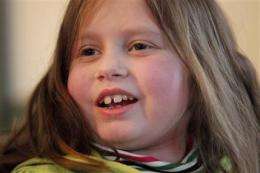
(AP) -- A 9-year-old Maine girl is home from a Boston hospital healthy, active and with high hopes - and a new stomach, liver, spleen, small intestine, pancreas, and part of an esophagus to replace the ones that were being choked by a huge tumor.
It's believed to be the first-ever transplant of an esophagus and the largest number of organs transplanted at one time in New England.
Spunky and bright-eyed as she scampered around her family's farmhouse outside Portland, Alannah Shevenell said Thursday that she's glad to be feeling well again and able to go sledding, make a snowman, work on her scrapbooks and give her grandmother a little good-humored sass.
The best part, though? "Being home," she said. "Just being home."
It was 2008 when Alannah, then 5, began running a fever and losing weight while her belly swelled. Doctors discovered the tumor that year and twice attempted to remove it, as it made its way like octopus legs from organ to organ. But it was difficult to access what turned out to be a rare form of sarcoma, said Debi Skolas, Alannah's grandmother, and chemotherapy didn't do the trick, either.
All the time, the growth - known as an inflammatory myofibroblastic tumor - continued to grow in her abdomen, causing pain, making it hard to eat and swelling her up with fluid. Surgery was the last resort to save her life, and Alannah spent more than a year on a waiting list for the organs, said Dr. Heung Bae Kim, the lead surgeon on the procedure at Children's Hospital Boston.
The family was told there was a 50 percent chance Alannah wouldn't survive the procedure. But without it, she had no chance whatsoever.
Things were more tense than celebratory in October when doctors prepared to remove the growth and the organs in one fell swoop and replace them with organs transplanted in one tangled piece from another child of similar size.
The hardest part was taking out her organs and the tumor, Kim said, calling it a difficult operation with lots of blood loss.
"It's probably one of the most extensive tumor removals ever done," the surgeon said.
Dr. Allan Kirk, professor of surgery at Emory University in Atlanta and the editor-in-chief of The American Journal of Transplantation, said no other esophageal transplant has been reported in medical literature.
After the surgery, Alannah spent three more months at the hospital, with her grandmother sleeping every night in a lounge chair by her bed. She battled infections and complications from the surgery before finally being given the OK to leave.
She arrived back home Wednesday in the 192-year-old house on a country road where she lives with her grandmother and grandfather, Jamie Skolas, in Hollis, a town of 4,500 residents about 20 miles west of Portland.
But just because she's home doesn't mean she's out of the woods. Alannah has to take nine medications each day, some two, three or four times. Her grandparents have to precisely measure what goes in and comes out of her body, and check her blood sugar.
She has an ostomy pouch and feeding tube attached to her for nutrition as she slowly gets used to eating again. Scars from her surgeries look like a roadmap on her stomach. A tutor comes to the home 20 hours a week for her schooling.
Her immune system is so weak that she can't go to places with large numbers of other people, such as school, church or a mall. She can't eat raw vegetables or fruits unless they have thick skins because of concerns over germs, and she'll never be able to swim in a lake because of the bacteria. The Skolases installed ultraviolet lights in their heating ducts to kill mold, mildew and bacteria that might sicken Alannah.
Alannah is aware of her limitations and what she's been through. "Don't even ask," she says when the subject of the medical costs, which have been covered by MaineCare - Maine's version of Medicaid - come up.
She's talkative and enjoys bantering with her grandparents.
"Grammy, you're not always right," she said to end a conversation.
The Skolases, who took Alannah in several years ago but declined to discuss the whereabouts of her parents, have made sacrifices for her through the years. Their hand-crafted-furniture business has suffered, with Debi devoting her time to care for Alannah, and the couple has dipped into retirement savings to make ends meet.
Friends have organized a fundraiser to help raise money to offset the costs.
More than anything, though, the family is thankful for the girl's second chance at life and to the family that went through the pain of losing a child and before deciding to donate the organs to help Alannah.
"That was a courageous decision," Debi Skolas said. "I still cry when I think about it."
©2012 The Associated Press. All rights reserved. This material may not be published, broadcast, rewritten or redistributed.


