Medical tattoos offer important health information
(AP) -- Tattoos have long served as fashion statements, but a small number of Americans are now relying on them for a more practical, potentially lifesaving purpose: to warn first responders about important medical conditions.
Some medical tattoos are being used to take the place of bracelets that commonly list a person's allergies, chronic diseases or even end-of-life wishes.
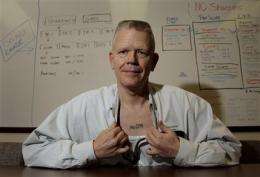
"Bracelets are nice, but something as strong as a tattoo ... that is a strong statement," said Dr. Ed Friedlander, a Kansas City pathologist who has "No CPR" tattooed in the center of his chest, where a paramedic would see it.
Friedlander, 60, got the tattoo to emphasize his decision to forgo CPR if his heart stops.
Medical tattoos don't appear to carry much legal weight. It's unclear whether an ambulance crew racing to treat a gravely ill patient could honor a request such as Friedlander's based on the tattoo alone.
But the markings do offer a simple and permanent way to give rescuers important health details.
Melissa Boyer, of Nashville, Mich., wore bracelets for years to identify her as a diabetic, but she kept losing or breaking them. The 31-year-old decided months ago to get a 3 1/2-inch tattoo on her left forearm that includes the medical symbol and identifies her as a Type 1 diabetic. It also declares her allergies to penicillin and aspirin.
"It's been 29 years that I've had (diabetes), and I went through I-don't-know-how-many bracelets," she said. "I went and got the tattoo, and it made life easier."
The American Medical Association does not specifically address medical tattoos in its guidelines. But Dr. Saleh Aldasouqi, an endocrinologist at Michigan State University, hopes that might change.
Aldasouqi, who has written about the tattoos, has seen them among his diabetic patients and feels they are becoming so popular that the medical profession needs to help guide their development.
"My intention has been to bring this issue to the surface so that medical organizations can have a say in that," he said. "When you just Google it, you're going to find hundreds of stories and discussions, but no medical say. So I feel we leave our patients kind of afloat."
It would be helpful, for instance, if the tattoos were uniform or placed in the same area of the body so responders would know where to look, he said.
"My perspective is that we as physicians need to be involved in this," he added.
Aldasouqi does not advocate for or against the tattoos, but he says patients and doctors should discuss the idea beforehand.
If one of his diabetic patients sought a tattoo, Aldasouqi would recommend using a licensed tattoo artist and carefully controlling blood sugar during the procedure.
The National Tattoo Association, a nonprofit that raises awareness about tattooing, does not track the numbers or styles of tattoos. Sailor Bill Johnson, a spokesman for the association, said he does about one medical tattoo a year at his shop in Orlando, Fla.
"Nine times out of 10, it's either allergic to something, penicillin or peanuts," he said.
Still, it's questionable whether medics or doctors would be under any obligation to honor end-of-life instructions in a tattoo, unless they could be sure the patient also had signed legally binding papers.
Laws on do-not-resuscitate orders can vary widely from state to state. Missouri law does not address medical tattoos at all.
"What we can tell you is what the law says. What we can't tell you is what assumptions people are going to make," said Gena Terlizzi, spokeswoman for the state Department of Health and Senior Services.
However, emergency professionals are always on the lookout for information about a patient's condition and treatment preferences, and that includes looking for medical tags, bracelets and possibly tattoos, said Dr. David Tan, medical director of Washington University Emergency Medical Services in St. Louis.
"It's something I have not seen a whole lot of, but it's out there," Tan said. "I think tattoos just aren't that conventional. But I don't think it makes it any less useful."
A tattoo alerts "any medical professional to stop and think a moment," he added.
Tattoos are unlikely to replace medical alert jewelry, said Ramesh Srinivasan, spokesman for the MedicAlert Foundation, which sells more than 100,000 pieces of jewelry a year that have medical conditions on them.
Unlike tattoos, MedicAlert jewelry also provide information that gives a "complete snapshot" of the person's health that can be accessed by professionals.
"Tattoos are totally different," Srinivasan said. "What's the validation behind it?"
Friedlander encourages patients to make their own medical decisions and to spell out their wishes ahead of time. He has paperwork outlining his preference to avoid CPR, but the tattoo, he explained, will "make people a whole lot more comfortable about honoring my known wishes."
"In pathology, you think a lot about the end of life," he said. "Nobody would ever accuse me of not loving life. ... When this thing stops beating, it's time for me to move on."
©2012 The Associated Press. All rights reserved. This material may not be published, broadcast, rewritten or redistributed.


